Floor Loudspeaker Reviews

Sort By: Post DateTitle Publish Date

EgglestonWorks Andra loudspeaker
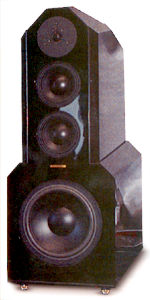
Bill Eggleston builds speakers because his father did. "My dad always told me that when he started, the only way you could get really good speakers was to build them yourself. We always had drivers and parts around, and I just began building my own so early I can't even remember. Much more important, my father passed on his wide-ranging approach to music. He listened to everything, and he taught me to be open-minded about music."

Artemis Systems Eos Signature loudspeaker & Base Module

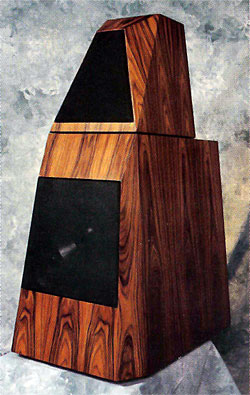
666Artemis_Eos.jpgThough the original Artemis Systems Eos has been around for a few years, it doesn't seem to have made a big impression on audiophiles. Judging by a brief but exciting audition of the new Eos Signature and its accompanying Base Module at HI-FI '96, I found it hard to understand how it could remain such a well-kept secret. A few weeks later, to my surprise, Wes Phillips asked me if I wanted to review a pair and, throwing caution to the winds, I jumped at the opportunity. Rash move.
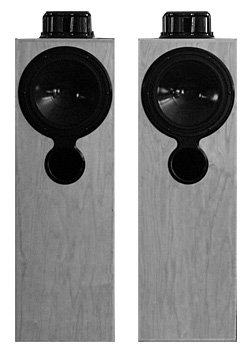

The movers delivered three large boxes and two absolutely huge crates. Inside the boxes were the two Eos Signatures and their external crossovers. Each crate contained a Base Module, and their appearance struck fear into my heart. I had gone too far—each one weighed 300 lbs, and together they were more commodious than some apartments in my Manhattan neighborhood. I signed for the delivery, then panicked when I realized there was no way to get these unpacked before my wife came home. Indeed, I didn't know how I was going to do it at all.

Linaeum Model 10 & Center-Channel loudspeakers

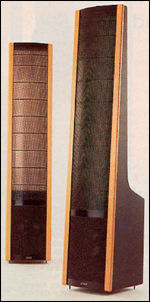
666linneumIt's been a long time since we've seen a really new tweeter design. Only five basic types have ever been developed: cones, domes, panels, ribbons, and ionic plasmas. And the most recent of these—the long-defunct DuKane "blue-glow" Ionovac—was introduced 40 years ago. Since then, tweeter development has been more evolutionary than revolutionary, a series of refinements that has made them more efficient, more reliable, and smoother and more extended in response.
Waveform Research Mach 17 loudspeaker

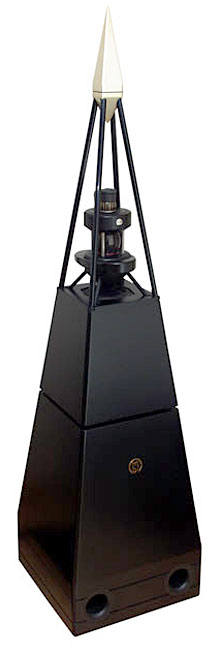
I first heard the Canadian-made Waveform Research Mach 17 loudspeaker system in New York City at HI-FI '96, Stereophile's Home Theater & Specialty Audio Show. Another Ontario native, Chris">http://www.stereophile.com/interviews/996russell">Chris Russell of Bryston Ltd., had raved to me about their sound. His recommendation sent me outside my assigned reporting area and down to the sixth floor of the Waldorf=Astoria, to dimly lit room 602—full of ASC">http://www.stereophile.com/roomtreatments/215">ASC Tube Traps, amplifiers, cables, and the twin truncated pyramids of the Mach 17s.


Focus Audio Signature Model 88 loudspeaker

A science-fiction parable I read too many years ago to remember who wrote it used the image of a glass jar stuffed with colored plastic spheres. The story's protagonist was asked whether the glass was full. "Of course," was his reply, whereupon a hidden faucet was turned, the jar filled up with water, and fish swam in the spaces between the balls.


MBL 111 loudspeaker

The speaker review in the July 1996 issue of the German audio magazine Stereoplay didn't hold back the praise. "Absolut Spitzenklasse III Referenz" was their overall rating, which I guess translates to "You'd better hear this, buddy," in American English. So when MBL of America's Marc Lawrence called to find out if I wanted to review the subject of that review, the MBL 111, I didn't need to be asked twice.

PBN Montana SP loudspeaker

Astute readers will note that although my name appears under the "hardware" heading of Stereophile's masthead, I have rarely written about specific products, and, apart from secondary comments or Follow-Ups, have never written a formal equipment report. For years I resisted reviewing because I was usually connected in some way to audio manufacturers and/or retailers, and felt very uncomfortable with the conflict of interest. The other reason I was disinclined to review is that the critical listening required of reviewers is work, and after a long day or week of working on, or with, audio equipment, the only thing I wanted to do when I came home was relax. But since I have hung up my soldering iron and oscilloscope probe for what I hope is the last time, and am cleaving instead to my word processor (or, as playwright David Ives dubbed it, my "verboblender"), you may see more of this—WP, JA, and God willing.


Vienna Acoustics Mozart loudspeaker

Vienna is a beautiful city known for many things, but the design and manufacturing of audio equipment is not one of them. Waltzes and strudel, yes; loudspeakers, no. One exception is Vienna Acoustics, a company that has introduced a line of loudspeakers named after composers: Mozart, Bach, Beethoven, and Haydn. At the 1996 Las Vegas WCES, Sumiko, US distributor of Vienna Acoustics products (footnote 1), demonstrated the second-from-the-top Mozart, and Stereophile reviewers as diverse in their approaches as Jonathan Scull, Tom Norton, and Sam Tellig (as well as yours truly) were unanimous in our admiration of the sound.


Advertisement
Advertisement
Advertisement