Floor Loudspeaker Reviews

Sort By: Post DateTitle Publish Date

Wilson Audio Specialties WATT/Puppy 7 loudspeaker

When I interviewed recording engineer Roy Halee (Simon and Garfunkel, The Byrds, The Lovin' Spoonful, etc.) at his home in Connecticut back in 1991, he pointed to his pair of monolithic Infinity IRS loudspeakers and said, "When I want to listen for pleasure, I listen to those." He then pointed to a pair of early-edition Wilson Audio Specialties WATT/Puppys in a second system set up in the corner of his large listening room. "When I want to hear what's on a recording I've made, I listen to those." It was obvious: Halee respected the Wilsons, but he loved the Infinitys. Not surprising, since Dave">http://www.stereophile.com//interviews/478/">Dave Wilson designed the WATT section to be a highly accurate portable monitor, and monitors are designed for respect, not love.


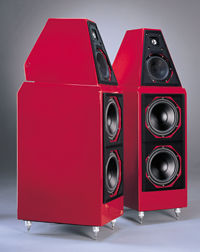
Audio Physic Virgo III loudspeaker

I was riding BART home from Home">http://www.stereophile.com/news/11662/">Home Entertainment 2003, thinking about the day—the new products, the old friends, the rooms with really great sound. It's a long ride from downtown San Francisco to Livermore, so I next got to thinking about all of the hi-fi shows I've attended over the years and which companies, year after year, always seem to have good sound. At the top of the list were Audio Physic and its US importer, Allen Perkins' Immedia.


Focal-JMlab Grande Utopia Be loudspeaker

I reviewed JMlab's Mezzo Utopia loudspeaker in the July 1999 Stereophile (Vol.22 No.7). By chance, the Mezzos had followed a pair of B&W">http://www.stereophile.com//loudspeakerreviews/207/">B&W Nautilus 801s into my listening room, and the substitution had proved rather interesting. For all their many fine qualities, the 801, with its 15" bass driver, was distinctly bass-heavy in my room, whereas the 11" drivers of the Mezzos seemed just right in this regard.


Calix Phoenix Grand Signature loudspeaker

Of all the components to be seen and heard at an audio show or in a dealer's showroom, the most memorable and attention-grabbing are inevitably the super-speakers—bogglingly expensive, filled with cutting-edge engineering and exotic materials, of mammoth size and weight, with full-range reproduction that shakes building foundations and extends far enough up top to disrupt the navigation of bats. Survey the field, and the biggest Wilson, Aln, JMlab-Focal, Burmester, EgglestonWorks, and Nearfield Acoustics models, to name a few, fit that description.


Audes Jazz loudspeaker

When I first got into hi-fi, stereo was just over the horizon and imported products were still rare. The inexpensive ones came from Japan, and you could find them, often with names that changed from week to week, in the open-air displays in and around Cortlandt Street in lower Manhattan. The more expensive brands were European, primarily British, and beyond my financial grasp.


InnerSound Eros Mk.III electrostatic loudspeaker

I was trading e-mails with Roger Sanders, manufacturer of the Eros Mk.III electrostatic (ESL) loudspeakers, when it occurred to me to ask him about his name. I was struck that he had the same last name as Gayle Sanders, president of another American electrostatic speaker company, MartinLogan. Were they related? "No," replied Roger Sanders, "it's simply a coincidence that we have similar names. I've never even met him.


Dynaudio Confidence C4 loudspeaker

Judging absolute sound quality under the unfamiliar circumstances of an audio show is always fraught with difficulty. If a system sounds bad, there are so many possible reasons for it to do so that pointing a finger of blame at the components is possibly unfair. Conversely, when a room sounds good at a show, it is probable that the components being used deserve some recognition. Such was the case at Home Entertainment 2002 in New York last May, when Dynaudio's Confidence C4 made its debut.


KEF Reference 207 loudspeaker

The very last review I wrote for Hi-Fi News & Record Review (these days just plain Hi-Fi News)—before crossing">http://www.stereophile.com//asweseeit/352/">crossing the Atlantic to take up the reins at Stereophile in May 1986—was of KEF's then-new flagship speaker, the Reference 107. That rave review appeared in the English magazine's July 1986 issue, and was followed by equally">http://www.stereophile.com//loudspeakerreviews/550/">equally positive reports from Stereophile's writers.


Canton Karat Reference 2 DC loudspeaker

Despite my 26 years in audio journalism, the amount of stuff I need to know seems to increase faster than I can cope with it. Thus it didn't come as too much of a surprise for me to learn that speaker manufacturer Canton, the Teutonic equivalent of England's B&W, a) was 30 years old in 2002, and b) claims the dominant market share of the German market. Yes, I'd been peripherally aware of Canton through the years, but for various reasons had never auditioned any of their models. I was amenable, therefore, when Canton USA's Paul Madsen suggested to me last May, at Home Entertainment 2002 in New York City, that I review their flagship speaker.


Advertisement
Advertisement
Advertisement