

Manley Labs: Tubes Rule!
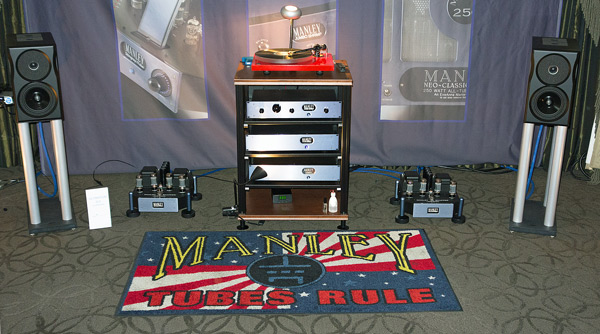
I sought out Manley Labs, manufacturer of tube amplifiers and preamplifiers, at CES. The system in their room included a Music Hall mmf-2.2le turntable, the Chinook phono stage that impressed Michael Fremer last August ($2250), a Steelhead phono preamplifier ($8000), a pair of Snapper monoblock 100Wpc tube amplifiers ($7650/pair), which use four EL34 output tubes, driving Neat Acoustic Ultimatum XLS speakers. EveAnna Manley mentioned after the show that she was working on a secret, prototype1 DAC that promises "to beat all comers." I greatly enjoyed the audio I heard in the Manley Labs room at CES. I had to agree with the saying on the rug that appears at every Manley abs exhibit: "Tubes Rule!"
Many Goodies from McIntosh

McIntosh's exhibit area in the Venetian Towers was busier than usual when I entered, and I soon found out why. Whereas most manufacturers in high performance audio were content to introduce one or two products, McIntosh seemed determined to introduce many, many new products. I could not mention them all, but Ron Cornelius, McIntosh's Product Manager, helped me focus on four products he felt of greatest interest to audiophiles. First, he showed me McIntosh's new Digital Preamplifier ($2500, above). This featured a new ESS DAC chip that operates its 8 channels in differential balanced mode for improved resolution. It includes a headphone amplifier, and four digital inputs: two optical, one coax, and one high-speed, asynchronous USB port.
Margules Strikes the Right Tempo
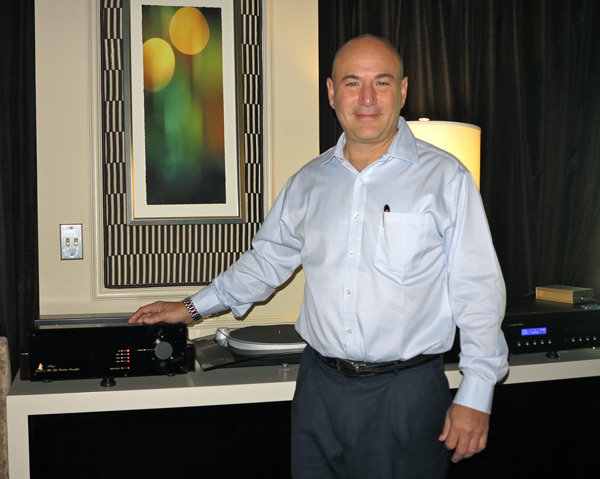
The Margules electronics and loudspeakers brand, long established in Mexico, is poised to make a big splash in the US. Picked up by Tempo High Fidelity, the same folks who distribute dCS, Verity, and Musical Fidelity, Margules will open ears once people hear their U280SC tube amplifier ($3900). Shown with the company's principal/designer, Julian Margules, the U280SC is a 23-year old design that now uses new transformers and semiconductors. A full class-A design that is claimed to be nearly as efficient as class-A/Byou can touch the tubesthe amp puts out 80Wpc in ultralinear mode (or 160W if two are strapped for mono) and 40Wpc in triode mode. The amp is so versatile that you can even have one channel output ultralinear, and the other triode. No bias adjustment is necessary.
MartinLogan's CLX
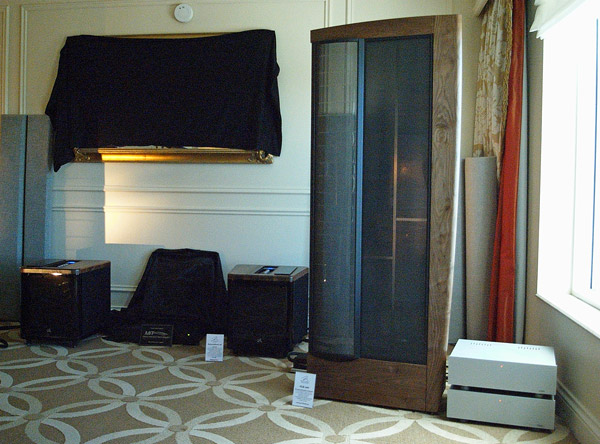
Listening to the big MartinLogan CLX full-range electrostatics ($25,495/pair) at the June 2012 Newport Beach Show had been a high point for me, though they were being demmed in too large a room. At CES, the CLXes were in a smaller room, and were being supported by a pair of MartinLogan's Balanced Force 210 subwoofers. Amplification was by Cello and the source included Berkeley's Alpha DAC. I sat down to listen to a 176.4kHz file of Respighi orchestral music from Referenece Recordings, but sadly it was not possible to form much of an impression, due to the conversations competing with the music.
MBL's Extreme X-Treme
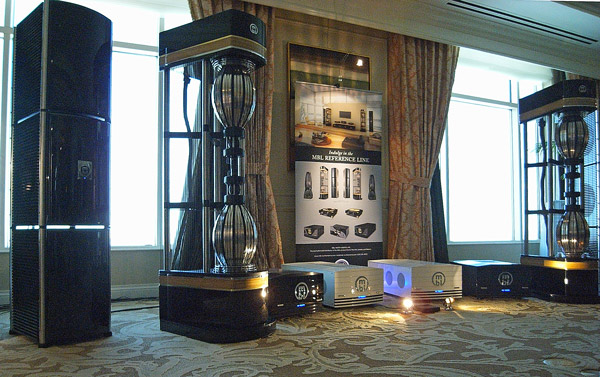
When I walked into the MBL suite in the Venetian, the recording of German pianist Martin Vatter, engineered by MBL's Juergen Reis, was playing on the MBL 101 X-Treme speaker system ($263,000, 3600 lbs, two 6' subwoofer towers operating below 80Hz, two double-101 omnidirectional upper-frequency towers). I was familiar with this superbly clean hi-rez recording, having auditioned it on MBL systems at other shows and also at home. But I had never heard it sound as though there was an actual grand piano in the room, which is what I experienced at this CES. Driven by two pairs of the massive MBL 9011 monoblock amplifiers that Michael Fremer reviewed in March 2012, this extreme system sounded better at this Show than I had heard it at earlier CESes.
MBL’s Corona Line
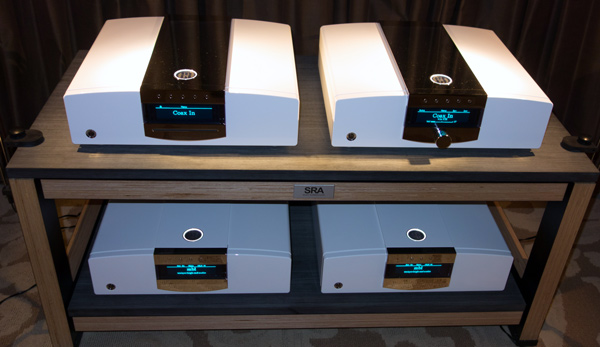
MBL’s Corona Line C-15 class-D monoblock amplifiers ($12,500 each) are rated at 500W into 4 ohms with low distortion, and none of the rising distortion with frequency found in other class-D designs. In addition, the distortion is load independent. This is a result of the circuit design MBL calls a "Linear Analog Switching Amplifier Design” (LASA). MBL designer Jurgen Reis was proud that the amplifier had been designed to meet the stringent South Korean "KT" consumer standard regulations, and "was on the way" to meeting the even more stringent "CCC" Chinese consumer requirements. Although the switching occurs at 300kHz, the amplifier is free of RF emissions up through several MHz because of extensive mu-metal shielding. The amplifier and preamplifier are available in several different cosmetics including a white or black chassis with center section in gold or chassis color. Matching C-11 preamplifier and C31 CD player, with price points are also available.
McIntosh D100 Digital Preamplifier

McIntosh had their new D100 digital preamplifier on hand with five digital inputs (each with their own DAC according to the company's Marc Lamb) and remote controlled volume. The preamp/DAC has been optimized to work with headphones and will retail for $2,500.
Meridian Media Source 200
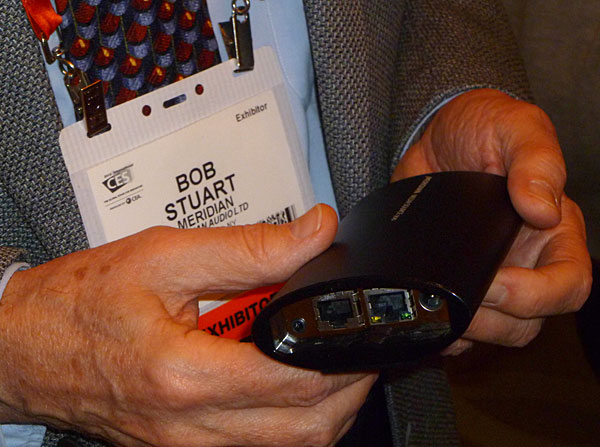
Meridian's Bob Stuart is holding the recently introduced Media Source 200 which allows current Meridian Digital Media System (Sooloos) owners to add another zone to their system for $1,000. As with other components in the MDMS line, the Media Source 200 includes Meridian's apodising upsamping filter.
There is an ethernet jack on the rear to connect to the network and then a combination analog/digital jack so you can connect the Media Source 200 via stereo analog cable or optical SPDIF. There is also a SpeakerLink output for connecting directly to Meridian DSP loudspeakers.
Meridian Updates the 7200 Speaker

Meridian pioneered the integration of digital crossovers and D/A converters in a powered loudspeaker and the first room I visited at the 2013 CES featured the DSP7200 speaker ($38,000/pair). The has anew tweeter, said to be smoother and more open-sounding than the HF units used in earlier speakers, but perhaps more importantly, the 7200's crossover now compensates for the low-frequency group delay associated with the high-order alignment. This is difficult to do, as it conventionally demands a very long digital, computationally intense filter. However, Meridian's engineering team came up with a solution that only adds around 40 milliseconds of latency. While this might make video synchronization tricky, the added clarity at low frequencies was impressively audible. Bass started and stopped as it should, with none of the feeling of the lows being detached from the upper ranges that is typical of high-order woofer alignments.
Micromega MyZic and Focal Spirit One
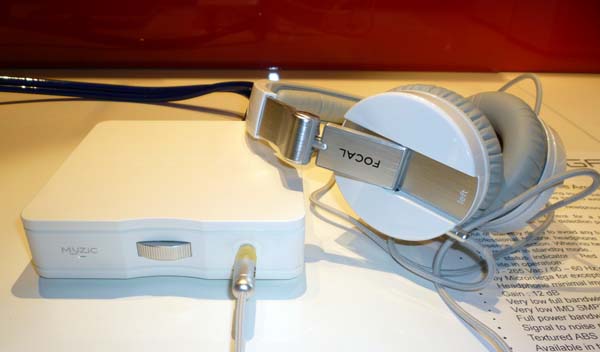
The track was “Common Exchange” from Emika’s awesomely sensuous, dark, and alluring self-titled debut.