

Bob Devices CineMag Blue
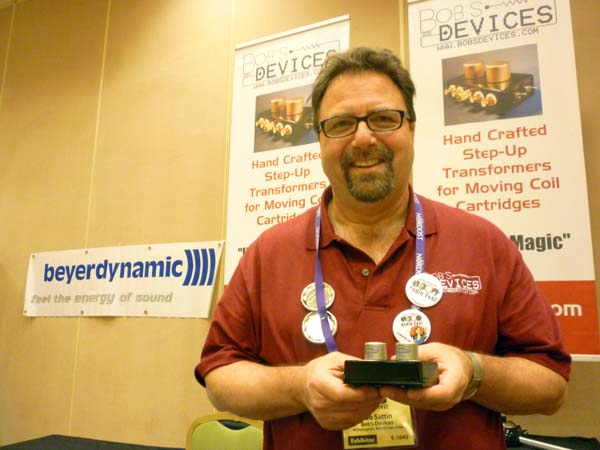
Bob’s Devices’ Bob Sattin was especially excited about his new CineMag 1131 (Blue) step-up transformer ($895). These transformers are especially developed for use with low-output moving-coil cartridges and represent the very best that CineMag has to offer. Hand-made and very limited.
BorderPatrol Audio Electronics
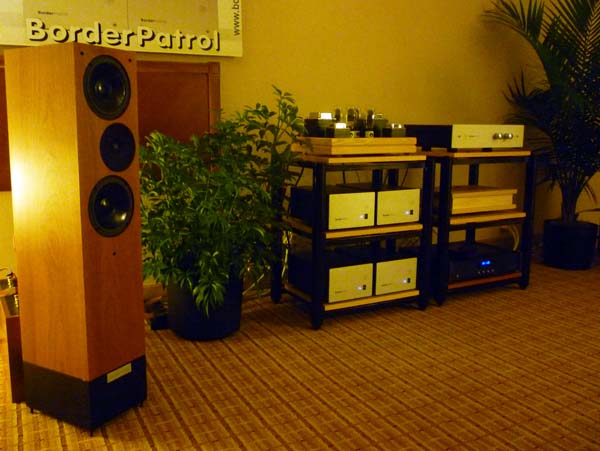
In the BorderPatrol room, we listened to that company’s beautiful-looking S20 300B single-ended power amplifier ($13,500) and EXT1 preamplifier ($12,250), driving a pair of Living Voice Avatar OBX-RW loudspeakers ($10,895/pair).
BSG Technologies
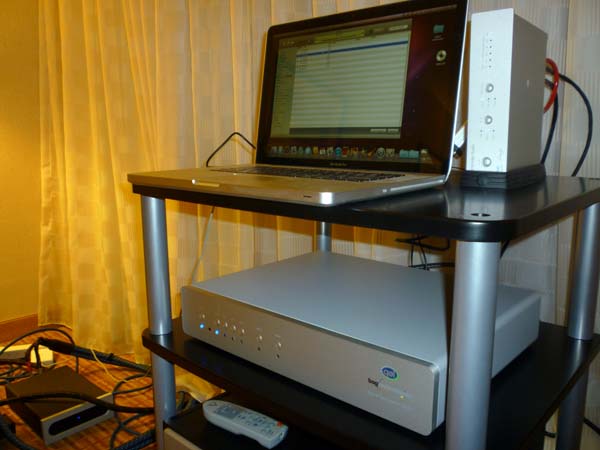
“In nature, sound has three elements,” explained BSG Technologies’ Larry Kay: “Amplitude, frequency, and phase.”
At a hi-fi show, there are many different types of demos. In some, there is music played casually, seemingly without much thought, selected either by the host or by an attendee; in others, music is carefully selected and introduced by your host, each track used to display certain characteristics of the system at hand; in others still, music is certainly played, but only after attendees are offered a detailed explanation of the gear in the room—we learn about the technologies employed and the work that went into creating the product—and we might even learn something about the art and science of listening. These last rooms are like demo-lectures, and they’re my favorite rooms. I feel like I’m in a classroom again, with one of my favorite professors.
Clarus Cables

Joe Perfito's Tributaries cable line is mainly found in home-theater systems but Joe launched a new brand at RMAF, Clarus, aimed at the high-end two-channel market. Significantly more expensive than the Tributaries equivalentsClarus Crimson balanced interconnect sells for $1500/1 pair and the Clarus Aqua $800/1m pair, compared with $400/1m pair for a Tributaries balanced cableClarus cables are designed by Jay Victor, who, I was told, has previously contributed cable designs to Monster and AudioQuest, among others. The speaker cables feature a combination of a large-gauge rectangular conductor and multiple Litz-wound conductors. All the cables feature polyethylene dielectrics and all PC-OCC copper conductors.
Joe was still fine-tuning the systemB&W 803 Diamond speakers, McIntosh MCD100 CD player/DAC and McIntosh monoblocks, and a Tributaries power manager when I visited the Clarus roombut I kidded him that the only non-Clarus cable in the system was the USB link from the laptop to the McIntosh MCD100.
Dan D'Agostino Momentum Preamplifier
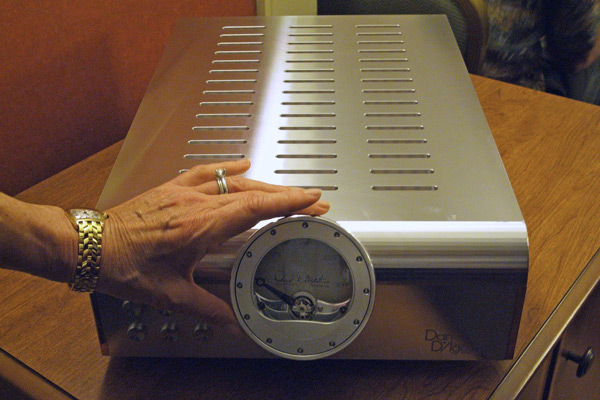
Stephen Mejias has already reported on the sound in the room shared by Wilson, Transparent, and Dan D'Agostino. I was equally impressed, agreeing with Millennia Media's John La Grou that one of Peter McGrath's classical recordings, Mahler's Symphony 5 performed by the New World Symphony under Michael Tilson-Thomas and captured with Joe Grado's omnidirectional microphones, was as good as it can get when it comes to two-channel representations of an orchestra. (John manufactures the very-low-noise mike preamps I use for my Stereophile recordings.) But I really just wanted to show another picture of the forthcoming Dan D'Agostino Momentum line preamplifier, with Dan's wife Petra lending me her hand for scale, as she rotates the volume control ring around the meter.
DEQX (pronounced Dex)
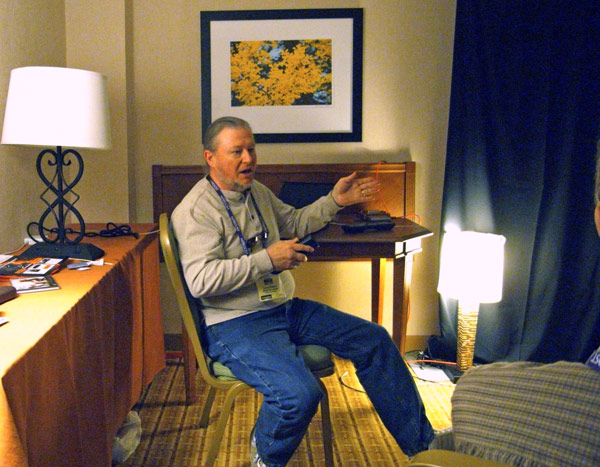
I first encountered DEQX when Kalman Rubinson and I reviewed the NHT Xd speaker system a few years back, which featured its digital signal processing to implement its crossover and response optimization. The Australian company was putting on an impressive dem of its HDP-3 standalone processor at RMAF, showing the sound of a pair of Gallo Reference speakers driven by Parasound Halo amplification could be first optimized in both time and frequency domains, then its interaction with the room. DEQX's Larry Owens, shown in the photo, enthused about an unanticipated benefit of the speaker correction was the reduction in loudspeaker intermodulation distortion.
Don Keele & the Constant-Directivity CRT36 Speaker
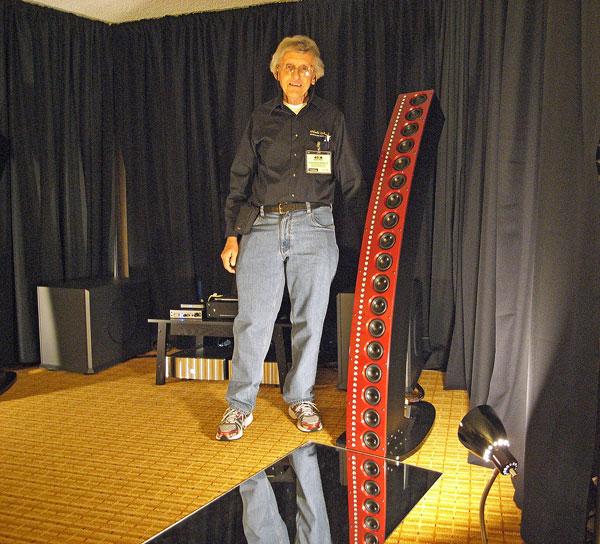
Speaker engineer Don Keele almost wrote the book on measuring speakers. so when I bumped into him at RMAF and he told me he had a new speaker on show, I went straight to his room. There, I saw and heard the CBT36, which as you can see, is very unusual in both appearance and design. CBT stands for Constant Beamwidth Transducer and is based on unclassified military underwater sound beam-forming research. There are 72 0.75" tweeters crossed over to 18 3.5" Dayton Audio midrange units, arranged in groups that, with the 36° arc of the 5'-tall array, gives sound that doesn't change its balance as the listener sits or stands. And as you can see from the mirror that Don has slipped in front of the speaker in my photo, the ground-plane reflection of the array effectively doubles its height.
Doshi Audio Tube Amps
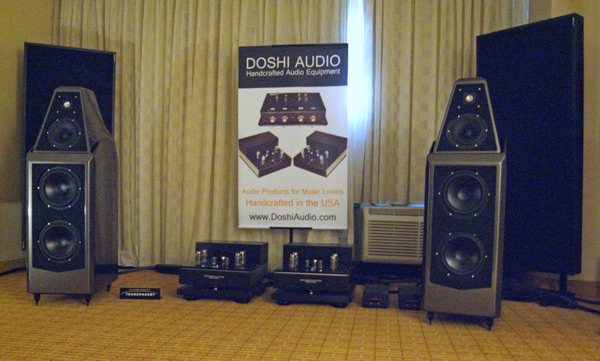
Doshi Audio was new to me, but the sound the Doshi Jhor 90W monoblock amp ($18,995/pair) was getting from Wilson Sasha W/P speakers withshudderan MP3 of Porcupine Tree was impressive. I was relieved, however, when a Milt Jackson LP, featuring Ray Brown playing a bowed solo version of Thelonious Monk's "'Round Midnight," went on the SME 20/3 turntable fitted with a Koetsu Onyx cartridge and SME Series V tonearm. The rest of the system included Doshi's own Alaap v2.1 full-function preamplifier ($14,995), a Wadia S7i CD player and 171i iPod Dock, with Transparent Audio cables used throughout.
And the names? "Jhor" and "Alaap," Nick Doshi explained to me, are two of three parts of the Indian raga musical form.
Dynaudio—Octave Audio—T+A
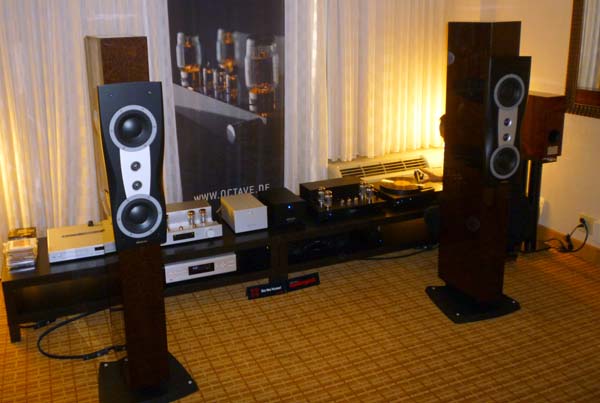
Despite their size, the Dynaudio Confidence C2 Signature loudspeakers ($15,000/pair) managed to disappear, leaving a clear view onto the music.
Dynaudio—T+A—AudioQuest
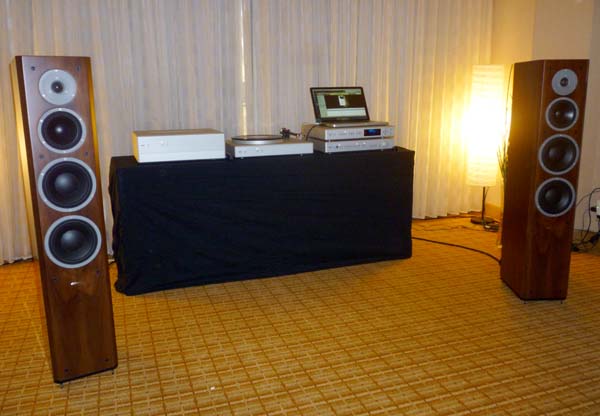
Dynaudio’s Mike Mannousselis always brings a ton of awesome music to hi-fi shows, and this time he played a track called “Suzanne” by Asobi Seksu, a band I once booked to play at Uncle Joe’s, a small but dearly loved dive bar in downtown Jersey City.