

Naim Uniti CD player/receiver
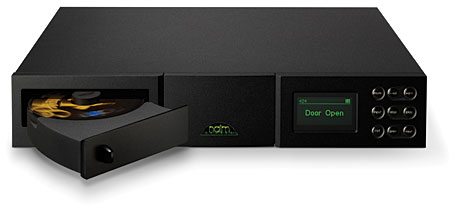
In an industry whose newest products are often as discouragingly unaffordable as they are short of the sonic mark, the Naim Audio Uniti ($3795) stands out. In a single reasonably sized box, the Uniti combines the guts of Naim's Nait 5i integrated amplifier and CD5i CD player with various additional sources: an FM/DAB tuner, and interfaces for an iPod, a USB memory stick, an iRadio, and a UPnP-compatible connected computer or server—all for the price of a very good television set.
Okto dac8 Stereo D/A processor
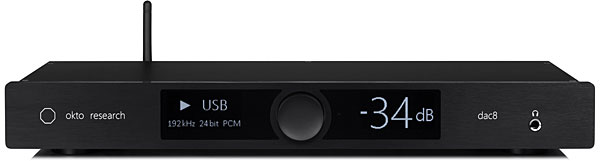
For his review of the Pink Faun 2.16x music server in the December 2020 issue, Kal Rubinson needed to use a Linux-compatible multichannel D/A processor. A little Googling uncovered the 8-channel dac8 PRO from Okto Research in the Czech Republic, so Kal borrowed one from the manufacturer. He found it to be a great-sounding DAC with an intriguing feature set. He purchased the sample.
Okto Research dac8 PRO D/A processor
For a couple of years, I have been following Prague-based Okto Research. At first, Pavel Krasensky, the founder and hardware developer, offered audio design ideas and DIY modules that I found tantalizing. For example, there was a dandy-looking ESS 9038Pro Sabrebased output module and some appealing power supply modulesbut to use those, the buyer had to manage inputs and integration on their own.
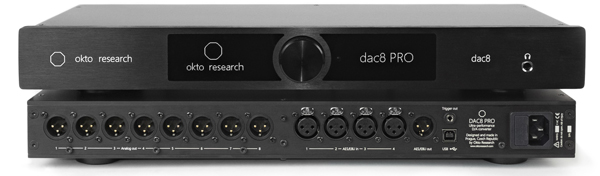
Then, finally, last year, Krasensky released the dac8 PRO, an 8-channel D/A processor with USB input and output, 8 channels of AES/EBU input, and 8 channels of balanced (XLR) analog output as well as a headphone output.
Parts Connection Assemblage DAC-1 D/A converter kit

"Dinner's fried chicken, honey."
Peachtree Audio decco65 D/A integrated amplifier
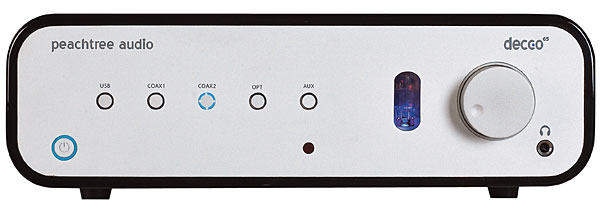
Whether one was surprised, in 2010, by the success of Peachtree Audio's iDecco may have more to do with age than anything else. My peers and I wondered, at first, who would want their high-end integrated amps to come bundled not only with digital-to-analog converters but with iPod docks, of all things; at the same time, younger hobbyists wondered who in the world still wanted their integrated amps to contain phono preamplifiers. (Respect for the elderly, myself especially, prevents me from adding "and mono switches.") Color me chastened.
Peachtree DAC•iT D/A converter

It's common knowledge that manufacturers tune the sound of each DAC model. There are the facts of product design and marketing: inputs, outputs, case materials, price points. After that, what's left are the trade-offs of different circuit designs and filter options, which are chosen with careeach has a subtle yet telling effect on a DAC's sound. Most designers try to go from bits to analog with minimal deviation from perfect. But when you look at the measurements and listen closely, you realize that perfect is elusive. One has to make choices.
Peachtree iDac D/A converter
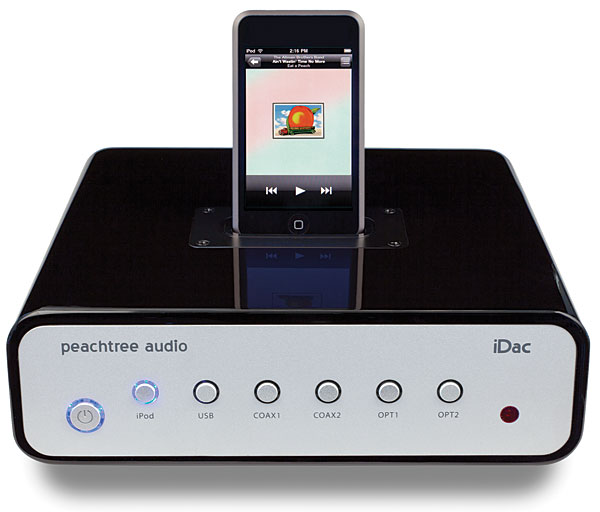
Oh boy, another new DAC review. Some folks think DACs, once you get past the features, all sound pretty much the same. I mean, it's just digital. Well, they're right. Pretty much. Just as two new cars of a particular make, model, color, and options package both look the same, sitting there on the lot.
But if you discover a ding in the door of one of them, where most folks still see only a new car, you now see the ding. It might have been there all along, undetected the first few times you walked around the carmaybe your buddy even had to point it out to you. It's insignificant in the scheme of all that a new car is, but once you've seen it, you always see it. Now you can easily tell the two cars apart, and we both know which one you'll drive home.
Peachtree iDecco D/A integrated amplifier
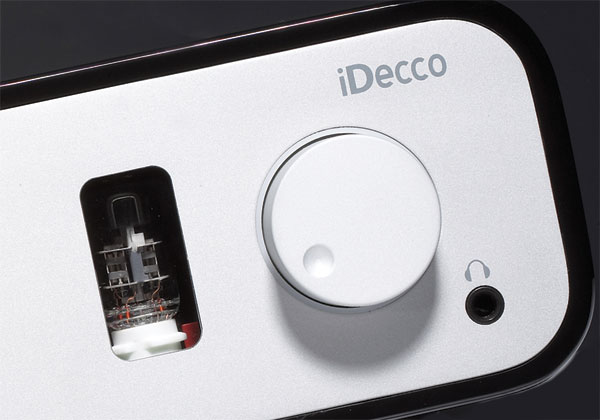
As with so many other things, from cell phones to soy milk, the idea of a portable MP3 player was something I at first disdained, only to later embrace with the fervor of any reformed sinner. But not so the idea of a high-fidelity iPod dock: Given that I now carry around several hundred high-resolution AIFF files on my own Apple iPod Touch, the usefulness of a compatible transport seemed obvious from the start. Look at it this way: In 1970, whenever I bought a music recording, I could enjoy it on any player, in any room in the house. In 2010, why shouldn't I enjoy at least that degree of convenience and flexibilitywithout resorting to a pair of tinny, uncomfortable earbuds?
Perpetual Technologies P-1A D/D & P-3A D/A processors
At the Consumer Electronics show in Las Vegas in January 1999, Mark Schifter, erstwhile president of Audio Alchemy, was handing out a press release announcing what seemed like a groundbreaking product from his new company, Perpetual Technologies. The product was the P-1A, a digital-to-digital processor that would do resolution enhancement, loudspeaker correction (amplitude and phase), and room correction—all for less than $1k. It sounded too good to be true.
Primare PRE35 Prisma streaming preamplifier
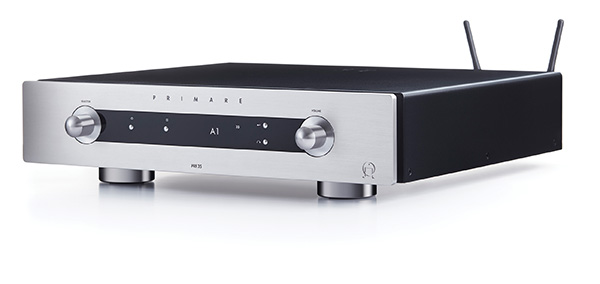
Hygge might not be the first word that comes to mind when contemplating the Primare PRE35 Prisma preamplifier, but in Limhamn, Sweden, that is how Primare likes to describe their products. It means "cozy," and it's a very important concept in the Nordic countries, almost a way of life. Another term that appears in Primare's product descriptions is lagom, which loosely translates as "not too little, not too muchjust right."