

Richard Gray's Power Company 400S AC line conditioner
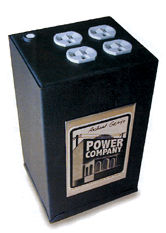
The Richard Gray's Power Company 400S arrived on the audiophile scene last year with a bang. Weighing in at a hefty 20 lbs and at $700 a pop, this four-outlet power conditioner, according to the paperwork, "effectively 'positions' audio, video, and home theater equipment 'electronically closer' to your utility company transformer, without introducing any type of series electronic 'traps' or capacitors into the circuit, which we feel degrade the performance of certain equipment, and severely limit the amount of current they can handle."
RME Digi96/8 PAD computer soundcard

When I read John Atkinson's reviews of the Digital Audio Labs CardDeluxe (Vol.23 No.9) and RME Digi96/8 Pro (Vol.23 No.11 and Vol.24 No.1), I realized that soundcard technology had matured far faster than I had been aware. For about the price of a mainstream CD player, anyone with a reasonably powerful computer could add multitrack digital recording technology to his bag of tricks.
RME Digi96/8 Pro computer soundcard
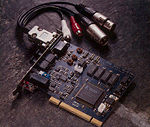
In the early days of digital audio, I remember talking with Dr. Tom Stockham, the developer of the groundbreaking Soundstream system used then by Telarc. As well as using a 50kHz sample rate, the excellent-sounding Soundstream stored its 16-bit data on large drum-shaped Winchester drives connected to a minicomputer. Twenty years later, the advent of ultra-high-density magnetic storage media and fast microprocessor chips has put high-resolution digital audio manipulation and storage within reach of anyone with a modern PC or Mac. And facilitating the transformation of the PC into a high-quality DAW has been a new generation of soundcards, such as the Digital">http://www.stereophile.com//digitalsourcereviews/280/">Digital Audio Labs CardDeluxe I reviewed in September 2000 and the subject of this review, the German RME Digi96/8 Pro.
Rogers Studio 3 loudspeaker
Back in the early 1970s, the BBC needed a physically unobtrusive, nearfield monitor loudspeaker for use in outside-broadcast trucks. Accordingly, they instructed their design department, which at that time featured such luminaries as Dudley Harwood (the "father" of the polypropylene cone, who went on to found Harbeth) and the late Spencer Hughes (the "father" of the Bextrene cone, who went on to found Spendor), to produce such a model. Thus, not only was what was then probably the finest collection of British speaker-design talent involved in its development, there were no commercial constraints placed on the design. The only limitations were intended to be those arising from the necessarily small enclosure and the absence of the need for a wide dynamic range under close monitoring conditions.
Rogue Audio Atlas power amplifier
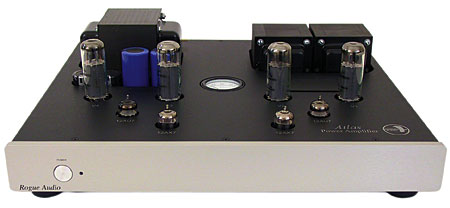
When I unpacked the Rogue Audio Atlas, I didn't know how much it cost. After examining its chassis of high-grade steel, its silver-anodized aluminum faceplate, its sleek and slightly rounded edges, and, above all, its two chunk-o'brick transformers—for such a little thing (a foot-and-a-half square by half-a-foot high), it's heavy—I guessed around five grand. Then I called Rogue Audio and learned that it retails for $1395.
Roksan Kandy K2 integrated amplifier
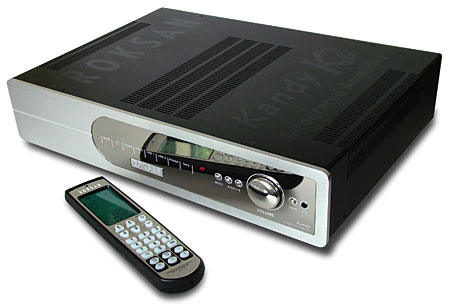
Besides my 20th wedding anniversary and the 15th anniversary of Listener magazine's first issue, this year marks the 25th anniversary of Roksan Audio Ltd., easily one of the most innovative design and manufacturing firms in British audio. Before Roksan came upon the scene in 1985, none of us had ever seen a loudspeaker whose tweeter was isolated from its surroundings by a sprung suspension. Or a commercial phono preamplifier designed to fit inside a turntable, just a centimeter away from the tonearm base. And who among us could have guessed that the Linn">http://www.stereophile.com/turntables/1103linn">Linn LP12's hegemony—among flat-earthers, I mean—would be broken by a turntable from outside of Scotland? Yet the Roksan Darius loudspeaker, Artaxerxes phono stage, and, above all, Xerxes turntable accomplished those things and more, to the genuine surprise of nearly everyone—and to the benefit of our industry at large, as other firms took those ideas and ran with them.
Roku SoundBridge M1001 network music player
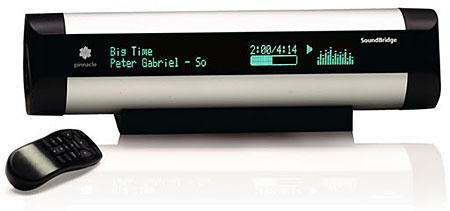
My interest in wireless network music players began during David Hyman's keynote">http://www.stereophile.com/news/11662">keynote speech at Home Entertainment 2003. Then CEO of Gracenote, Inc. (footnote 1), Hyman stunned me with his opinion that CDs and DVDs were already obsolete. Rather than pursue discs with greater storage capacity, Hyman urged industry designers to design music-server units with large hard drives to allow instantaneous access to any digital music track. With all of your music stored on a central hard drive, you could, within seconds, locate a specific track among thousands just by knowing the name of the artist, song, group, composer, year of recording, or even recording venue. Music mixes could be instantly grouped into playlists by the owner.
Roon Labs Roon v.1.0 music-playback app
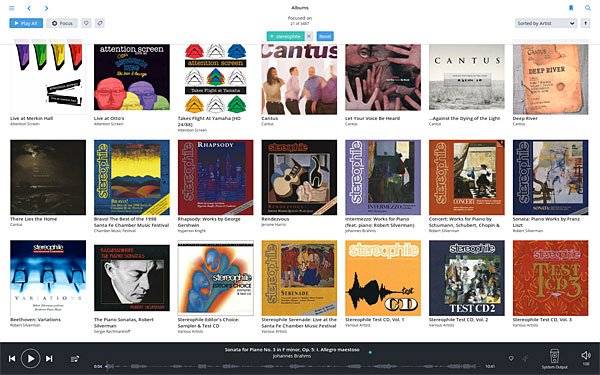
There are dozens of music-playback programs for computers, touchpads, and smartphones, ranging from Amarra, Audirvana, JRiver, Pure Music, and VLC, which manage libraries or work with library software, to programs that are integrated with a specific distribution service: Pandora, Spotify, Tidal, and, of course, iTunes. Still others, such as Sonos, are integrated with a dedicated hardware product.
Rotel RB-960BX power amplifier
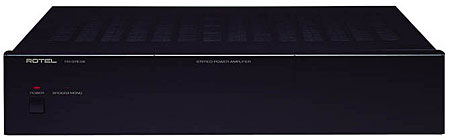
Okay, here you are: You're a Real World music lover trying to sling together a Real World hi-fi rig. You gotcha budget-king NAD/Rotel/JVC/Pioneer CD player, your SOTA Comet/Sumiko Blue Point analog rig, and your cool-man NHT/PSB/Definitive Technology entry-level speakers. Hell, you've even gone out and bought a few pairs of Kimber PBJ interconnects to hook it all up. This ain't no dog and pony show—you want that High-End High, not just some cheap'n'cheerful, low-rez rig to stick in the rumpus room so the kids can listen to that weak-ass, faux-grunge, watered-down Hendrix-howl that modern-day wimp-boys like Pearl Jam dish out to anyone under 30 who doesn't know any better.
Rotel RB-991 power amplifier
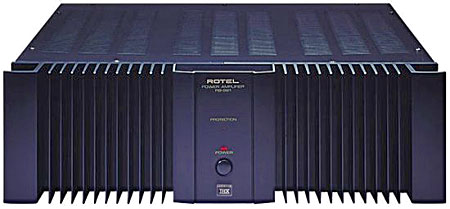
As a reviewer who has focused on seeking out high-quality audiophile gear for cost-constrained readers, I'm embarrassed to say that the flagship RB-991 stereo amplifier is the first Rotel product I've had in my house. (To be fair to myself, this 38-year-old family-owned company did not develop a large US market presence until this last decade.)