

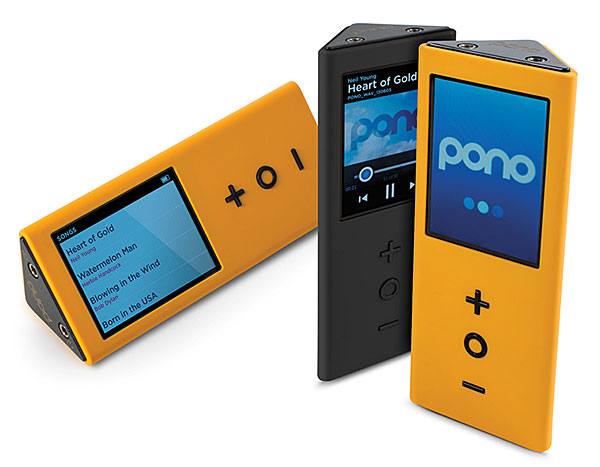
Pono PonoPlayer portable music player
In the 1960s, musical giants walked the earth. I vividly remember the first time I heard a song called "Expecting to Fly," in a UK record store. The vast, reverberation-drenched sound was extraordinary; the frail, shaky alto voice of the singer riveting.
"Who is that?" I asked the clerk.
"It's a new American band, Buffalo Springfield . . . but they've already broken up."
I bought all I could find of the Springfield, which wasn't much, and learned that the singer and composer of "Expecting to Fly" was a Canadian, Neil Young.
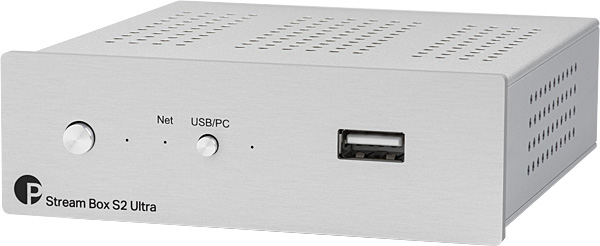
Pro-Ject Audio Systems Stream Box S2 Ultra network bridge
I have reviewed several network-connected music servers in recent years, from Antipodes, Aurender, and NAD. All performed well but are relatively expensive, and their associated player apps didn't equal Roon's user friendliness in terms of interface, organization of the library, and inclusion and updating of metadata. So when Roon Labs introduced their own server, the Nucleus+, I first reviewed and then purchased it, along with a lifetime subscription to Roon. But at $2498 without an internal drive for storing music files, the Nucleus+ is still relatively expensive, and even Roon's less-powerful Nucleus costs $1398. I was still on the lookout for a server that would be more accessible to our budget-minded readers.
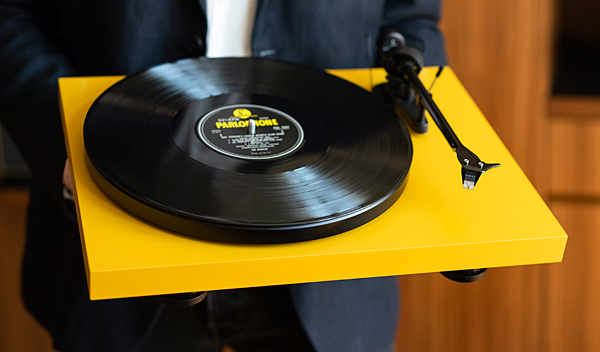
Pro-Ject Debut Carbon EVO turntable
A few months ago, a friend asked me to recommend a record player. This friend knows and loves music as much as I do; when he visits, we spend our time drinking wine and listening to records. Last time, it was Scott Walker, Fela, Joni Mitchell, Jacques Brel, Burzum, and both glorious sides of The Chronic.
"How much do you want to spend?" I asked cautiously. His answer: $500, tops.
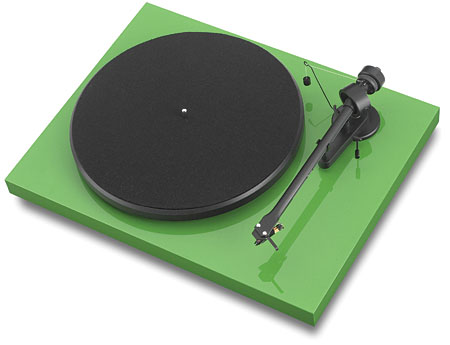
Pro-Ject Debut III record player
In the January 2010 issue of Stereophile I gushed">http://www.stereophile.com/integratedamps/marantz_pm5003_integrated_amp… effusively about the $450 Marantz PM5003 integrated amplifier. Not only was I impressed with the sound, build quality, and features of this very affordable component, but, intrigued by how it might be combined with other gear to build a complete entry-level system for about a thousand bucks, I began to ponder other entry-level components that might nicely complement it. My goal here, of course, is to inspire a new generation of young audiophiles. I felt a turntable would be a good place to start.
Pro-Ject Pre Box S2 Digital D/A headphone amplifier
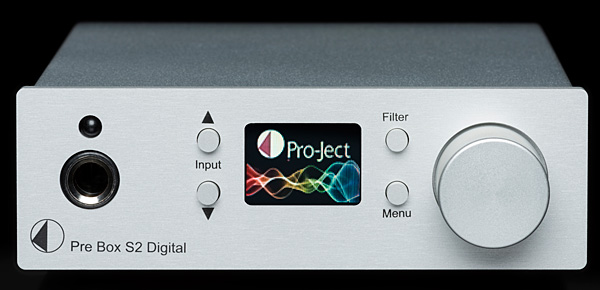
I first met Pro-Ject Audio Systems' founder and president, Heinz Lichtenegger, in 2016, at the US launch of the Austrian company's The Classic turntable. His passion for all things hi-fi was so intense I thought his head might explode. Gleeful in his mission to bring high-end audio to the people at less than typical high-end prices, Lichtenegger and Pro-Ject can fairly claim bragging rights for their entry-level Debut Carbon (DC) ($460 and up), one of the world's best-selling turntables.
PS Audio P300 Power Plant
Although advertising copywriters would have us believe otherwise, there is not a lot of true innovation in audio. Most audio products are based on well-established principles, perhaps refined in detail and execution. Of course, some products do take novel approaches, but they tend to be too off-the-wall to be taken seriously, or simply don't do the job as well as more conventional products. What's really exciting is to encounter a product that is audaciously original in concept, yet makes so much sense that you wonder why no one even thought of it before (footnote 1).
PS Audio Quintet Power Center
PS">http://www.stereophile.com/powerlineaccessories/ps_audio_power_plant_pr… Audio's Power Plant Premier is a high-end product that takes the regeneration approach in providing audio/video gear with the cleanest AC possible. But not everyone can afford to spend $2195 on such a product, and although the new amplifier design that forms the basis of the Premier is relatively efficient, it does use power, and concern about conservation of the planet's energy resources might lead one to prefer a passive approach to power-line treatment. PS Audio's line of Power Centers provides such an alternative. The model I had for review was the Quintet Power Center, which differs from the Duet Power Center only in having five pairs of receptacles to the Duet's two.
PS Audio Sprout integrated amplifier

I find small humans more beguiling than big people. My favorites are the two-footersthose little two-year-old boys with a kind of wobbly, bent-kneed stride that dips like a blues song every fourth step as they stagger ahead of their watchful parents. I like three-footers toosprightly three-year-old girls who dress better than their moms and never need a lifestyle consultation. Whenever we see one of these cheerful, bouncing young'uns coming toward us on the sidewalk, I smile and my dog's tail wags. Their bright faces and excited voices make me think, You go, little sprouts! These miniature humans' special beauty is that they still possess their full force de vie.
PS Audio Sprout100 integrated amplifier
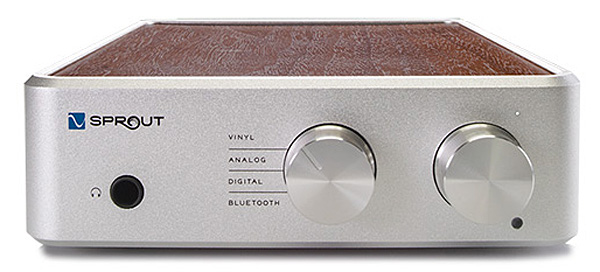
The original PS Audio Sprout, which I reviewed in the May 2015 issue, showed newcomers an easier, smaller way to amplify music recordings in the home. At $599, the Sprout100 costs $100 more. It fixes a few of the old Sprout's weirdnesses: no power-on indicator light, no remote control, five-way binding posts that weren't really five-way. It also doubles the Sprout's class-D power output into 4 ohms, from 50 to 100Wpc (or 50Wpc into 8 ohms), and adds a few sonic and mechanical enhancements.
PS Audio Ultimate Outlet AC conditioner
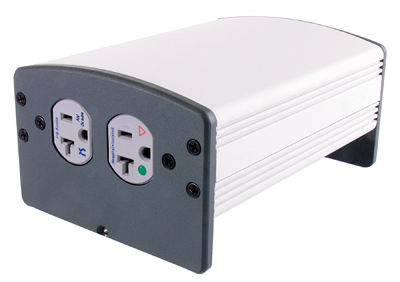
PS Audio's Power Plant AC-regeneration devices have taken the audio and home-theater worlds by storm. The P300 was voted 2000 Accessory of the Year in Stereophile (December 2000), and the P600 won the Editors' Choice Platinum Award in Stereophile Guide to Home Theater (January 2001). The Power Plant differs from conventional power-line conditioners (PLCs) in that it doesn't just "clean up" AC but actually synthesizes (or regenerates) it. Each Power Plant is essentially a special-purpose amplifier, producing AC to run the equipment plugged into it, the maximum output wattage indicated by the model number. (The most powerful Power Plant available is the P1200, which produces 1200W.)