

Musical Fidelity M1 DAC
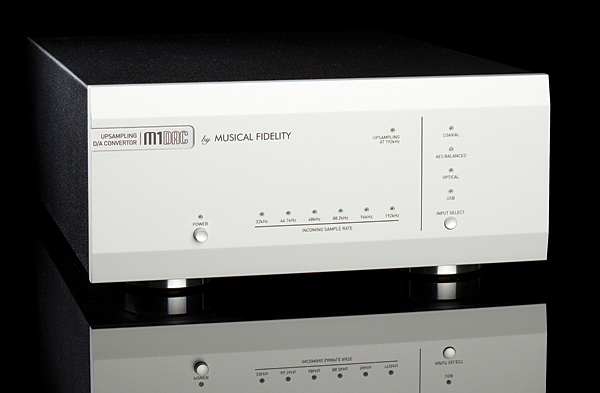
The M1 DAC is by Musical Fidelity. At $699, it's a stunning bargain. Comparing it to $995 for the Digilog in 1989. Meanwhile, the M1 is far more versatile, way better built, and, if memory serves me right, sounds vastly better.
It appears that the way to sell a DAC in 2011 is to almost give it away, in real-dollar terms. Some people pay far more than this for a set of speaker cables, a pair of interconnects, even a power cord. The M1 DAC is a piece of kit that can transform your system. I kid you not.
Musical Fidelity V-DAC D/A processor
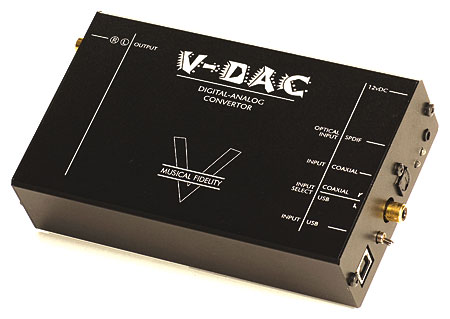
"The victor belongs to the spoils."—F. Scott Fitzgerald, The Beautiful and the Damned, 1922
Musical Fidelity V-DAC II D/A processor
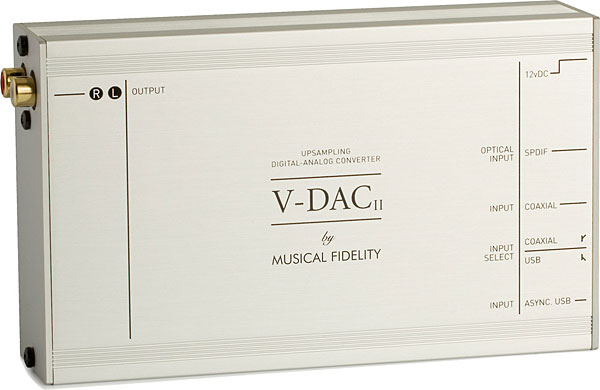
There's so much uncertainty and confusion surrounding computer audio and high-resolution downloads. Which hi-rez formats will win out? How do you store the downloads you've bought? (Easy. Don't buy them.) How do you access them? Will digital rights management (DRM) cramp your style, or data-storage fees for cloud computing crumple your wallet?
Musical Fidelity V-Link USB-S/PDIF converter
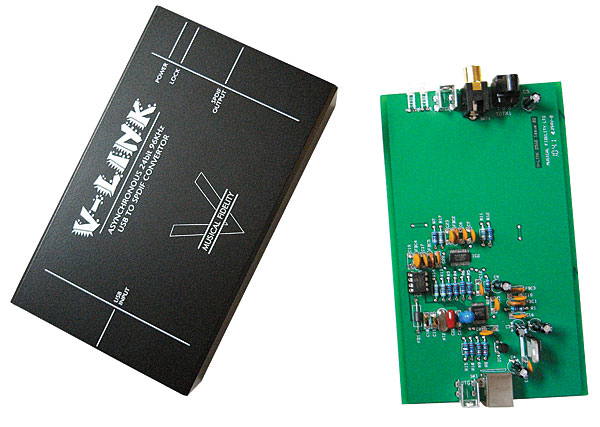
A computer is not optimized for the uninterrupted streaming of audio data. It has rapidly become established wisdom, therefore, that the optimal means of extracting audio data from a computer's USB port is to operate that port in what is called "asynchronous isochronous" mode. This lets the receiving device, such as a digital-to-analog converter (DAC), control the flow of data from the PC. In theory, asynchronous USB operation (not to be confused with the asynchronous sample-rate conversion used in some DACs) reduces jitter to unmeasurable levels, depending on the accuracy of the receiver's fixed-frequency oscillator, which is used to clock the data to the DAC. By contrast, in the alternative and almost ubiquitous USB operating mode, called "adaptive isochronous," while the sample rate of the output data, averaged over a longish period, will indeed be the specified 44.1 or 48kHz, there will be short-term fluctuations, or jitter, due to the oscillator having to change its frequency every millisecond to match the uncertain rate of data flow from the PC.
Musical Fidelity V-LPS Phono Stage
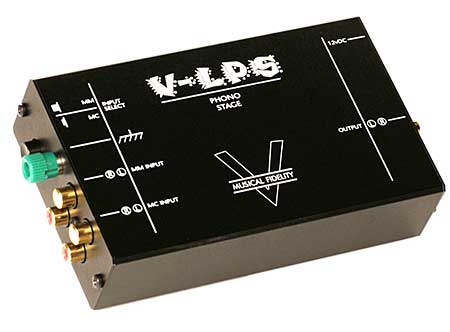
Not being fond of self-flagellation, I don't usually do analog. I am not a fuddy-dudley, nor am I especially fremerous.
Musical Fidelity V90-DAC D/A processor
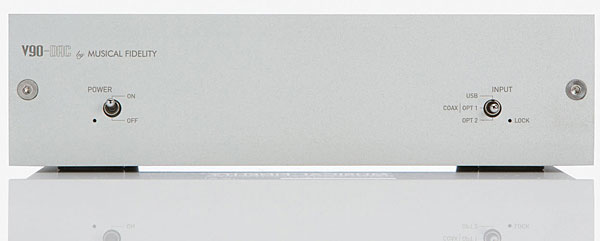
They can't sound very goodthey're not big enough. As we all know, in hi-fi, big products mean big performance. Musical Fidelity's V90 series can't be any good. They don't cost enough. With your golden ears, you must pay through the nose.
The V90 components turn all this around. They are tiny. Inexpensive. Beautifully built.
Musical Fidelity X-DACV3 D/A processor
The X-DAC v3 replaces Musical Fidelity's Tri-Vista 21 DAC, which is no longer in production, although you might find some on dealer's shelves. The Tri-Vista 21 used two pairs of subminiature 5703 WB military tubes in the analog output stage. MF's Antony Michaelson called this Cold War tube, which is no longer made, a trivistor. The Tri-Vista 21 was last seen selling for $2395.
Musical Fidelity X-T100 integrated amplifier
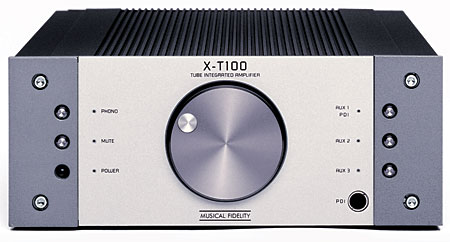
Specialization seems to be an inevitable consequence of progress: As the products of man and God become more and more complex, they're called on to do fewer things in more focused ways.
NAD 5000 CD player
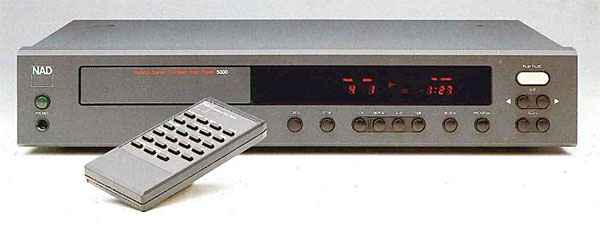
The $499 NAD 5000 looks nothing like most inexpensive CD players. Its plastic trim doesn't look cheap. It doesn't look expensive either, but it certainly won't be embarrassed to show its face in polite company. The front panel is neatly arranged and easy to interpret and use. It's the smallest and lightest of the present company of playersthe only obvious physical reflections of its low-budget heritage. Inside, however, NAD has done a lot to put your money where it counts.
NAD 5425 CD player

One of my favorite parts of writing for Stereophile is reading all the heartfelt letters our readers take the time to write me. There's nothing I like better than to kick off my boots, stretch out on the futon-couch, and let the groovy love vibes just shine off the pages. Time doesn't always permit a reply, but for now...AS in MD: thanks! RP in CA: sure, why not? And SH in IN: I've tried that, but it chafed.