

Two More Channels?
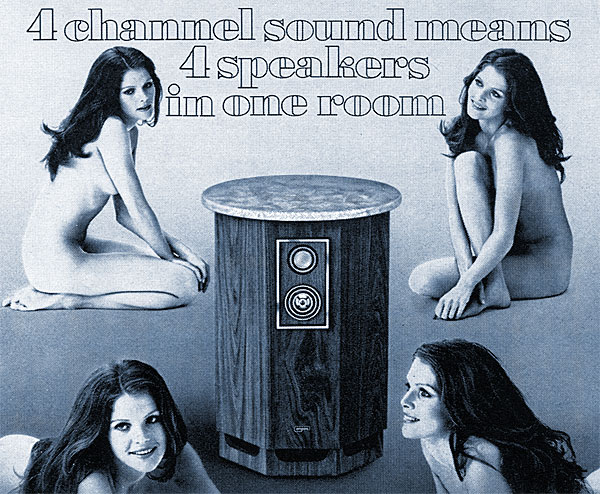
Four-channel stereo is here, but for how long? By the time this gets in print, it is extremely unlikely that any of our readers will have escaped being told that 4-channel stereo is here. "Two channels brought us direction," the announcements trumpet. "Now, four channels bring us dimension." Now, for the first time in the history of hi-fi, modern technology can bring us hall acoustics in stereo, to surround us with the sense of spaciousness that we hear in the concert hall.
Two New FTC Rules

The US Federal Trade Commission (FTC) has issued two new/newly revised rules relevantor possibly relevantto the hi-fi industry.
As John Atkinson reported in the October Stereophile (see Industry Update), the FTC recently announced a revision to the "Amplifier Rule," with changes that took effect in August. It's the culmination of a process that lasted several years and a significant modification of a rule that has been in place for half a century. Amplifier manufacturers take note. Then in mid-August, the FTC announced the final version of a new rule aimed at banning fake reviews and fake product testimonials. It also forbids companies from intimidating people engaging in critical speech.
Under Pressure: Loudspeakers at Altitude
"The large peak at 16kHz reported by Stereophile...was nowhere in evidence...The most probable explanation of this discrepancy is that the [Waveform supertweeter's] very light ribbon depends on the air load for damping, and that load is much smaller in the thin air up there at 7000' in Santa Fe than at altitudes where less lightheaded and scientifically more accountable reviewers dwell." Thus spake Peter Aczel (footnote 1), erstwhile loudspeaker designer and Editor/Publisher of the reincarnated The Audio Critic, a publication that advertises itself as having "unusual credibility among the top professionals in audio."
Universal Components
A reader who asked to remain anonymous wrote to tell us the results of some tests he saw conducted on one of our top-rated loudspeaker systems. Frequency-response checks showed that the system had virtually no deep bass, a midbass peak, a midrange slump, and a high-end rise. Further checks had shown gross distortion at input levels of over about 6W, and a definitely limited (although adequate for Row-M listening) maximum output-level capability. Said reader then went on to ask how we could possibly consider such a speaker to be one of the best available.
Upsampling or Oversampling?
Charles Hansen said it best, in a recent e-mail: "People have been holding back from criticizing this technology because they weren't certain that some new discovery hadn't been made." Ayre Acoustics' main man was talking about "upsampling," whereby conventional "Red Book" CD data, sampled at 44.1kHz, are converted to a datastream with a higher sample rate. (Because of its association with DVD-Audio, 96kHz is often chosen as the new rate.)
Upward and (Hopefully) Onward
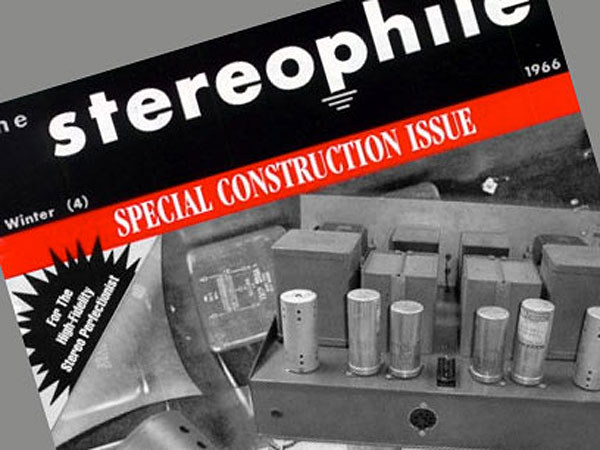
Editor's Note from 1974: As you can read in the following "As We See It," the last issue of Vol.1 No.12 (cover dated "Spring 1966") was perhaps not as "strong" as it might have been. If we had been doing things according to Proper Business Practice, we should have held back our best articles and our gutsiest reports until that issue, as a high-powered incentive for our subscribers to renew their subs. We didn't. There were better articles and a greater variety of topics covered in earlier issues, but Issue 12 was significant in that it set the pattern of topic emphasis, and the balance of reports versus other editorial material, that was to continue more or less unchanged for the next 7 years.
Us and Them
I've known a lot of folks with impressive LP and CD collections who were perfectly content with the sound of the crappiest of hi-fis. This diverse group has included recording engineers, musicians, and owners of record stores. Loving music isn't the same thing as caring about the sound of music, and maybe, in some alternate universe, those folks would-have-been, could-have-been audiophiles. But in this universe, they didn't, and I'm not sure why.
Video Actions & Audio Reactions
To every action there is always opposed an equal reaction.—Sir Isaac Newton, 1687
Vinyl Value
I recently bought a turntable, the first I've owned in about 15 years. I had sold my vinyl collection—a mix of classic rock, early 1980s pop, and the odd jazz or classical LP—when I was in grad school, for economic reasons: I needed the money for rent, or food, or beer, or something. Nor do I know what happened to my old plastic turntable; more than likely, I left it curbside for anyone strolling by who was able to appreciate its value.
Voices to Live For

Every music-loving audiophile has a unique storya story of the first time he or she was grabbed, body and soul, by a first, usually low-budget listen to a 78, LP, CD, open-reel, cassette, or MP3a story that continues today in that audiophile's quest for high-end bliss. For me, it was my desire to move closer to the voices of the singers I most loved.