

The Rolling Stones: Their Satanic Majesties Request 50th Anniversary Edition

While it may elicit shakes of the head, nasty, distasteful looks, or vociferous yawps about its being nothing more than a load of warmed-over psychedelic pandering, the time may have come to listen again to Their Satanic Majesties Request, the much-maligned 1967 album by the Rolling Stonesand perhaps think of it in a slightly more humane light. Few records from that or any other era have been as widely savaged. It's easy to make the argument that any record with such a pretentious title deserves to be ridiculed. The music itself is scattered and feels unfinished in spots. Then there's that cover image.
The Silverman Concert
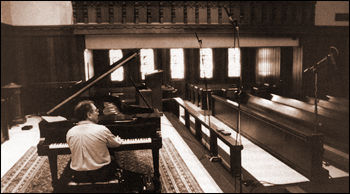
"What's that noise?" Bob Harley and I looked at each other in puzzlement. We thought we'd debugged the heck out of the recording setup, but there, audible in the headphones above the sound of Robert Silverman softly stroking the piano keys in the second Scherzo of Schumann's "Concerto Without Orchestra" sonata, was an intermittent crackling sound. It was almost as if the God of Vinyl was making sure there would be sufficient surface noise on our live recording to endow it with the Official Seal of Audiophile Approval. Bob tiptoed out of the vestry where we'd set up our temporary control room and peeked through a window into the church, where a rapt audience was sitting as appropriately quiet as church mice.
The Solti Ring Remastered...Again
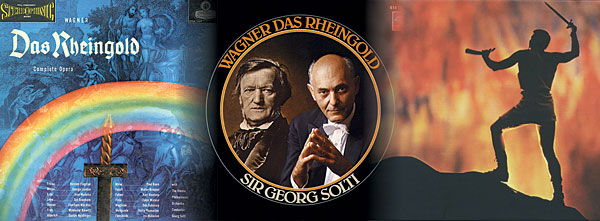
A few conductors have perhaps equaled Georg Solti in their conducting of Richard Wagner's baton-breaking Der Ring des NibelungenKarl Böhm, Daniel Barenboim, Herbert Keilberth, and Reginald Goodall have all had coherent visions of the work which they were able to translate effectively to disc. But no one has ever equaled what Solti, producer John Culshaw, and what looks increasingly like a hitherto unsuspected golden age of Wagner singers, together accomplished: what is still the recording art's crowning achievement.
The Stereo Image
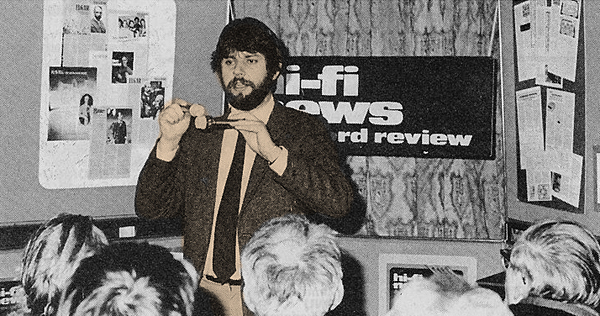
The author demonstrating stereo microphone techniques at an English audio show in 1981.
For most people the terms hi-fi and stereo are synonymous, and yet it is clear that there is still a great deal of confusion over what the word "stereo" actually means. There isn't even a consensus of opinion amongst producers of records, designers of hi-fi equipment, audio critics and music lovers as to the purpose of stereo, and considering that the arguments show no sign of diminishing in intensity, it is instructive to realise that 1981 sees both the 100th anniversary of Clement Ader's first stereo experiments and the 50th anniversary of Alan Blumlein's classic patent on stereo.The Stereophile Test CD

The end of two audiophiles' friendship:
The Survivalists: Mosaic and Newvelle Records

One is a well-established reissue label, known the world over for its completist black boxes filled with beautifully remastered jazz recordings from the 1930s through the 1960s.
The other is a new label that records only new jazz, released in elaborate packages that include a poem and original artwork, not to mention transparent 180gm pressings, tying into the newly fashionable idea of a vinyl lifestyle.
In both cases, hope truly springs eternal.
The Unmaking of Elvis Presley: New Reissues 1960-1972

No artist in the history of sound recordings has a more confused recorded legacy than Elvis Presley. Thanks to several generations' worth of ruthless avarice by his label, the constant machinations and eventual fire sale by his manager, Col. Tom Parker, and his own pathetic sloth, due in part by a 20-year addiction to prescription drugs, Elvis's recorded catalog is an absolute disaster: cut and pasted, issued and reissued as both budget and full-priced collections, exploited beyond all recognition. Keeping track of Elvis's catalog is one of, if not the most, labyrinthine discography in rock 'n' roll history. When all the foreign issues and reissues of his work are taken into account, it is, (speaking from recent experience) an endeavor which severely tasks the human capacity for tedium.
The Wind Cries Marty (Krystall)

Marty Krystall is a musician's musician, highly regarded and known to his peers in the LA music world as a triple-threat wind player equally adept at jazz, classical, and in the studio. He is also an audiophile, a recording engineer, and a record company owner, having created the K2B2 label with bassist and colleague Buell Neidlinger in 1979.
There Lies the Disc, the making of the new Cantus CD

Wes Phillips on the Sessions
One of the enduring myths of audiophilia is that of the recording as a true and honest picture of a musical event—a sonic "snapshot" that captures a unique moment of time the way a photograph captures the light of a day long since past.
One of the enduring myths of audiophilia is that of the recording as a true and honest picture of a musical event—a sonic "snapshot" that captures a unique moment of time the way a photograph captures the light of a day long since past.
To Save a Soul Like Mine: the Blind Willie Johnson Project
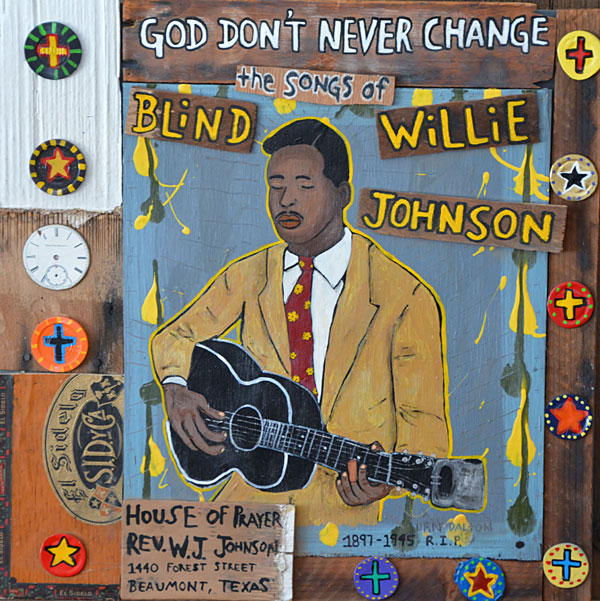
He is easily among the most accomplished and influential slide-guitar players ever to put a ring of glass or metal around his finger. In 1977, on the golden record carried by the space probe Voyager, alongside the first movement of Beethoven's Symphony 5 and recordings of "footsteps, heartbeat, and laughter," his greatest song, "Dark Was the Night, Cold Was the Ground" went off to represent humanity to the stars.