

Revel Performa3 F208 loudspeaker
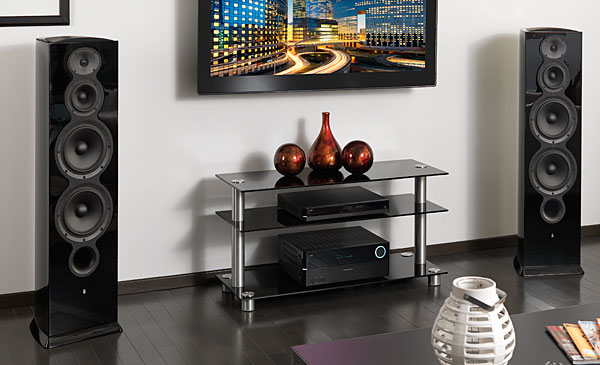
The year: 1999. The city: Minneapolis. While taking a break from partying with Prince like it was, well . . . that year, I wandered into a local audio emporium to see what new and exciting goodies were on display. Set up in a large listening room, attached to the latest Mark Levinson gear, were Revel's original Ultima Studio loudspeakers. I sat down, gave them a listen, and heard the best sound I had yet heard. For the first time, it seemed to me that I was listening to an audio system that played with low distortion and little coloration. Also, the system's wide dispersion threw a huge soundstage, engrossing me in the music in ways other speakers couldn't. I was hooked.
Revel Salon loudspeaker
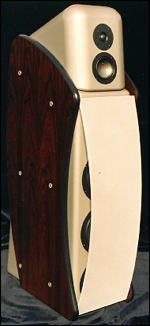
On a very special Saturday night in early September—late winter in Australia—I was deeply moved by hearing Brahms' Symphony 1 in the concert hall of the Sydney Opera House complex. Perhaps it was Marek Janowski's fiery, inspired conducting, but I keep recalling the hall itself. Earlier that day, I had photographed—first from my hotel room, later from a ferry—the huge, nesting sail-like roofs, covered with a million white ceramic tiles, that enclose an opera theater, concert hall, and restaurant. Twenty-five years in construction and costing over $107 million, the Sydney Opera House is described in my Fodor's '98 Australia guide as "the most widely recognized landmark of urban Australia." Attending the concert that night—all 2679 seats were occupied—I found the acoustics lovely, dark, and rich.
Revel Ultima Salon2 loudspeaker
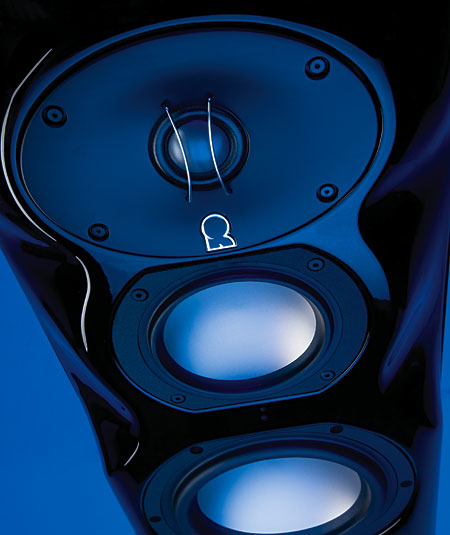
Back in March 1998, Revel's Ultima Salon1 floorstanding loudspeaker generated quite a stir at Stereophile (Vol.22">http://www.stereophile.com/floorloudspeakers/96">Vol.22 No.3). Our reviewers were impressed by its seven designed-from-scratch drive-units, its ultramodern enclosure with curved rosewood side panels, exposed front tweeter and midrange, rear-facing reflex port and tweeter, and a flying grille over the mid-woofer and woofers. In the December issue (Vol.22 No.12), the Ultima Salon1 ($16,000/pair) was named Stereophile's "Joint">http://www.stereophile.com/features/178/index1.html">Joint Speaker of 1999" for its "big bass, timbral accuracy, low distortion, dynamics, lack of compression, and best fit'n'finish."
Revel Ultima Studio loudspeaker
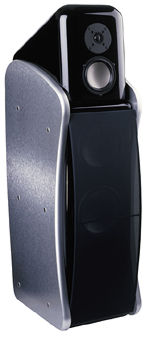
The Revel Ultima Studios came to me by chance. I'd wanted to review Revel's high-value Performa F-30—see my May">http://www.stereophile.com//loudspeakerreviews/244/">May 2000 report—but the Studio was offered instead. By the time a pair of Studios had arrived, however, the F-30s were also on their way, and the Studios were put on the back burner. Because of the mix-up, I thought the Studios would be freebies—just listen for a while and send 'em back. I am now obliged to do the honest thing and fess up in public: Many months have passed and the Studios are still here.
Revel Ultima Studio2 loudspeaker
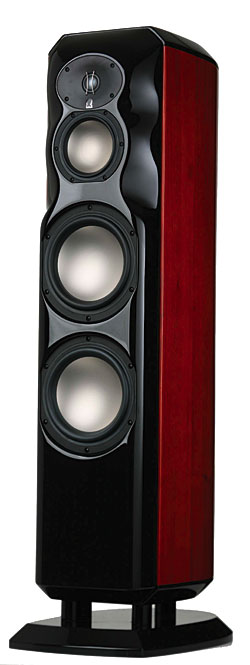
This is my fourth review of a Revel loudspeaker, and I was even more excited by the arrival of the Ultima Studio2s ($15,999/pair) than I was when their predecessors, the original Ultima Studios ($10,799/pair when first reviewed; $15,000/pair when last listed in "Recommended Components"), were delivered in 2000. (See my">http://www.stereophile.com/floorloudspeakers/302">my review in the December 2000 Stereophile, Vol.23 No.12.) After all, the Studios were my reference speakers for years and, along with the larger Ultima Salons, were statement products that were the product of the talented designer Kevin Voecks and the considerable resources of Harman International, parent of Revel as well as of JBL and Infinity. Over the years, I've also reviewed Revel's Performa">http://www.stereophile.com/floorloudspeakers/244">Performa F30 (May 2000, Vol.23 No.5) and Concerta">http://www.stereophile.com/floorloudspeakers/706revel">Concerta F12 (July 2006, Vol.29 No.7), each outstanding at its price point. If, after all these years, Voecks and his team were ready to reconsider their statement products, they should be something special.
Rockport Technologies Antares loudspeaker
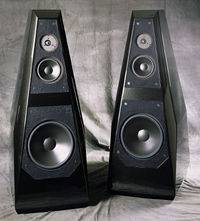
Antares is a giant red star in the constellation Scorpio. According to Rockport Technologies' Andy Payor, the $41,500/pair Antares loudspeaker is the "ultimate" reasonably sized, full-range loudspeaker, and is built to a standard "unequaled in the industry." Rockport's $73,750 System">http://www.stereophile.com//analogsourcereviews/258/">System III Sirius turntable came with equally boastful claims that turned out to be anything but hyperbole. Has Rockport done it again with the Antares?
Rockport Technologies Avior II loudspeaker
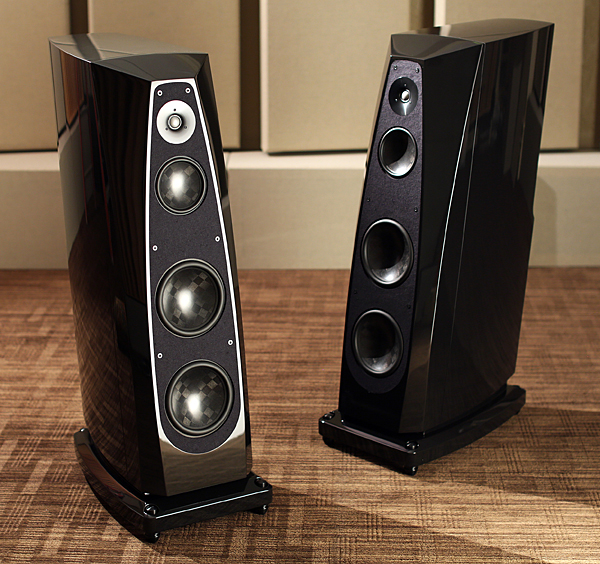
Following my review of the floorstanding Magico S5 Mk.II last February, I spent some time with two-way stand-mounted speakers from Aerial Acoustics, Bowers & Wilkins, and Dynaudio. As much as I appreciated the small speakers' virtues, I found myself missing the big Magico's bass extension and ability to play loud; my next loudspeaker review, therefore, would be of another floorstander.
It's been a while since we published a review of a Rockport Technologies loudspeaker.
Rockport Technologies Lynx loudspeaker
Music often brings me joy, awe, and, if I'm lucky, something close to transcendence, but it's not my only route there. A few years ago, on a sunny January day in Madrid's Prado museum, I went looking for Hieronymus Bosch's The Garden of Earthly Delights.
Rockport Technologies Merak II loudspeaker & Sheritan II subwoofer
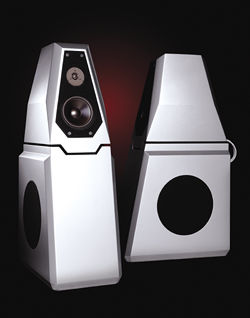
No one has ever accused Rockport Technologies' Andy Payor of under-engineering a product, and this set of gleaming black beauties is no exception. The system is available in two configurations: as the two-way Merak II for $19,500/pair, including sturdy custom cradle-stands with integrated crossover; and as the Merak II/Sheritan II, a three-way, two-box floorstander that, to afford them at $29,500, will reduce some to living in the speakers' shipping crates. You could do worse for housing than checking into the Sheritan Rockport: The wooden crates are almost exquisitely finished.
RSL Speedscreen II loudspeaker
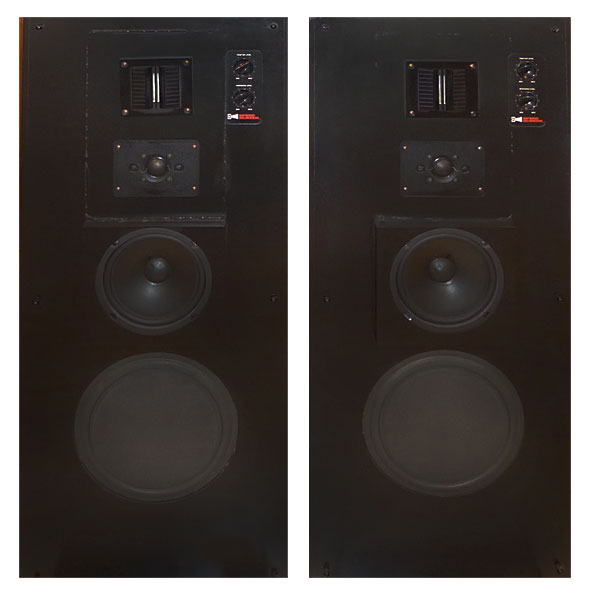
RSL is the house brand of a California chain of retail stores, Rogersound Labs, that is part-owned by the leader of the RSL loudspeaker-design team, one Howard Rodgers. (Rogersound Labs also owns the Upscale Audio high-end store in north Los Angeles.) The range offered by RSL is unbelievably wide, with models addressing just about every market niche and price category. The Speedscreen II, however, is Howard's attempt to produce a true high-end loudspeaker at an affordable price. To the casual observer, the Speedscreen ($898/pair) appears to be a planar design; however, its shallow, braced enclosure houses moving-coil drive-units, and is a result of Howard's attempts to minimize the effect of cabinet resonances. "I always thought deep, narrow enclosures sound 'boxy'," said Howard when he visited Santa Fe last September, "and the wide but shallow cabinet seemed to be the best way to get a large internal volume without 'boxiness'."