

Dahlquist DQ-12 loudspeaker
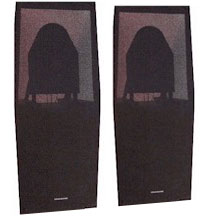 The DQ-12 is the latest loudspeaker from Dahlquist employing their "Phased Array" technology, first used in 1973. The company was formed that year by Jon Dahlquist and Saul Marantz to produce the DQ-10, a loudspeaker that enjoyed a long and successful life. When I sold hi-fi in a retail store in the late 1970swe stocked Dahlquist speakersthe DQ-10 was among the more prominent audiophile speakers, prized for its imaging abilities.
In 1976, Carl Marchisotto joined the company, designing support products for the DQ-10 including a subwoofer, variable low-pass filter, and a passive crossover. Jon Dahlquist is no longer actively involved with the company; Carl has now assumed the engineering responsibilities at Dahlquist and is the designer of the latest group of Phased Array loudspeakers (footnote 1). This new line, introduced at the Winter 1990 CES in Las Vegas, encompasses three models: the $850/pair DQ-8, the DQ-12 reviewed here, and the $2000/pair flagship, the DQ-20i.
The DQ-12 is the latest loudspeaker from Dahlquist employing their "Phased Array" technology, first used in 1973. The company was formed that year by Jon Dahlquist and Saul Marantz to produce the DQ-10, a loudspeaker that enjoyed a long and successful life. When I sold hi-fi in a retail store in the late 1970swe stocked Dahlquist speakersthe DQ-10 was among the more prominent audiophile speakers, prized for its imaging abilities.
In 1976, Carl Marchisotto joined the company, designing support products for the DQ-10 including a subwoofer, variable low-pass filter, and a passive crossover. Jon Dahlquist is no longer actively involved with the company; Carl has now assumed the engineering responsibilities at Dahlquist and is the designer of the latest group of Phased Array loudspeakers (footnote 1). This new line, introduced at the Winter 1990 CES in Las Vegas, encompasses three models: the $850/pair DQ-8, the DQ-12 reviewed here, and the $2000/pair flagship, the DQ-20i.DALI Callisto 6 C wireless loudspeaker
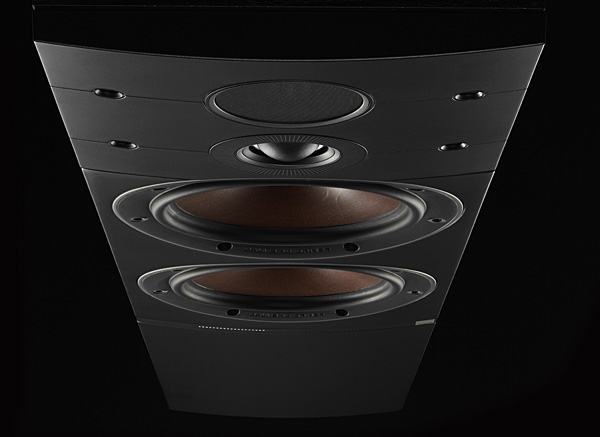
PS Audio's Paul McGowan has been sending out a daily newsletter by email since 2011. In his May 29, 2019 epistle he asked, "What would our world of high-end audio look like if there were only active wireless loudspeakers? If even the half-a-million-dollar mega-beasts were internally amplified and connected via wireless and controlled from an iPad? No more boxes. No more wires and cables. Only speakers."
DALI Helicon 400 Mk.2 loudspeaker
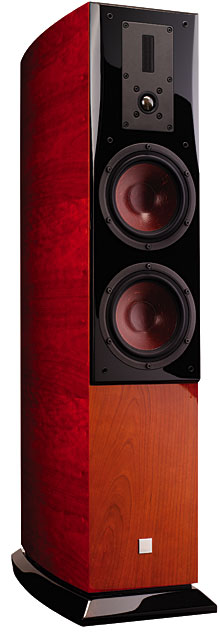
Danish Audiophile Loudspeaker Industries (DALI), a relatively large maker of loudspeakers, was founded in 1982 by the peripatetic Peter Lyngdorf, who has worked with or founded Steinway/Lyngdorf, Lyngdorf Audio, TacT, NAD, etc. Audionord International, another company founded by Lyngdorf, owns DALI as well as American subsidiary DALI USA, along with yet another Lyngdorf creation: the 60 Hi-Fi Klubben stores, said to be the world's largest chain of high-end audio retail shops. Whew! The guy keeps busy.
DALI Ikon 6 loudspeaker
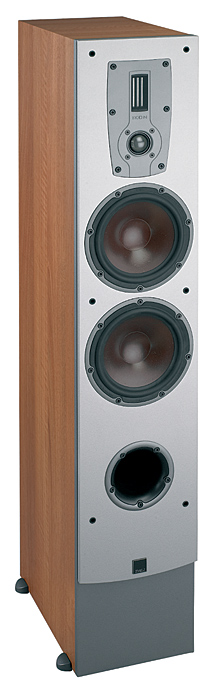
When I review an affordable loudspeaker, first impressions are important. Once I've unpacked the speaker, noted the quality of its construction and finish, and have complimented or grumbled about the ergonomics of its five-way binding posts, I fire 'er up and give 'er a first listen. Occasionally, the sound will put a smile on my face, either because I'm impressed with the amount of uncolored detail emanating from such an affordable product, or because the speaker sounds so sweet that I'm intoxicated.
DALI Rubicon 8 loudspeaker
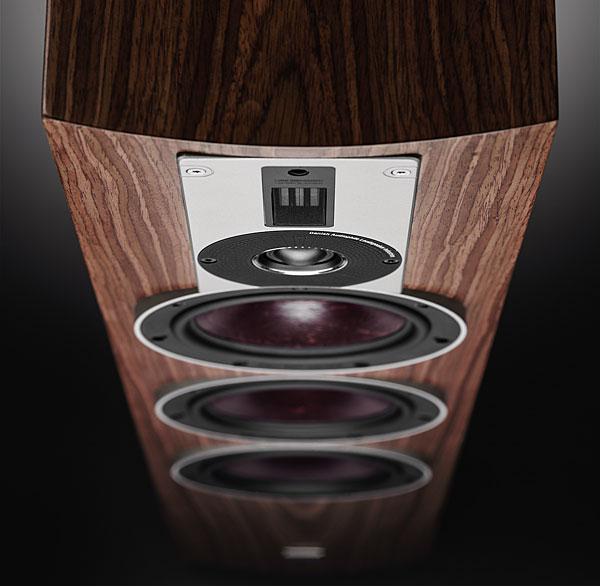
Looking back at our September 2014 issue, I think my review of the Triangle Signature Delta loudspeaker marked something of a watershed in the evolution of my taste in loudspeaker sound quality. For decades I have been a devotee of what might be called "British" sound: low coloration and, overall, a rather polite presentation, coupled with low sensitivity. The Triangle speaker opened my ears to what could be achieved with a very different approach: still-low coloration but high sensitivity, impressive clarity, and a hefty dose of what the late J. Gordon Holt called "jump factor," in which the leading edges of transients are neither smeared nor tamed. So when, last September, on a visit to Dallas and The Sound Organisation, the US distributor of Danish Audiophile Loudspeaker Industries (DALI), I encountered DALI's Rubicon 8 speaker (footnote 1), which had benefited from a low-loss design philosophy similar to the Triangle's, I asked for a pair for review.
dbx Soundfield 1A loudspeaker
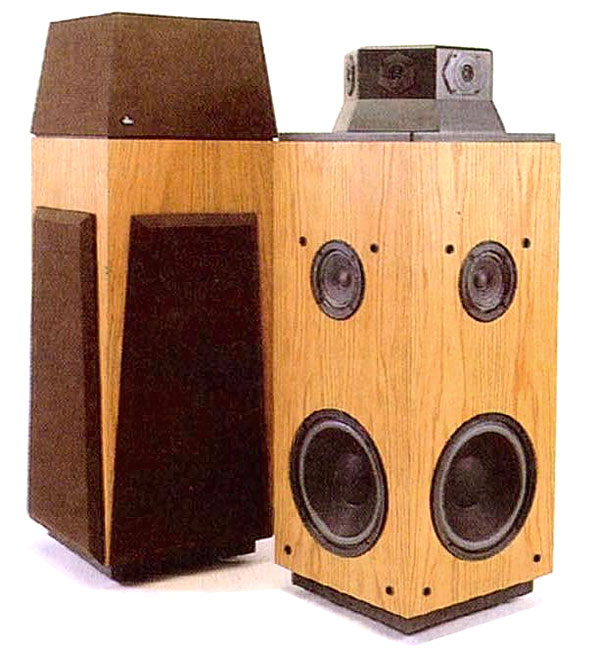
The unsung sage who first observed that high-end audio is a solitary vice was probably not implying that audiophiles are antisocial; he was merely acknowledging the fact that a decent stereo stage is usually only audible from one place in the entire listening roomthe so-called sweet spot. Stray from that spot, and the whole soundstage shifts to one side, spaciousness collapses, and images become vague and unstable. This is the antisocial aspect: only one member of a group can hear good stereo at any one time. (The gracious host at a listenfest will take a secondary seat, allowing his guests to take turns sitting in the sweet spot.)
DCM Time Frame TF1000 loudspeaker

It is almost ten years since I last heard a pair of DCM loudspeakers, the Time Windows made famous by writer Peter Aczel in the first incarnation of his magazine The Audio Critic. The "Time" nomenclature traditionally used by DCM in their models refers to the fact that for any hi-fi component, its performance in the frequency domain is related to, and implicit in, that in the time domain, the two being connected by the mathematics of the Fourier Transform. To put it in simplistic language, a speaker's impulse response can be translated directly into its frequency response: all the information needed to show how its response varies with frequency is contained in the shape of the impulse it produces.
Definitive Technology Mythos STS SuperTower loudspeaker
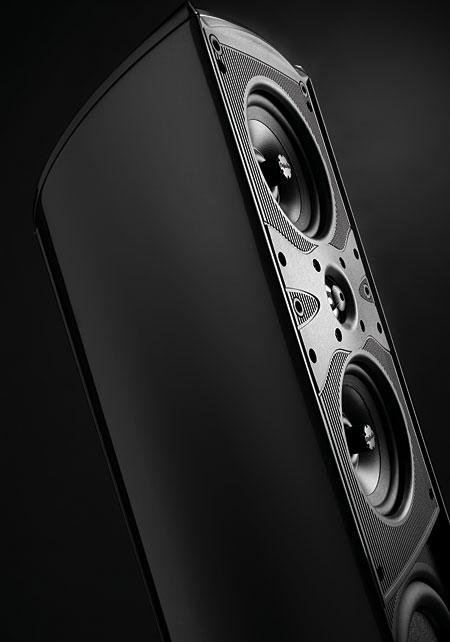
John Atkinson and I were in a Manhattan loft apartment that could have stood in for every sophisticated NYC loft you've ever seen in films. We were surrounded by fabulous contemporary art. Asian and South American antiquities were discreetly displayed. The furniture was sparse but choice. And, over in one corner, facing a conversation grouping of paintings, two sleek metal tower loudspeakers were making extremely convincing music. We managed to delay examination of this urban paradise long enough to drink adult beverages and inhale some music.
Delaware Acoustics DELAC S10 loudspeaker
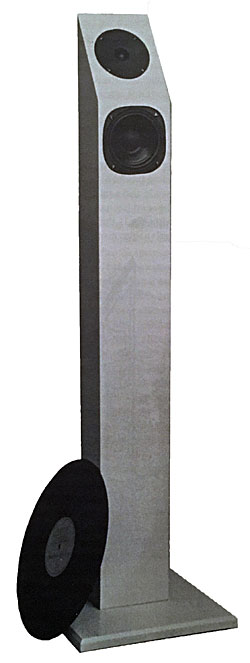 One of the joys of reviewing loudspeakers is that there are always intriguing aspects of any particular design. The problems involved in producing a speaker that has an even tonal balance, well-controlled directivity, good bass extension, and a smooth integration of the outputs from often widely disparate drive-units have what appears to be an infinite number of solutions. The result is often a speaker so different from the norm that it just cries out to be auditioned.
Such was the case with the Delaware Acoustics DELAC S10, which costs $629/pair. Only sold factory-direct, this would therefore have been low on Stereophile's priority list for review if it weren't for two things: first, the fact that the S10 was designed by one Ralph Gonzalez, a name that should be familiar to readers of Speaker Builder magazine for having written a very useful speaker design and analysis program; second, as implied in the first paragraph, the S10 is one of the weirdest speakers I have ever laid ears on.
One of the joys of reviewing loudspeakers is that there are always intriguing aspects of any particular design. The problems involved in producing a speaker that has an even tonal balance, well-controlled directivity, good bass extension, and a smooth integration of the outputs from often widely disparate drive-units have what appears to be an infinite number of solutions. The result is often a speaker so different from the norm that it just cries out to be auditioned.
Such was the case with the Delaware Acoustics DELAC S10, which costs $629/pair. Only sold factory-direct, this would therefore have been low on Stereophile's priority list for review if it weren't for two things: first, the fact that the S10 was designed by one Ralph Gonzalez, a name that should be familiar to readers of Speaker Builder magazine for having written a very useful speaker design and analysis program; second, as implied in the first paragraph, the S10 is one of the weirdest speakers I have ever laid ears on.DeVore Fidelity Gibbon Super Nine loudspeaker
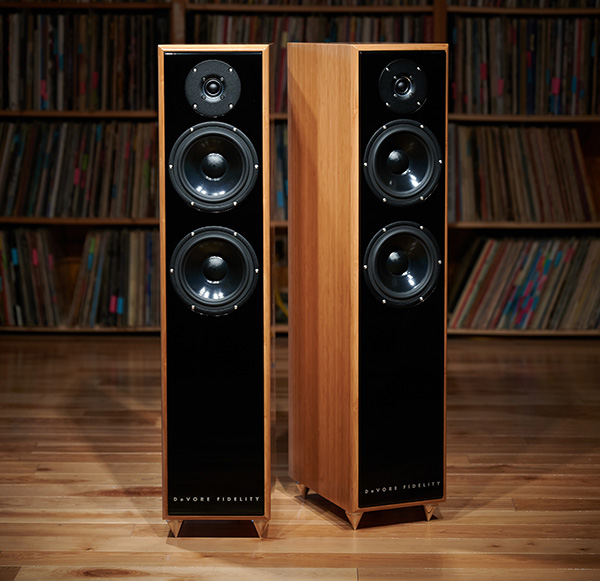
I've watched the DeVore Fidelity factory develop from its humble start as an early tenant in the Brooklyn Navy Yard—once a sprawl of crumbling ruins, now a sleek high-tech hub—into a thoroughly professional facility housing a cabinet shop, assembly, and R&D. It is also the legendary Monkeyhaus, where late-night listening sessions and pizza feasts are a tradition.