

Artemis Systems Eos Signature loudspeaker & Base Module
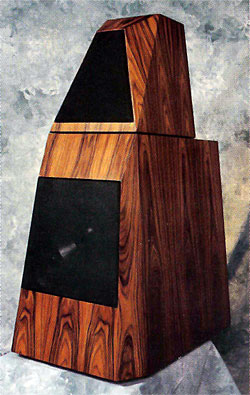 Though the original Artemis Systems Eos has been around for a few years, it doesn't seem to have made a big impression on audiophiles. Judging by a brief but exciting audition of the new Eos Signature and its accompanying Base Module at HI-FI '96, I found it hard to understand how it could remain such a well-kept secret. A few weeks later, to my surprise, Wes Phillips asked me if I wanted to review a pair and, throwing caution to the winds, I jumped at the opportunity. Rash move.
The movers delivered three large boxes and two absolutely huge crates. Inside the boxes were the two Eos Signatures and their external crossovers. Each crate contained a Base Module, and their appearance struck fear into my heart. I had gone too fareach one weighed 300 lbs, and together they were more commodious than some apartments in my Manhattan neighborhood. I signed for the delivery, then panicked when I realized there was no way to get these unpacked before my wife came home. Indeed, I didn't know how I was going to do it at all.
Though the original Artemis Systems Eos has been around for a few years, it doesn't seem to have made a big impression on audiophiles. Judging by a brief but exciting audition of the new Eos Signature and its accompanying Base Module at HI-FI '96, I found it hard to understand how it could remain such a well-kept secret. A few weeks later, to my surprise, Wes Phillips asked me if I wanted to review a pair and, throwing caution to the winds, I jumped at the opportunity. Rash move.
The movers delivered three large boxes and two absolutely huge crates. Inside the boxes were the two Eos Signatures and their external crossovers. Each crate contained a Base Module, and their appearance struck fear into my heart. I had gone too fareach one weighed 300 lbs, and together they were more commodious than some apartments in my Manhattan neighborhood. I signed for the delivery, then panicked when I realized there was no way to get these unpacked before my wife came home. Indeed, I didn't know how I was going to do it at all.Athena Technologies AS-F2 loudspeaker
I have always had an affection for speakers designed and manufactured by the Canadian conglomerate Audio Products International Corp. (API), which markets speaker designs under the names Mirage, Energy, Sound Dynamics, and Athena. In fact, it was 20 years ago that API created the first budget speaker that caught my attention, the Mirage 350. At the time, the 350 was the only speaker I'd heard that cost less than $300/pair. It sounded open, musical, and detailed without seeming bass-shy. (A larger successor, the 460, was for many years my reference home-theater speaker.) Although I've been impressed with many other API designs I've heard over the years at friends' houses, press events, and hi-fi shows, it had been more than a decade since I'd formally reviewed an API product.
Atlantic Technology AT-1 loudspeaker
John Atkinson nudged my ribs with an elbow. "Did you bring your Cornelius CD with you?" he whispered.
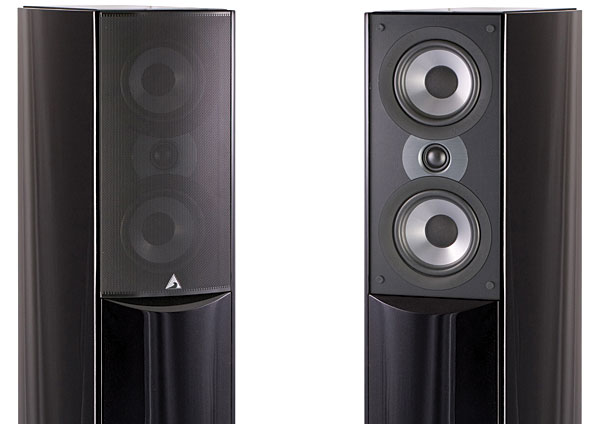
It was the 2010 Consumer Electronics Show, and JA and I were nearing the end of a dog-and-pony act expertly presented by Atlantic Technology's president, Peter Tribeman, touting a prototype of his company's new loudspeaker, the AT-1. JA and I had just heard about the finer points of the AT-1's new bass-venting technology, the Hybrid-Pressure Acceleration System (H-PAS), which was supposed to combine all the benefits and qualities of a transmission-line enclosure, horn loading, and sealed and ported designs. At the time, I didn't care if it combined all of the qualities of Kim Kardashian, Sacagawea, Joan of Arc, and Marie CurieI was just thrilled that the AT-1s were sounding so good in a partitioned ballroom.
Audes Jazz loudspeaker
When I first got into hi-fi, stereo was just over the horizon and imported products were still rare. The inexpensive ones came from Japan, and you could find them, often with names that changed from week to week, in the open-air displays in and around Cortlandt Street in lower Manhattan. The more expensive brands were European, primarily British, and beyond my financial grasp.
Audio Artistry Beethoven loudspeaker system
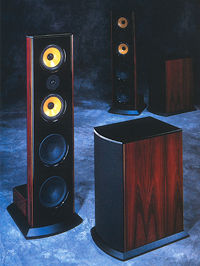
Audio Artistry's Beethoven is the banner model of the company's Composer series (footnote 1), which includes the entry-level Vivaldi as well as the Dvorak I reviewed in the April 1996 Stereophile (Vol.19 No.4, p.204). Like the Dvorak, the Beethoven is a four-piece, bi-amplified, dynamic dipole design; unlike the Dvorak, the Beethoven has been taken to the nth degree of refinement.
Audio Physic Avanti III loudspeaker
Success can be a two-edged sword. With the Virgo (reviewed">http://www.stereophile.com//loudspeakerreviews/147/">reviewed in September 1995), Audio Physic created a $5000/pair benchmark product at the midpoint of the company's speaker lineup. While an upgraded, $5800 Virgo is due out soon, the original version will remain in production, its price dropping to $4495/pair—less than it cost six years ago.
Audio Physic Caldera III loudspeaker
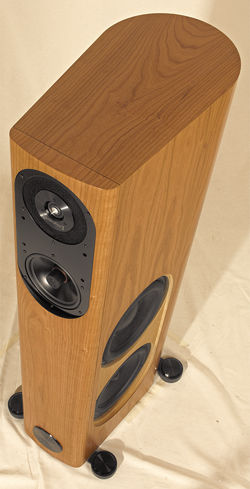
More, I think, than any other link in the audio chain, loudspeaker designs tend to reflect the personal preferences, opinions, and philosophies of their creators—think Henry Kloss, Paul Klipsch, Rudy Bozak, David">http://www.stereophile.com/interviews/478">David Wilson, Jon Dahlquist, Arnie Nudell, and Amar Bose (just kidding). Consider, if you remember, where Ken">http://www.stereophile.com/interviews/232">Ken Kantor took Acoustic Research when he took over AR's design reins. Might as well have called AR NHT, for all that the new designs followed the old.
Audio Physic Kronos loudspeaker
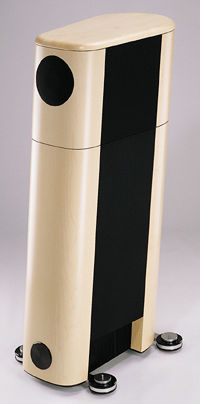
Thirty-one flavors may work for an ice-cream chain, but a speaker manufacturer who sets out to please every sonic palate ends up with a serious identity crisis, pleasing no-one. From its inception in 1985, Audio Physic, based in Brilon, Germany, has been an event-oriented speaker company. Founder and original chief designer Joachim Gerhard focused much of his attention on providing listeners with the sensation of "live" by emphasizing coherent three-dimensional imaging and soundstaging—though not to the exclusion of timbral accuracy. Except for the Medea, based on a Manger driver (a fascinating design nonetheless), every Audio Physic speaker I've heard has fulfilled the company's mission statement.
Audio Physic Scorpio loudspeaker
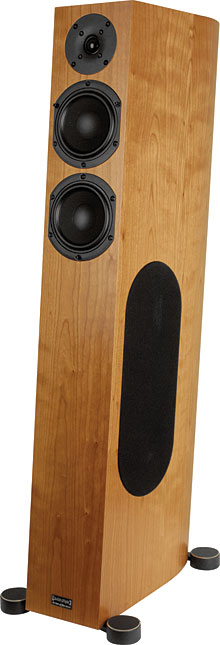
There is a sweet spot in any manufacturer's lineup where minimum price and maximum performance meet. More expensive products in the line may offer higher fidelity, but the cost may not be commensurate with the improvement. For instance, VPI's HRX and Super Scoutmaster turntables cost more than their standard Scoutmaster model, and they perform better—but for my money, the sweet spot of VPI's line is the standard Scoutmaster, with or without such options as the outer clamp and Signature tonearm.
Audio Physic Virgo III loudspeaker
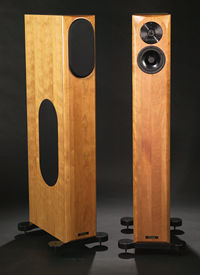
I was riding BART home from Home">http://www.stereophile.com/news/11662/">Home Entertainment 2003, thinking about the day—the new products, the old friends, the rooms with really great sound. It's a long ride from downtown San Francisco to Livermore, so I next got to thinking about all of the hi-fi shows I've attended over the years and which companies, year after year, always seem to have good sound. At the top of the list were Audio Physic and its US importer, Allen Perkins' Immedia.