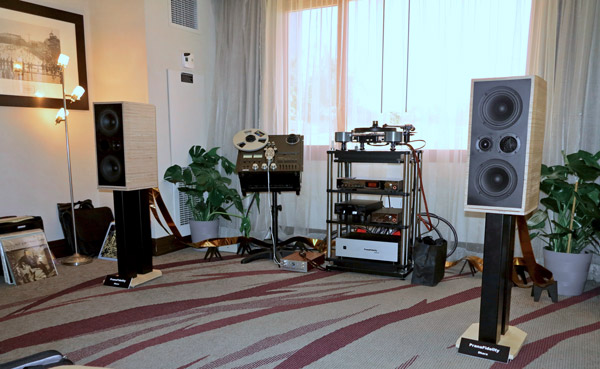
Bob Katz on Loudspeaker Isolation

Bob Katz on Loudspeaker Isolation

(Photo by Mary Kent)

Of late, Stereophile has written a lot about vibration-isolating footers under loudspeakers. The idea of isolating loudspeaker vibrations from floors is controversial. Many (perhaps most) designers believe that dynamic loudspeakers in particular—those with significant moving mass in their cones—should be rigidly connected to the floor as is typically done with spikes. A rigid connection of the speaker to the floor reduces the Newton-1 reactive motion of the cabinet in response to the motion of the cones, heavy woofers in particular. Cabinet motion could be expected to smear the loudspeaker's sound.

AudioQuest Niagara 3000 AC power conditioner

AudioQuest Niagara 3000 AC power conditioner

It stands to reason that any audiophile system would benefit from improved AC power. The rooms in most older homes are equipped with a single duplex receptacle on each wall, maybe two per wall in homes employing more modern construction practices. Behind the wall you're likely to find standard 14-gauge Romex, passing through via receptacles that typically sell for about a buck each. The electrical work meets local code, but audiophiles aren't involved in setting local electrical codes.

Looking Back at Fleetwood Mac

Looking Back at Fleetwood Mac

I've just recently finished reading guitarist/vocalist Walter Lure's autobiography, To Hell and Back. Walter has a great story about his days in Johnny Thunders's Heartbreakers and his own Waldos. Until he died in late August, you could still hear him playing with the Waldos and running periodic tributes to Johnny. But he also took some space to write about his first band, a hard-rock dance band called Bloodbath that pounded the risers in the North Bronx at the dawn of the 1970s.

California Audio Labs Sigma D/A processor

California Audio Labs Sigma D/A processor

Though their first CD player featured a vacuum-tube output stage, California Audio Labs is recently known for making good-sounding, moderately priced solid-state CD players, like the Icon Mk.II that Jack English reviewed in July 1992 (Vol.15 No.7). The Sigma, a $695 tubed D/A converter, furthers their reputation in both areas.
Advertisement
Advertisement
Advertisement