Full-range speakers are usually at least three-way rather than two-way, for good reasons. Although a three-way crossover network is harder to do right, and there can be phase-coherence issues if the drivers aren't well-matched and well-integrated, a two-way speaker with a woofer big enough to generate room-filling lows is even more difficult, because a big woofer needs to cross over at a frequency that is low for most tweeters. The dispersion of the tweeter and woofer around the crossover point need to be similar so that there aren't discernible poke-outs or dips in that frequency range, especially outside a narrow "sweet spot."
On the other hand, a simple two-way crossover is very appealing. It uses fewer parts in the signal path. Two drivers instead of three can also simplify cabinet design and build. When done right, a big two-way speaker sounds highly coherent and throws a big, cinematic image with precise placement of instruments; sounds passing through the crossover point don't appear to shift or "wobble."
Then there's the choice of tweeter. Many vintage big two-ways had horn tweeters (sometimes concentric within the large woofer), but aside from Klipsch's large-scale offerings—many of them based on old designs that are still sonically valid—these days most designers making big two-ways choose ribbon or dome tweeters.
A quick check of Stereophile floorstanding speaker reviews over the past year revealed no true two-way designs. The Stenheim Alumine Two.Five reviewed by John Atkinson in May 2025, and the DeVore Fidelity Gibbon Super Nine reviewed by Ken Micallef in November 2025, are "2.5-way" speakers: They both feature two medium-sized woofers, one handling only bass frequencies and one handling bass plus midrange.
I bucked the trend and spent several months with a pair of big two-ways. It was a rewarding and informative experience.
 From the progeny of Vikings, a big and bold statement
Ø Audio (pronounced like ur as in fur) began in 2017 in Asker, Norway, about 12 miles southwest of Oslo. Ø is owned by Sveinung Djukastein Mala and Jonathan Magnus Cook. Mala is the principal designer, and Cook, who has been known to walk around trade shows with a replica Viking battle ax on his hip, is the salesman. The company's website proclaims, "Ø Audio means strong Audio."
Distribution in the US and Canada is more recent. Harmonia Distribution took on Ø Audio after President Jesse Luna discovered the company at the Florida International Audio Expo in February 2025. There are now 14 US dealers, most east of the Mississippi.
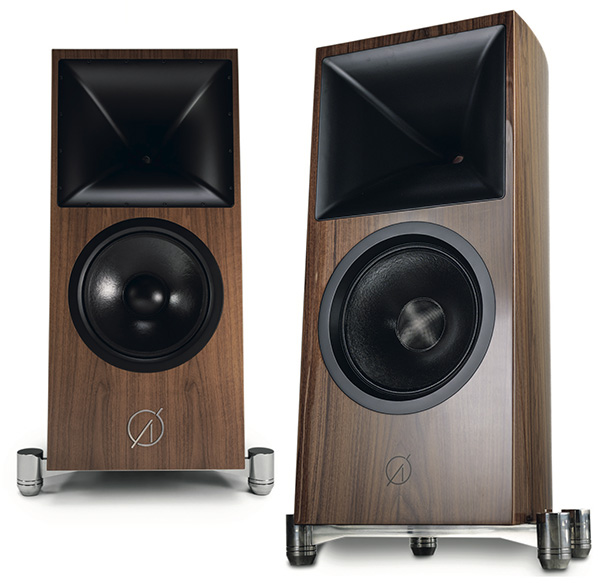
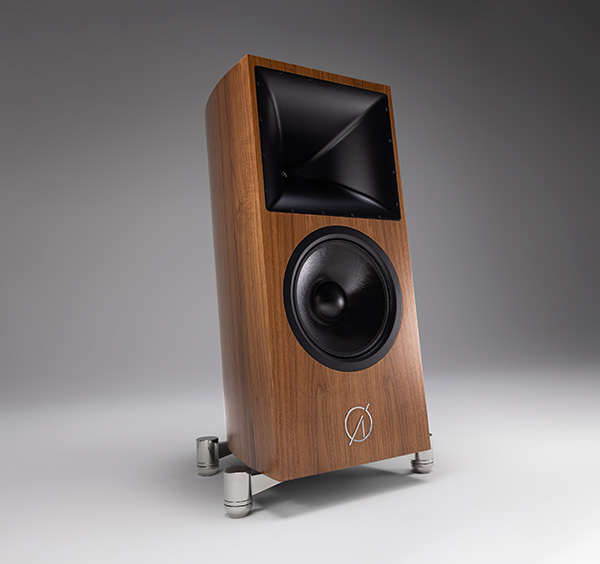
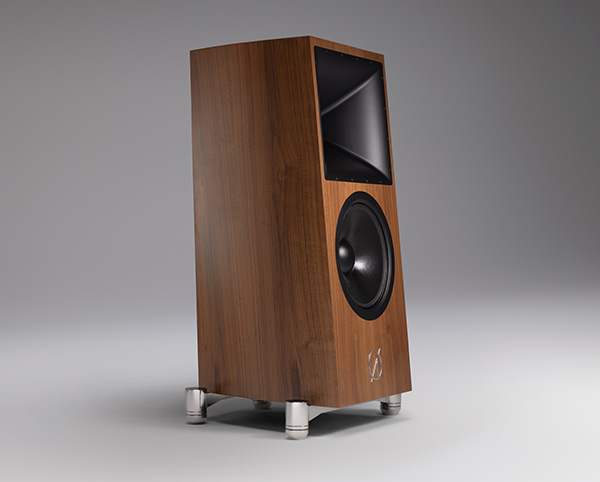
Last year, Ø Audio introduced their biggest speaker yet: the Verdande. These are true two-ways: On bottom is a "15" ultra-linear long stroke extended range woofer." On top is a "Quad Vertex SoundField–Constant Directivity" horn, about which more later. The Verdandes are indeed large: nearly 4' tall, almost 20" wide, and just under 2' deep. They weigh about 220lb each. The cabinets are two-layer MDF with bitumen tar in the middle to dampen resonances. The skin is precisely matched strips of walnut veneer, with several coats of gloss ("piano") finish. They're also available in black. I was happy to get a review pair in attractive wood; my wife said they were the most attractive large speakers we've had in for review.
They were indeed large pieces of eye candy, with handsome grain patterns matched speaker to speaker and where veneer pieces join, in this case where the top meets the sides. Mala said the veneer for "each pair is individually book-matched and assembled so the grain flows continuously across panels, with finishing tolerances intentionally held above typical production loudspeakers." All edges were smooth and slightly beveled. The photos supplied by Mala and Cook don't do the speakers full justice, at least compared to the ones I had in my house: The veneer was a rich chocolate brown—richer than in the photos—and the coating seemed thicker and glossier.
Cook said the cabinets are made by a woodworking company, separate from Ø Audio.
Okay, so they're big handsome devils—what makes them woof and tweet?
 Technical details
Mala said the woofer is "a fully proprietary Ø Audio design," with a "motor system, suspension geometry, and operating parameters developed specifically for the Verdande and manufactured exclusively to our specification. "The cone is a treated lightweight paper composite optimized for stiffness-to-mass ratio and low stored energy"—presumably to minimize "low stored energy." "The surround is a high-compliance long-throw double-roll design. The driver uses our L.M.T. motor topology and D.F.I.T. inductance-control structure to maintain linearity and reduce distortion across excursion." He further explained, "L.M.T. means Linear Motor Technology. This is our proprietary motor design that keeps the force factor (Bl) very flat and linear over the full excursion range of the woofer. It means the driver can move in and out with minimal distortion, even at large displacements, because the magnetic flux and coil interaction remain stable and linear. This helps preserve dynamics and reduces mechanical and electrical distortion (footnote 1).
"D.F.I.T. means Dynamic Fixed Inductance Technology. This is a structure in the motor and coil design that keeps the (magnetic) inductance stable, even when the voice coil moves off center. By controlling inductance variation, we reduce distortion and maintain a clean, stable response across the driver's entire range."
Cook and Mala told me that the woofer-driver inductance is 0.28mH, the magnet is made of neodymium, the suspension material is soft for wide excursion, the former is made of titanium, and the voice coil measures 4". The bass is ported out the bottom via five holes, each about 3" in diameter. In the accessories box with each speaker are foam plugs for all the holes. How many, if any, holes are plugged depends on listener taste and speaker-room interactions.
Regarding the horn, which is 18" wide and 15" high at the front panel, Cook said the compression driver is 3.4" with a carbon fiber cone and is "completely stable to 17kHz. ... It doesn't sound like a typical horn speaker." He explained, "Many manufacturers add a dB or two to make more 'presence' with horns. ... We don't do that. ... If anything, this horn sounds restrained."
"Quad Vertex SoundField" refers to the specific geometry of the horn, which, he said, is "designed to control directivity while suppressing higher-order modes, maintaining stable imaging and consistent tonal balance on- and off-axis."
The crossover network is first-order, at 800Hz, using nine electronic parts total and only two parts in series with the signal (one coil for the woofer, one foil capacitor for the horn), and a L-C-R filter to tailor horn response. Cook said the simplified design results in "stable and high" impedance that doesn't dip below 9 ohms.
Mala and Cook wouldn't say which company makes their drivers, but they did mention that Ø Audio is located about 40 minutes from SEAS (Scandinavian Electro Acoustic Systems) and that they use that company's anechoic chamber. SEAS, however, does not make and sell any off-the-shelf 15" woofers.
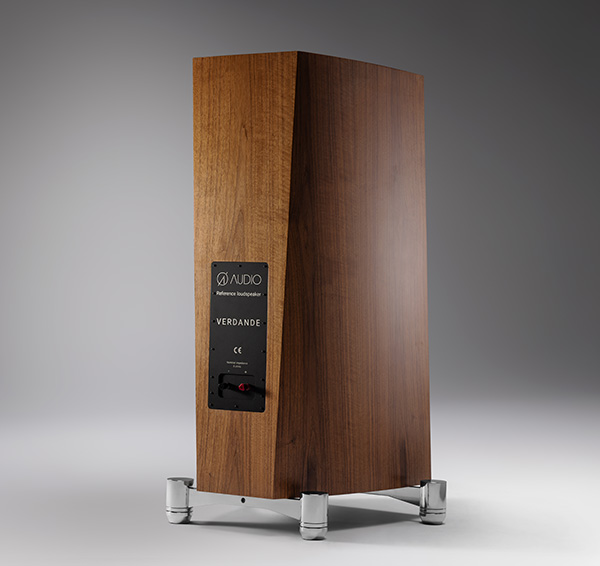
The Verdande cabinets rest on four large, polished steel feet, inside of which a circle of tungsten ball bearings isolates the cabinet from the floor and vice versa. The speakers tilt backward, so the front panel slopes a bit. There is a single pair of multiway binding posts at the rear.
 Visitors from Norway
The Verdandes leave the factory in large flight cases: 53" wide, 31" deep, and 35" high, with heavy-duty castors. The speakers are packed with wheels, which is convenient for setup, although the wheels on the review pair were somewhat flimsy, screwed into the bottoms of the feet. In a perfect world, you'd bring the flight cases into the listening room, stand them up so that the speaker is upright, open the hinged top panel, roll the speakers down a plywood ramp (packed inside the flight case), and roll them into place. Then it's a two-person job (at least) to remove the wheels and attach the bottom cups with the ball bearings via a heavy-duty screw that threads into the same hole as the wheels. This is best done with one strong person holding the speaker tilted forward or backward (depending on which pair of feet are being assembled), and another person on the ground working on the feet (footnote 2). Alas, we do not live in a perfect world. The crates would not fit up the stairs to my living room, so the speakers had to be uncrated in my driveway. The movers who delivered the speakers were not up to the job: The wheels snapped off. The movers needed, but did not bring, a heavy-duty appliance cart, so it was a major struggle for two dudes to herk these things into the living room. But first we had to dismantle the feet outside, on a rather cold day, to remove the nubs of the broken-off wheels.
If you buy or audition a pair of Verdandes, make sure your dealer either has big buff dudes on staff to get them into your listening space or the phone number of a competent piano mover.
The movers got one speaker in place and got the other one halfway up the stairs before things went south. They dropped the second speaker and snapped off the wiring terminals on the back. It is a testament to the Verdande's build quality that more damage wasn't done.
This happened just as Capital Audiofest (CAF) was getting underway. Just a few hours away by car were Cook, Mala, and Alex Brinkman of Harmonia Distribution. Harmonia had extra wiring terminals in their warehouse, which they shipped overnight.
The Tuesday after CAF, Cook, Mala, and Brinkman arrived to fix the speakers and help me get them set up in my listening space for best results. Cook brought a party favor: the same replica Viking ax that dangled from his belt at last season's audio shows (footnote 3). "It is a replica of King Harald Fairhair's Ølukur ax," Cook said. "It is handmade by one of the few remaining families who still work folded steel in the old way. Harald Fairhair ruled from Tønsberg, Norway's oldest town and a core Viking stronghold, ... where I live." He added that the ax was used in "DómrDundrheim" competitions at CAF and AXPONA for things like pounding nails into logs as fast as possible.
While Cook was filling me in on Viking history (and answering questions about the Verdande and Ø Audio), Mala fixed the broken speaker by taking off the rear panel and replacing the wiring terminals. Brinkman sat back and watched the goings-on with an amused look on his face. I probably had a similar look. Soon enough, we were ready to play music.
I ran through a variety of tunes, streaming from my various Qobuz playlists. My Benchmark AHB2 power amp was driving the speakers, fed by my Benchmark LA-4 preamp and dCS Bartók APEX streaming DAC. At first, I placed the speakers near where my reference Bowers & Wilkins 808s like to be: fronts about 40" from the wall behind them, centers about 8' apart, toed in but only slightly. Cook removed all five foam plugs from both speakers, explaining that the woofers needed time to loosen up and there may be a time when I wanted to replace at least some of the plugs.
Things didn't sound right with the Verdandes in the 808s' places. Cook and Mala suggested toeing them in, so the horn throats were in line with my ears. That's more toe-in than I have ever preferred, but with these speakers it worked. As Cook had said, these horns do not blare or scream; in fact they are restrained. Things were improving.
Cook suggested moving the speakers farther apart, out to 9' between woofer centers. We also moved them farther out in the room, about 49" from the center of the front panels to the wall behind. The final adjustment was to move my listening chair closer, to about 9' from the center of the plane between the woofer centers. The toe-in was adjusted a little bit so that the horns were aimed right at my head.
In my listening chair, when I sit up, my head is 42" off the floor. The centers of the horns are 38" above the floor. Cook and Mala played an assortment of classical, choral, and heavy metal music, none of which was familiar to me but all of which sounded impressive at the loud listening levels they preferred. At the end of the afternoon, they declared themselves satisfied.
Footnote 1: For those who aren't speaker builders, force factor is the product of the flux density in the magnetic gap (B) and the length of the voice-coil wire (l). A bigger force factor means more control over the cone. In a big woofer especially, large force factor often translates into that feeling of bass whomping you in the chest.—Jim Austin Footnote 2: Pro tip: A low-profile scissor jack makes it possible to do stuff like this on your own. The best one I know is the Lo-Pro Low Profile Billet Aluminum Scissor Jack, though it isn't easy to find—big online audio retailers, are you listening? I also don't know if it would work with the Verdandes, since you need an appropriately sturdy surface to lift from without doing damage.—Jim Austin Footnote 3: Although, if memory serves, at last year's AXPONA he was forbidden to carry the full-sized ax, so instead he wielded a much smaller hatchet.—Jim Austin
From the progeny of Vikings, a big and bold statementØ Audio (pronounced like ur as in fur) began in 2017 in Asker, Norway, about 12 miles southwest of Oslo. Ø is owned by Sveinung Djukastein Mala and Jonathan Magnus Cook. Mala is the principal designer, and Cook, who has been known to walk around trade shows with a replica Viking battle ax on his hip, is the salesman. The company's website proclaims, "Ø Audio means strong Audio."
Technical detailsMala said the woofer is "a fully proprietary Ø Audio design," with a "motor system, suspension geometry, and operating parameters developed specifically for the Verdande and manufactured exclusively to our specification. "The cone is a treated lightweight paper composite optimized for stiffness-to-mass ratio and low stored energy"—presumably to minimize "low stored energy." "The surround is a high-compliance long-throw double-roll design. The driver uses our L.M.T. motor topology and D.F.I.T. inductance-control structure to maintain linearity and reduce distortion across excursion." He further explained, "L.M.T. means Linear Motor Technology. This is our proprietary motor design that keeps the force factor (Bl) very flat and linear over the full excursion range of the woofer. It means the driver can move in and out with minimal distortion, even at large displacements, because the magnetic flux and coil interaction remain stable and linear. This helps preserve dynamics and reduces mechanical and electrical distortion (footnote 1).
Visitors from NorwayThe Verdandes leave the factory in large flight cases: 53" wide, 31" deep, and 35" high, with heavy-duty castors. The speakers are packed with wheels, which is convenient for setup, although the wheels on the review pair were somewhat flimsy, screwed into the bottoms of the feet. In a perfect world, you'd bring the flight cases into the listening room, stand them up so that the speaker is upright, open the hinged top panel, roll the speakers down a plywood ramp (packed inside the flight case), and roll them into place. Then it's a two-person job (at least) to remove the wheels and attach the bottom cups with the ball bearings via a heavy-duty screw that threads into the same hole as the wheels. This is best done with one strong person holding the speaker tilted forward or backward (depending on which pair of feet are being assembled), and another person on the ground working on the feet (footnote 2). Alas, we do not live in a perfect world. The crates would not fit up the stairs to my living room, so the speakers had to be uncrated in my driveway. The movers who delivered the speakers were not up to the job: The wheels snapped off. The movers needed, but did not bring, a heavy-duty appliance cart, so it was a major struggle for two dudes to herk these things into the living room. But first we had to dismantle the feet outside, on a rather cold day, to remove the nubs of the broken-off wheels.
Footnote 1: For those who aren't speaker builders, force factor is the product of the flux density in the magnetic gap (B) and the length of the voice-coil wire (l). A bigger force factor means more control over the cone. In a big woofer especially, large force factor often translates into that feeling of bass whomping you in the chest.—Jim Austin Footnote 2: Pro tip: A low-profile scissor jack makes it possible to do stuff like this on your own. The best one I know is the Lo-Pro Low Profile Billet Aluminum Scissor Jack, though it isn't easy to find—big online audio retailers, are you listening? I also don't know if it would work with the Verdandes, since you need an appropriately sturdy surface to lift from without doing damage.—Jim Austin Footnote 3: Although, if memory serves, at last year's AXPONA he was forbidden to carry the full-sized ax, so instead he wielded a much smaller hatchet.—Jim Austin