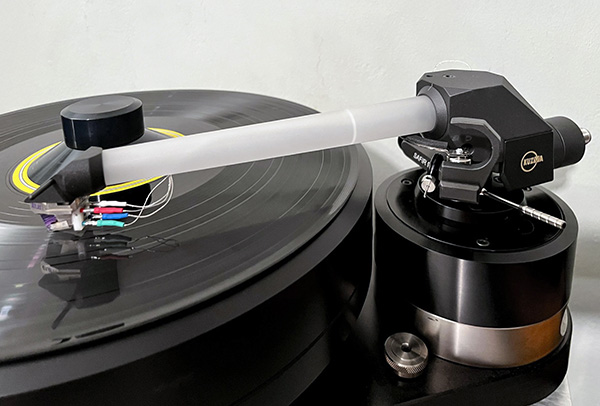
 Franc Kuzma's most recent breakthrough came when he began to experiment with the extreme stiffness and favorable resonant properties of sapphire. Back in the '80s at Sound By Singer, with the original Stogi arm, we would joke that stogi was the Slovenian spelling of stogie, referring to its cigar-shaped armtube. Franc Kuzma, though, says that stogi is the Slovenian word for rigid or stiff (footnote 2), a key principle behind Kuzma's designs and the catalyst for his decision to explore sapphire for the armtube. For the Safir 9, Kuzma uses a single tapered piece of lab-grown sapphire. Its translucent quality gives the arm a truly striking appearance. Apparently, lab-grown sapphire doesn't come cheap: As tested, with Kondo silver wiring and an RCA output cable, the Safir 9 sells for a wallet-busting $23,140. Versions with alternate wiring configurations start at $22,620. Kuzma has come a long way since the $340 Stogi.
Looking at the Safir 9's specification sheet, one number jumps out: its 60gm effective mass. Any arm with an effective mass of over 25gm is considered high mass; the Safir more than doubles that. This can affect the low-frequency resonance of the cartridge you pair with the arm. When you use one of those old-school mass-over-compliance charts to calculate the expected resonant frequency, the results with most cartridges don't look good. It's like putting three tons of lumber in the bed of a half-ton pickup. It may run and drive, but the suspension is going to be under stress.
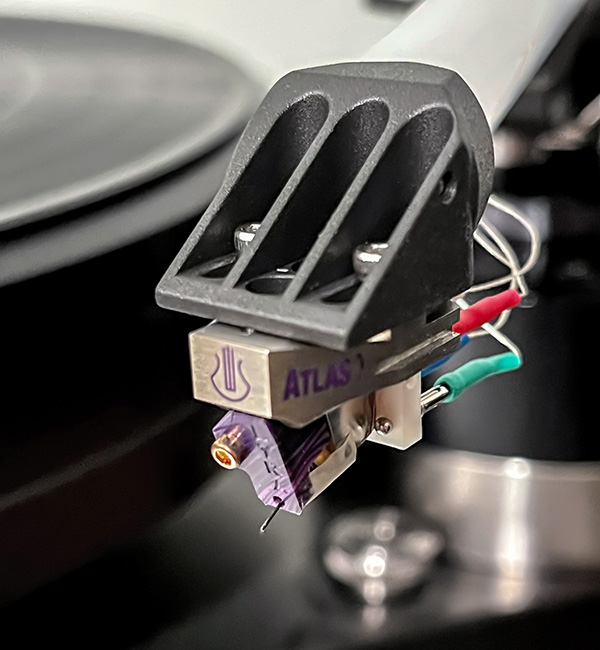
Recently, though, we've learned that the old resonant-frequency tables, though theoretically sound, may be too simple to be accurate in the field; anyway, they're less relevant with today's low-compliance moving coil cartridges. I have started to use the compliance calculator on the Korf Audio website (footnote 3); I used it to get a better picture of how various cartridges would work with 60gm of tonearm hanging over them. Most of my listening was done using a Lyra Atlas λ Lambda cartridge, but I also used my Dynavector XV-1S and my Zu Audio modified Denon DL-103, which is known (or widely believed) to work best in a heavyweight arm. (At less than one-20th the price of the arm, the Zu Denon is admittedly an unlikely pairing.) Mounted on the Safir, none of the three cartridges showed any signs of (di)stress or woofer pumping.
Franc Kuzma's most recent breakthrough came when he began to experiment with the extreme stiffness and favorable resonant properties of sapphire. Back in the '80s at Sound By Singer, with the original Stogi arm, we would joke that stogi was the Slovenian spelling of stogie, referring to its cigar-shaped armtube. Franc Kuzma, though, says that stogi is the Slovenian word for rigid or stiff (footnote 2), a key principle behind Kuzma's designs and the catalyst for his decision to explore sapphire for the armtube. For the Safir 9, Kuzma uses a single tapered piece of lab-grown sapphire. Its translucent quality gives the arm a truly striking appearance. Apparently, lab-grown sapphire doesn't come cheap: As tested, with Kondo silver wiring and an RCA output cable, the Safir 9 sells for a wallet-busting $23,140. Versions with alternate wiring configurations start at $22,620. Kuzma has come a long way since the $340 Stogi.
Looking at the Safir 9's specification sheet, one number jumps out: its 60gm effective mass. Any arm with an effective mass of over 25gm is considered high mass; the Safir more than doubles that. This can affect the low-frequency resonance of the cartridge you pair with the arm. When you use one of those old-school mass-over-compliance charts to calculate the expected resonant frequency, the results with most cartridges don't look good. It's like putting three tons of lumber in the bed of a half-ton pickup. It may run and drive, but the suspension is going to be under stress.
Recently, though, we've learned that the old resonant-frequency tables, though theoretically sound, may be too simple to be accurate in the field; anyway, they're less relevant with today's low-compliance moving coil cartridges. I have started to use the compliance calculator on the Korf Audio website (footnote 3); I used it to get a better picture of how various cartridges would work with 60gm of tonearm hanging over them. Most of my listening was done using a Lyra Atlas λ Lambda cartridge, but I also used my Dynavector XV-1S and my Zu Audio modified Denon DL-103, which is known (or widely believed) to work best in a heavyweight arm. (At less than one-20th the price of the arm, the Zu Denon is admittedly an unlikely pairing.) Mounted on the Safir, none of the three cartridges showed any signs of (di)stress or woofer pumping.
 As Kuzma's most expensive tonearm, you might expect that it would come equipped with all of the nifty luxury features found on most of their higher end models, eg, viscous damping troughs, swappable headshells, and a VTA tower with on-the-fly adjustment. In fact, the Safir takes most of its cues from the stripped-down 4Point 9, which has none of those features. I expect there are two reasons for this. At nearly 3lb, the Safir is already fiendishly heavy; adding those features would likely compromise compatibility with some turntables. Adding a VTA tower would work against the Safir's goal of maximum rigidity. For the same reason, probably, the Safir only comes in a 9" version, although Kuzma showed a prototype of a 12" Safir at High End Munich in May 2024.
Setting up the Safir 9
As Kuzma's most expensive tonearm, you might expect that it would come equipped with all of the nifty luxury features found on most of their higher end models, eg, viscous damping troughs, swappable headshells, and a VTA tower with on-the-fly adjustment. In fact, the Safir takes most of its cues from the stripped-down 4Point 9, which has none of those features. I expect there are two reasons for this. At nearly 3lb, the Safir is already fiendishly heavy; adding those features would likely compromise compatibility with some turntables. Adding a VTA tower would work against the Safir's goal of maximum rigidity. For the same reason, probably, the Safir only comes in a 9" version, although Kuzma showed a prototype of a 12" Safir at High End Munich in May 2024.
Setting up the Safir 9Kuzma has come a long way from those early days of sketchy instruction sheets using weird fonts. Their setup procedures, manuals, and packing materials are now among the best in the industry. Most Kuzma arms, including the Safir 9, mount using what's commonly referred to as the Linn mounting pattern, which has also been used by Jelco, Alphason, and several other brands. The mounting distance is 212mm, which splits the difference between some of the other arms that use the same pattern but at distances ranging from 210mm to 214mm. Kuzma's importer supplied the arm with an armbase designed for use with the SME 30 turntable; I found that the back of the counterweight didn't clear my SME's right rear suspension tower. This armbase should work fine with other Kuzma arms that have a VTA tower, but not with their direct-fitting arms like the 4Point 9 and Safir 9. Switching to plan B, I tried to get an armboard that would fit my Brinkmann La Grange turntable, but because it's a discontinued model, Brinkmann could only supply a blank, undrilled version. Luckily, my handy friend Joshua Walfish, of Hyendaudio Services in New Jersey, came to the rescue: He was able to drill the thick aluminum Brinkmann armboard to accommodate the Kuzma mounting collar.
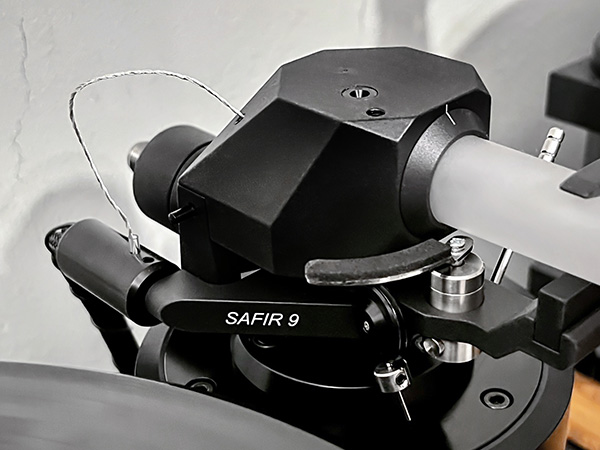 While it may be less convenient to adjust than some other Kuzma arms, the Safir 9 allows you to optimize all parameters with precision. The arm height can be fine-tuned using a stop screw to limit movement, much like with the SME Series V and AMG tonearms. Azimuth adjustment is similar to the 4Point but even more elegantly executed, with a gear that rotates the armtube where it enters the bearing housing, which is made from brass and aluminum. Instead of having to juggle counterweight plates and spacers as on the 4Point, the Safir has a single, split counterweight that covers all cartridge weights; tightening the halves together locks the weight in position.
 Listening
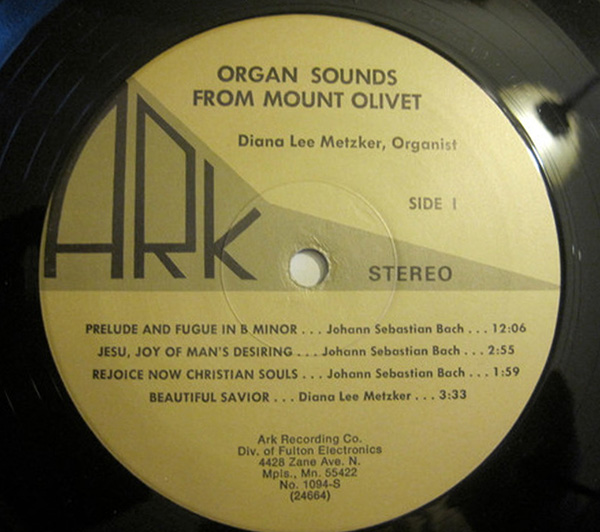
When I was a much younger audiophile, discovering a new component that significantly advanced the performance of my system would send me on a quest, playing familiar records to discover what new revelations I could hear. That doesn't happen as often these days, but the Safir 9 did it, sending me into several late-night listening sessions: I wanted to hear what the arm could extract from some old chestnuts in my collection. One of the first things that struck me was how quiet this arm is, with almost none of that familiar vinyl sound as the stylus hits the record and before the music even begins. Playing Yello's Tied Up (Mercury 872 367-1) kicked off a flurry of spinning, including a bunch of UK 12" 45rpm singles. On "Tied Up in Life," the realism and dynamics of the conga drums was particularly striking, while the synth bass had a twang and color to the sound that I've never heard before with so much vibrancy. To further explore the bass performance of the Safir, I played a favorite reference album for organ recording, Organ Sounds From Mount Olivet by Diana Lee Metzker (Ark 1094-S). This is the kind of record you might flip past in the thrift store dollar bin, but it's worth picking up if you happen to see it. The late Bob Fulton of Fulton Musical Industries is remembered as a brilliant loudspeaker designer, but he was also an exceptional recording engineer who made wonderfully natural-sounding records. The catch is that Bob was also an example of what's known as Holt's Law, a term coined by Stereophile founder J. Gordon Holt when he proclaimed that the better a record sounded, the worse the performance would be, and vice versa. Many of Bob's releases on his Ark Recordings label were of amateur school and church choirs, which hold little interest for most of us, but this organ record is a real gem. On Bach's "Prelude and Fugue in B Minor," the sound immediately opened up to reveal a massive soundstage, allowing you to really feel the size of the church and the volume of air contained within. The bass stops were especially impressive, with a relaxed naturalness that went really deep yet never sounded forced or overcooked.
 The Safir 9 tonearm is a bit like a stripped-down, high-performance race car. It's expensive and uses advanced technology in a package shorn of some luxury features so that it can deliver sonic excellence that leaves more conventional offerings in the dust. The Safir conjures up adjectives like fast, clear, focused, powerful, and dynamic, on a level I have rarely heard. While some care is needed when matching it with cartridges and turntables, in the right context, it's hard to beat; potential competitors, such as the SAT, sell for even more.
With that in mind, following all the armboard mishegas, US importer Elite A/V has agreed to follow up with a Stabi M turntable that I can pair with the Safir, so stay tuned.
Calling a $23k tonearm good value is the sort of thing that gets us audiophiles into trouble, but if you can swing it, it would be hard to say no.
The Safir 9 tonearm is a bit like a stripped-down, high-performance race car. It's expensive and uses advanced technology in a package shorn of some luxury features so that it can deliver sonic excellence that leaves more conventional offerings in the dust. The Safir conjures up adjectives like fast, clear, focused, powerful, and dynamic, on a level I have rarely heard. While some care is needed when matching it with cartridges and turntables, in the right context, it's hard to beat; potential competitors, such as the SAT, sell for even more.
With that in mind, following all the armboard mishegas, US importer Elite A/V has agreed to follow up with a Stabi M turntable that I can pair with the Safir, so stay tuned.
Calling a $23k tonearm good value is the sort of thing that gets us audiophiles into trouble, but if you can swing it, it would be hard to say no.
Footnote 2: Franc Kuzma should know. However, when I consulted several online translators and Slovenian-English dictionaries, the results I got were, alternately, "stacks" or "roof." Footnote 3: See korfaudio.com/calculator. Footnote 4: At $28.39 on Amazon (see amzn.to/3B9tdnG), the patented Riverstone Audio Record Level VTF Pressure Gauge, which comes in two colors, is one of hi-fi's great bargains, but beware of even cheaper knockoffs.—Jim Austin