Honest Jons'
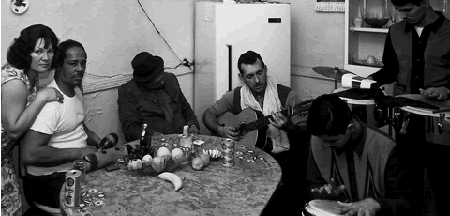
Son Cubano NYC is a compilation of very hot tracks released by mostly obscure artists during one wonderful decade of music, 1972-1982. It is an outstanding collection, and I hope you'll seek it out. The liner notes alone are worth the price of admission. Before going into harder language and larger claims, the notes begin with quiet strength: "Salsa is the sound of Cuba in exile."
I had no idea there was such a rift between advocates of salsa and others who simply wanted to preserve the traditional sounds of Cuba. Why should a rift even exist? It's not an easy question to answer. To some, "salsa" was little more than a marketing strategy, one that would allow the popular Fania record label to reach audiences worldwide. Fania's sound—large, sexy, rebellious, and often brash—perhaps lacked some discipline, missed some sense of history. It was the fiery, new sound of New York City's Latino community mixing with American jazz, soul, and rock and roll. It spread quickly and burned bright.
In light of salsa's rise, a second movement formed, one interested in going back to basics. It abandoned the superficial influences of US culture and sought to embrace its Latino roots. Honest Jons makes the case that during these Cold War years, Cuban musicians were accused of "communist salsa" and suppressed by the major US radio stations. Nevertheless, NYC record labels like SAR and Salsoul continued to support these neglected musicians, building an impressive roster of enormous talent. And thank goodness they did.
Through Honest Jons' loving presentation of these wonderful musicians, my eyes and mind have been opened to an entire world of absolutely gorgeous, soulful sounds. I'm excited to share them with you. Armando "Chocolate" Armenteros, Roberto Torres, and Lita Branda are lovely highlights. The tracks by Fernando Lavoy y Los Soneros and Angelo y Su Conjunto Modelo are marvelous surprises. But what really caught my heart was the plaintive, urgent, yearning sound of
Henry Fiol's restoration of Cheo Marquetti's "Oriente." The song delights me, troubles me. I say without doubt that I've never been moved this way. It's stifling. Time-stopping. Indeed, Fiol's "Oriente" is a wash of sadness and beauty, ten fleeting minutes of churning, swaying, and pleading; tres locked in dance with guiro, delicate piano backed by heartrending trumpet lines, and, above all, that mysterious, otherworldly croon: "Yo me voy a morir / Caramba, me voy a matar." It's magic. I could cry.
I don't want to leave the impression, however, that "Oriente" is morose. It's not. There is hope, pride, strength in its many movements. It ends where it begins, with a wave and a graceful turn. It,
this song, feels so true to me, I'm nearly afraid no one else will understand. The thought is painful. It's difficult to imagine another person being lifted, moved,
possessed by this song in the same way.
Henry Fiol's "Oriente" is a treasure. I thank Honest Jons'
Son Cubano NYC for presenting it. I have since gone on to find Fiol's
Fe, Esperanza y Caridad (SAR SCD-1012, released 1980), on which "Oriente" originally appeared. I was not disappointed. The entire album is superb. I hope you'll decide to find it and listen. And I hope you'll be similarly impressed.