Sidebar 3: Measurements
I measured the Rogue Audio Sphinx using my top-of-the-line Audio Precision SYS2722 system (see www.ap.com, and the January 2008 "As We See It"). Before performing any measurements, I ran the Sphinx for an hour at one-third its specified maximum power of 100Wpc into 8 ohms. Thermally, this is the worst case for an amplifier with a class-B or -AB output stage, but it's irrelevant with an efficient class-D amplifier like the Rogue, which uses the well-regarded Hypex modules. By the end of that period the Sphinx's chassis was only mildly warm, but at least I could be confident that the circuits were all nicely toasted for testing.
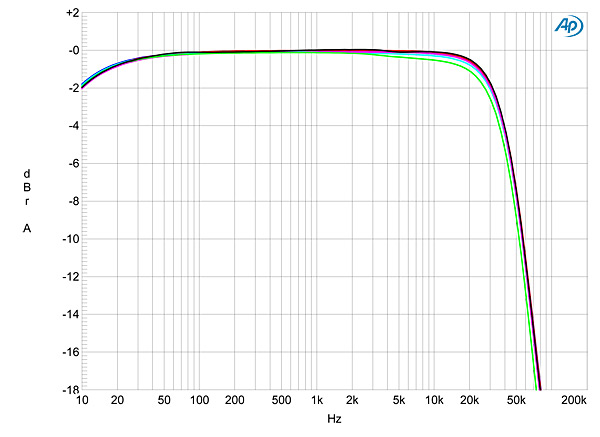
Looking first at the line inputs, the maximum gain into 8 ohms was 31.16dB, with excellent matching of the two channels. The Sphinx preserved absolute polarity (ie, was non-inverting), and its input impedance was usefully high, at well above 100k ohms at almost all audio frequencies, and still 103k ohms at 20kHz. The output impedance was very low for a class-D design, at around 0.02 ohm at 20Hz and 1kHz (including 6' of speaker cable), rising slightly to 0.11 ohm at 20kHz. As a result, the variation in frequency response with the Sphinx driving our standard simulated loudspeaker (fig.1, gray trace) was negligible. Unusually for a class-D design, the Rogue's ultrasonic rolloff was identical into loads ranging from 2 to 8 ohms. There is usually a passive low-pass filter between the class-D output stage and the speaker terminals to reduce the level of ultrasonic switching noise, and this filter will misbehave into loads other than the one it was optimized for. The Sphinx offered no such misbehavior.
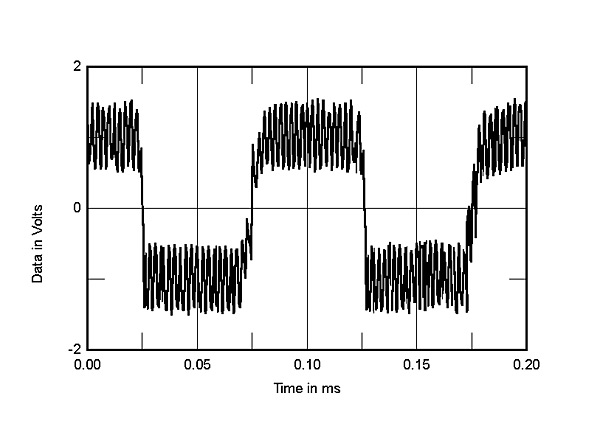
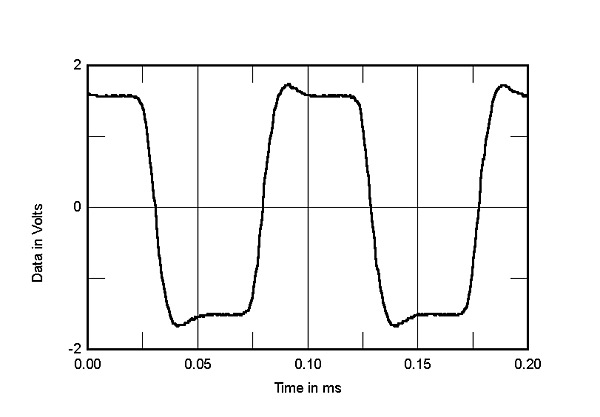
 Present in the Rogue's output, however, was around 225mV of ultrasonic noise with a center frequency of 415.5kHz in the left channel and 418.5kHz in the right. This can be graphically seen in the waveform of a 10kHz squarewave (fig.2). For all the measurements other than this one, I used a precision passive low-pass filter from Audio Precision to eliminate noise above 200kHz that would otherwise contaminate the analyzer's reading. Repeating the squarewave measurement with this filter gave the waveform shown in fig.3—the risetimes are slowed by the amount you would expect from the response in fig.1, and though there is a small degree of overshoot on the waveform's leading edges, this is critically damped, with no ringing.
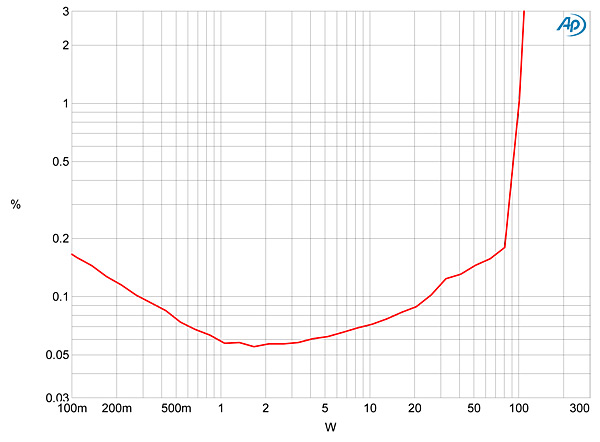
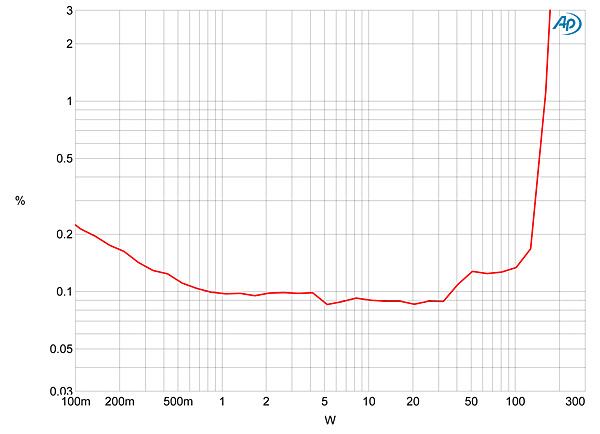
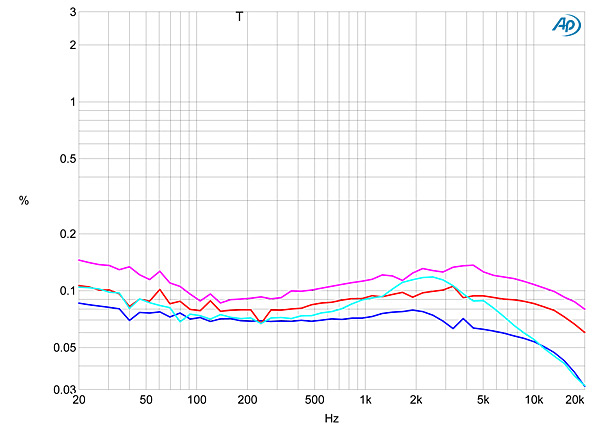
 The Sphinx precisely met its specification of maximum power into 8 ohms: 100Wpc, or 20dBW at 1% THD+noise (fig.5), with very low distortion between 1 and 20W. Into 4 ohms, the amplifier clipped at 155Wpc or 18.9dBW (fig.6), but with a little higher distortion at lower powers. Plotting the THD+N percentage at 8.7V into 8 and 4 ohms (fig.7), a voltage where I could be sure I was looking at actual distortion rather than noise, indicated that the left channel (blue and cyan traces) was a little more linear than the right (red, magenta). Neither channel changed its behavior with frequency, other than above 10kHz, where I assume the limited ultrasonic bandwidth is affecting the result.
 The RIAA correction was superbly accurate for what must be a relatively inexpensive circuit, with very little error and the two channels matching to within 0.1dB (fig.11). The bass rolls off early, conforming to the IEC modification of the RIAA specification and reaching –3dB at 11Hz. Channel separation via the phono input was excellent, at 80dB in both directions at 1kHz. The phono input's noise performance was also excellent, with unweighted audioband signal/noise ratios (ref. 1kHz at 5mV input signal) of 77.3dB left and 79.8dB right. The ratios improved by 6dB when A-weighted.
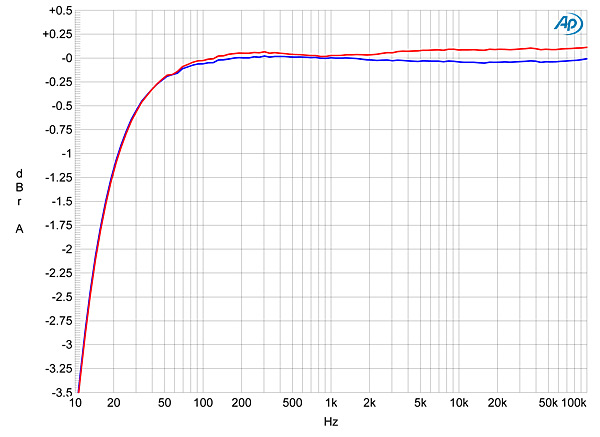
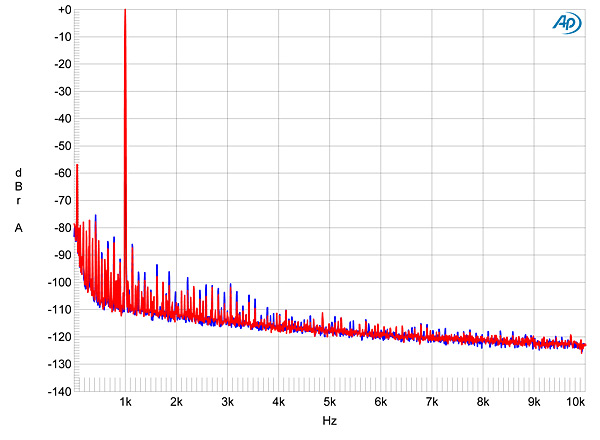
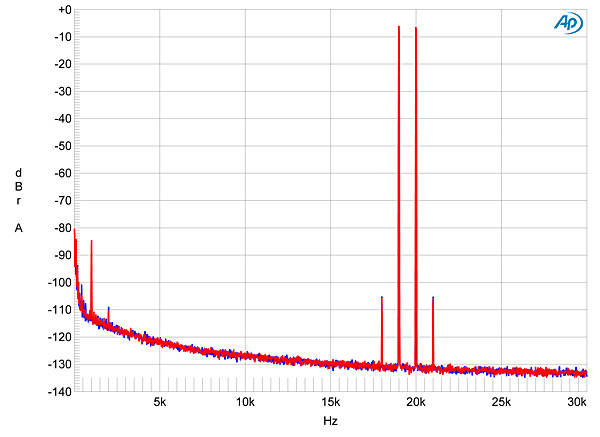
Fig.1 Rogue Sphinx, volume control set to maximum, frequency response at 2.83V into: simulated loudspeaker load (gray), 8 ohms (left channel blue, right red), 4 ohms (left cyan, right magenta), 2 ohms (green) (2dB/vertical div.).
Fig.2 Rogue Sphinx, small-signal 10kHz squarewave into 8 ohms.
Fig.3 Rogue Sphinx, small-signal 10kHz squarewave into 8 ohms with Audio Precision low-pass filter.
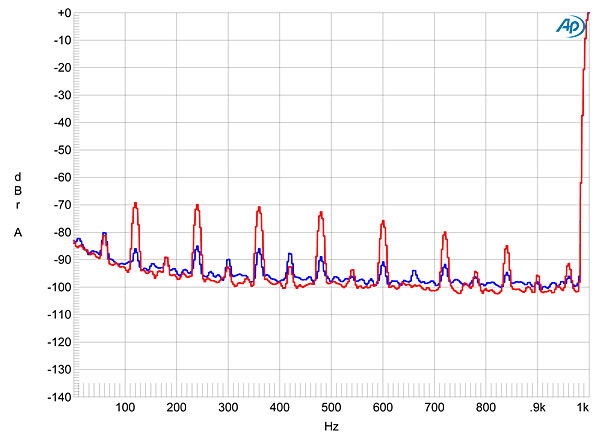
Channel separation (not shown) was good rather than great, at 60dB in both directions below 1kHz, and around 40dB at the top of the audioband. The unweighted signal/noise ratio in the audioband, taken with the input shorted but the volume control at its maximum, was moderately good, at 67.2dB left and 63.3dB right. This was primarily due to full-wave–rectified, supply-related spuriae, which were a little higher in the right channel (fig.4). I experimented with the grounding between the amplifier and the analyzer; this was the spectrum I took with the optimal arrangement.
Fig.4 Rogue Sphinx, spectrum of 1kHz sinewave, DC–1kHz, at 1W into 8 ohms with Audio Precision low-pass filter (linear frequency scale).
Fig.5 Rogue Sphinx, distortion (%) vs 1kHz continuous output power into 8 ohms with Audio Precision low-pass filter.
Fig.6 Rogue Sphinx, distortion (%) vs 1kHz continuous output power into 4 ohms with Audio Precision low-pass filter.
Fig.7 Rogue Sphinx, THD+N (%) vs frequency with Audio Precision low-pass filter at 8.9V into: 8 ohms (left channel blue, right red), 4 ohms (left cyan, right magenta).
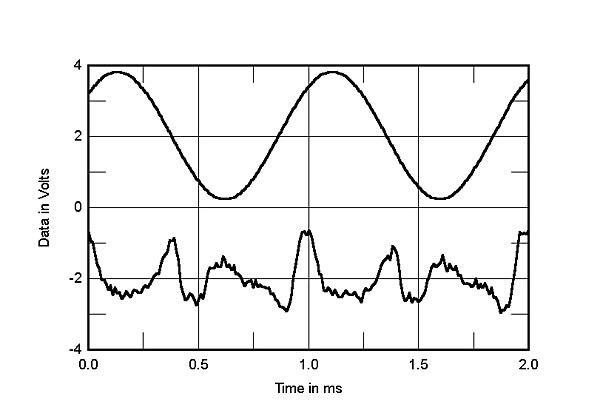
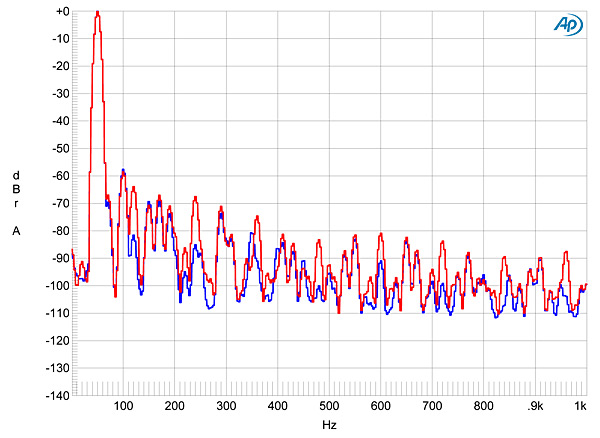
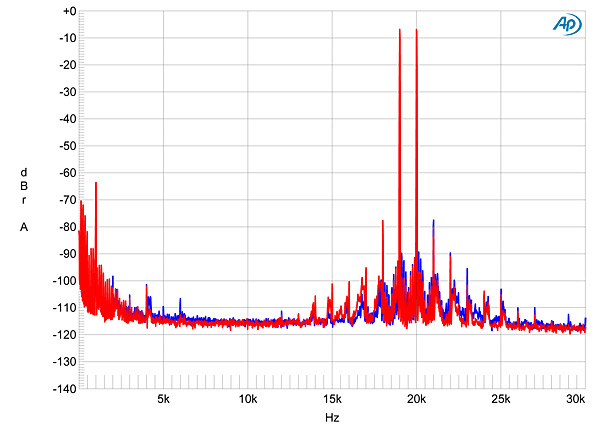
The distortion result is heavily second-harmonic in nature, though there must be higher-order products present into lower impedances, giving rise to low-level peaks that are slightly displaced in time from the waveform's zero crossings (fig.8). This can also be seen in fig.9, which shows the spectrum of the Sphinx's output with a 50Hz tone driven at 40% power into 4 ohms. However, intermodulation distortion with an equal mix of 19 and 20kHz tones at the same power into 4 ohms is respectably low (fig.10). The second-order product at 1kHz lies at –64dB (0.06%).
Fig.8 Rogue Sphinx, 1kHz waveform at 1W into 8 ohms with Audio Precision low-pass filter, 0.058% THD+N (top); distortion and noise waveform with fundamental notched out (bottom, not to scale).
Fig.9 Rogue Sphinx, spectrum of 50Hz sinewave with Audio Precision low-pass filter, DC–1kHz, at 60W into 4 ohms (linear frequency scale).
Fig.10 Rogue Sphinx, HF intermodulation spectrum with Audio Precision low-pass filter, DC–30kHz, 19+20kHz at 60W peak into 4 ohms (linear frequency scale).
I measured the phono input at the fixed-output jacks with the volume control set to its minimum so that I could keep the output stage quiescent. These outputs operate at unity gain for line-level inputs; for the phono input I measured a voltage gain of 37.7dB, which is appropriate for moving-magnet cartridges and high-output moving-coils. The input preserved absolute polarity, and the input impedance was 41k ohms at 20Hz and 20kHz, rising slightly to 46k ohms at 1kHz. Again, these figures are appropriate for MMs and high-output MCs.
Fig.11 Rogue Sphinx, phono input, response with RIAA correction (left channel blue, right red) (0.25dB/vertical div.).
With its relatively low gain, the Sphinx's phono input offered superb overload margins, ranging from 30.6dB at 20Hz to 28.7dB at 1kHz, and still 21.7dB at 20kHz. Distortion at typical recorded levels was very low, at 0.005% at all frequencies, and all that can be seen in the spectrum of a 1kHz signal at 5mV input are some low-level, supply-related spuriae (fig.12). Intermodulation distortion via the phono input (fig.13) was also superbly low, the 1kHz difference component lying at –86dB (0.005%).
Fig.12 Rogue Sphinx, phono input, spectrum of 1kHz sinewave, DC–10kHz, at 384mV (5mV input) into 100k ohms (linear frequency scale).
Fig.13 Rogue Sphinx, phono input, HF intermodulation spectrum, DC–24kHz, 19+20kHz at 2V peak into 100k ohms (linear frequency scale; left channel blue, right red).
Even without taking into account its affordable price, Rogue Audio's Sphinx offers excellent measured performance with little sign of the usual compromises made in class-D designs. It also has an excellent, moving-magnet–compatible phono stage.—John Atkinson