Brian Damkroger
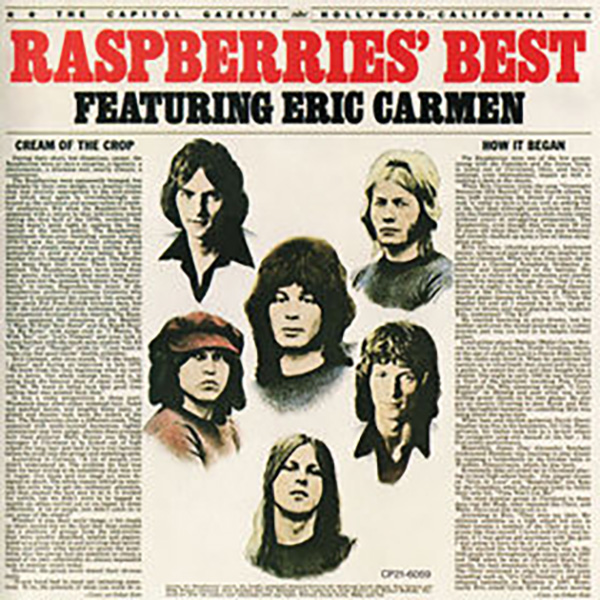 Raspberries: Raspberries' Best
Capitol Records ST-11524 (LP). 1976. Jimmy Lenner, prod.; Shelly Yakus, eng. Okay, picking a greatest hits compilation is cheating. But here's the thing. I'm convinced that Best is and always was a single album. Raspberries, Fresh, Side 3, and Starting Over weren't albums, you see, but products of an insidious conspiracy. Think about it. These four were like any 1970–'80s power pop albums, a couple of great cuts surrounded by filler. Here's where it gets interesting, though. Power pop albums were unfailingly one and done, but as if by magic, the Raspberries somehow managed to crank out four in just over a year. How? C'mon, isn't it obvious? Their first album was so strong that the greedy record company suits demanded it be split into four. Best just reassembles the pieces into the best power pop album ever recorded.
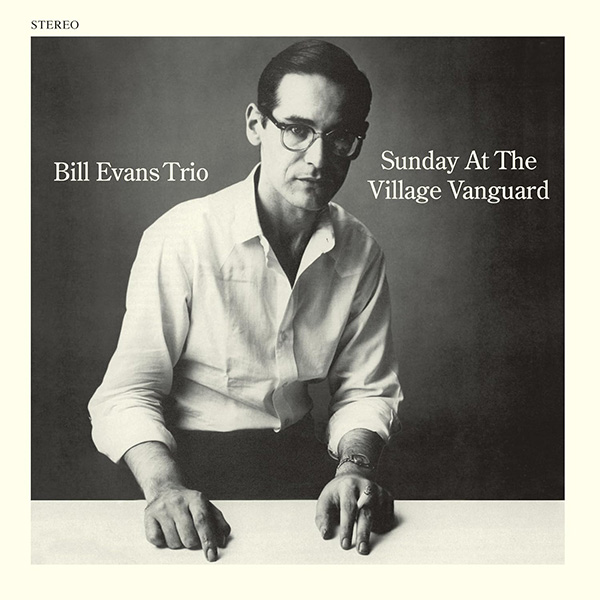 Bill Evans Trio: Sunday At The Village Vanguard
Bill Evans, piano; Scott LaFaro, bass; Joe Hunt, drums
Riverside Records RLP-9376 (LP). 1961. Orrin Keepnews, prod.; Dave Jones, eng. An audiophile friend and I were working our way through Bill Evans's Complete Riverside Recordings box one afternoon and at one point he said, "Sometimes I don't know if he's being really subtle or just not doing much." I don't remember which LP or cut was playing at the time but I'm pretty sure that it wasn't something from the Village Vanguard. Evans's playing on this album is achingly subtle at times, but there's no doubt he's doing something—doing quite a lot, actually, across a range of expression that truly boggles the mind. There's a reason that this album is atop just about every list of best jazz recordings in existence.
Tom Fine
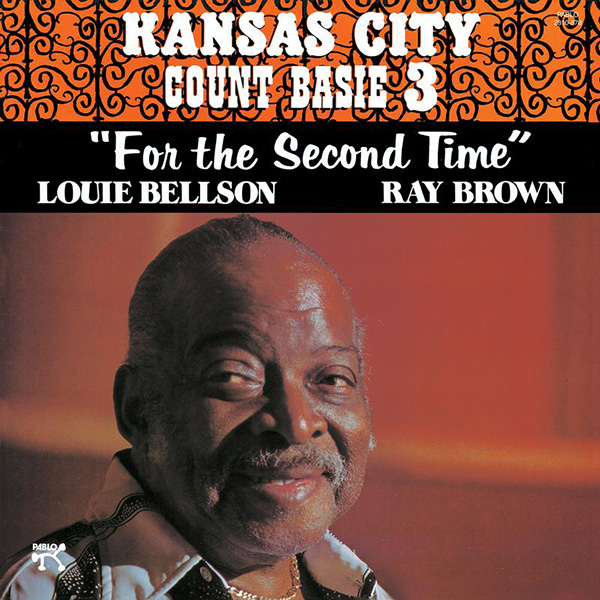 Count Basie, Ray Brown, Louis Bellson: Kansas City 3—For The Second Time (2024 Reissue)
Analogue Productions AJP 166 (LP). 1983/2024. Norman Granz, prod. Jazz stripped to its essentials and played by three departed masters, swinging from the first second to the last. Recorded at Cherokee Studios in Los Angeles, in a single August 25, 1975, session, the music leans toward blues, with room for everyone to stretch out even as they tightly intertwine their sounds. The beat is the super glue bonding everything tightly and at the same time maintaining a constant forward propulsion. The original Pablo platter was mono. For this super-sounding reissue, mastering engineer Matthew Lutthans mixed live to stereo from the first-generation four-track session tapes as he cut the lacquers. The result is a feeling of being in the room with these musical giants, a beautiful time capsule.
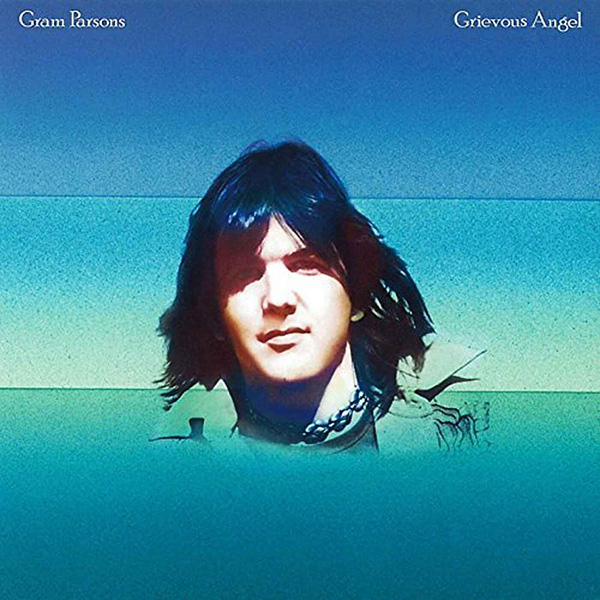 Gram Parsons With Emmylou Harris: Grievous Angel (2024 Reissue)
Rhino RHF1 2171 (LP). 1974/2024. Gram Parsons, prod.; Kevin Gray, remastering.
Larry Greenhill
 Mussorgsky: Pictures At An Exhibition
Sviatoslav Richter, piano
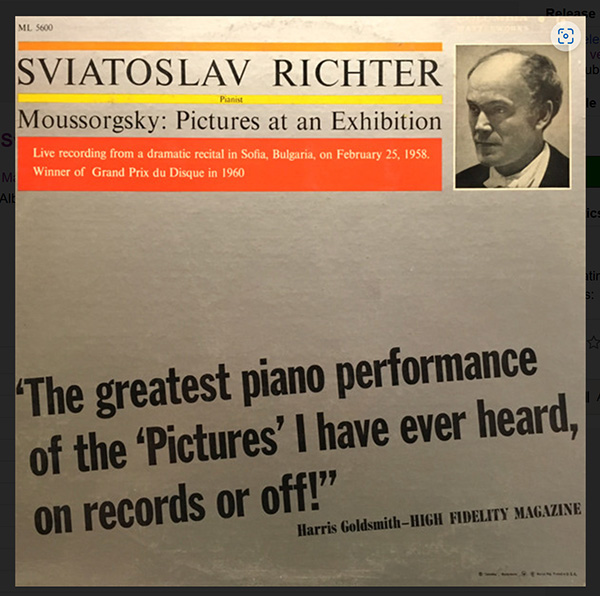
Columbia Masterworks ML-5600; Library of Congress R60-1349. 1961. Recorded live at a recital in Sofia, Bulgaria, on February 24, 1958, Winner of Grand Prix du Disque in 1960. I have orchestral and organ transcriptions of Mussorgsky's Pictures at an Exhibition, but this mono LP of a live piano concert is my favorite. Its wide dynamic range, technical mastery, extremely clean and clear piano chords, feeling, and tonal color are extraordinary. Richter displays dazzling technical skill, enabling him to play sections with blinding speed, each note distinct from the other. The tempo of The Marketplace at Limoges increases exponentially until it stops with the first chord of the next section, The Catacombs. Richter's playing creates a dazzling sparkle of notes in Les Tuileries and in the Ballet of the Unhatched Chicks that is astounding in speed and lightness of touch. I agree with the Gramophone review's summary that "No one with any interest in piano ... can afford to be without this shattering disc."
 A Chorus Line
(Original Cast Recording)
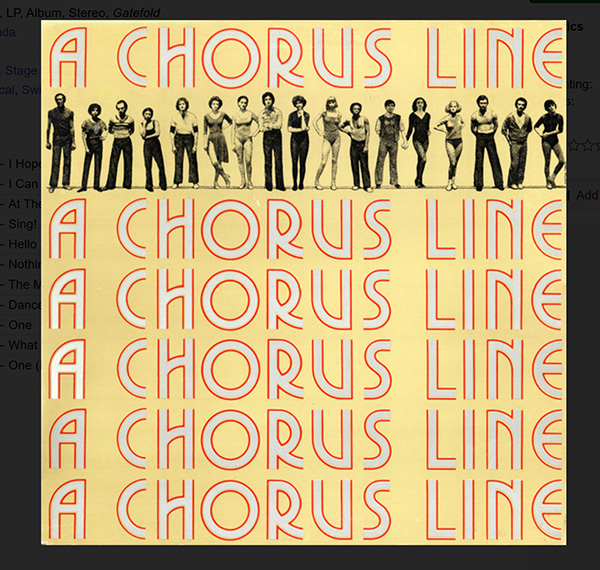
Columbia Masterworks JS 33581 (LP, Pittman pressing). Michael Bennett, choreography; Marvin Hamlisch, music; Edward Kleban, lyrics; Frank Laico, recording eng.; John Guerriere, editing eng. Recorded in 1975 at Columbia Studio, 207 East 30th Street, June 2, 1975. I never tire of listening to A Chorus Line, a musical that follows a group of dancers facing elimination auditions before a Broadway show opens. The show captivates with its energy, witty lyrics, incredible songs, talented vocalists, and rich, layered soundstage. In "At the Ballet," multiple soloists sing from different points in the soundfield as they step forward from the chorus line—sometimes alone, sometimes in harmony—with the orchestra's driving rhythm underpinning it all. My favorite selection is "One," which builds a complex, multilayered choral texture. Some singers deliver a sarcastic tribute to the star's dancing abilities, while others repeat the precise dance instructions each dancer must memorize and internalize. This piece is followed by Priscilla Lopez's beautiful solo with chorus, "What I Did for Love," a bittersweet tribute to the inspiration that drives dancers until injury or age inevitably forces them to stop. This record is a treasure, filled with sadness, ambition, and hope.