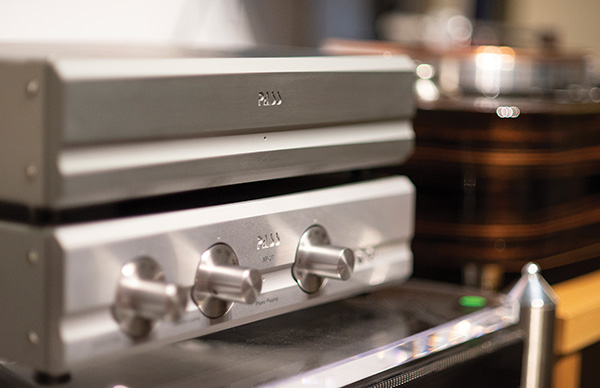
 Setup
SetupApart from cartridge setup—details of which go beyond the scope of this review—preparation was straightforward. I simply inserted the XP-27 in my reference system, keeping everything else the same. Like many manufacturers of multichassis components, Pass Labs prefer that the chassis not be stacked, lest noise from the power supply get picked up by the signal chassis. "The transformers are shielded and very quiet," Pass's Desmond Harrington told me in an email, "but there is a lot of gain in the XP-27, so best to keep the transformers away." I didn't stack them, mainly because the fixed shelves on my Butcherblock Acoustics rack are about a millimeter too narrow for two layers of Pass Labs components. Periodically throughout the review, I switched in different amplifiers and line-level preamps, from among spares or in house for a review, altering the sound subtly and providing a different perspective. I used three phono cartridges, all high-performance moving coils with low-voltage output: the Ortofon Windfeld Ti (0.3mV; the Windfeld was mounted with custom shims from WallyTools), the Ortofon Verismo (0.2mV), and the Lyra Etna λ Lambda (not the SL version; 0.56mV), all installed on the SME Series V tonearm that comes with the SME 30/12 turntable. At one point, I subbed in the Sutherland Big Loco phono stage for contrast. Incidentally, my longtime reference system is populated with other Pass Labs components: the XP-32 preamplifier and the XA60.8 monoblocks. I also used the CH Precision L1 preamplifier and amplifiers from CH Precision (the M1.1) and Burmester (the 216). Loudspeakers were the Wilson Audio Specialties Alexx V.
How quiet is the XP-27? With no music playing, I set the XP-27 to its highest gain setting (76dB) and turned the preamp volume up and up. I heard no noise—not a hint, even with my ear to the various speaker drivers—until the volume was about 20dB above my typical listening level. At that point, the volume display on the CH Precision L1 preamp (which was in the system at the time) was well into the orange, almost to red. This is a quiet phono preamp. Over years, I've gradually set aside my previous procedure of auditioning components solely with familiar music. I do always listen with familiar music, even if I don't always write about it. But including new music makes reviews more interesting, for me and for readers, and I find that including unfamiliar music alongside familiar tracks adds a different and useful perspective (footnote 4). In sonic character, the XP-27 is liquid and detailed—and of course very quiet. It is mostly literal, but there may be a hint of added warmth. Bass is deep and solid but not exaggerated. The soundstage is true, reflecting, as far as I can tell, the information present on an LP.
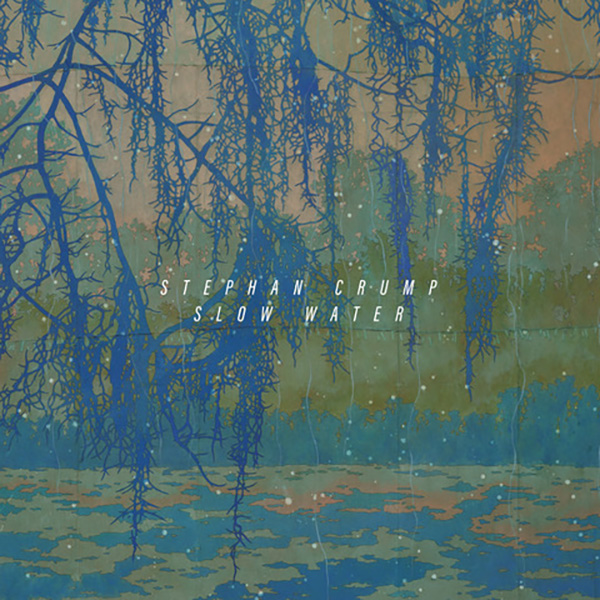 An example—not an old friend but a new one, a record I've come to know fairly well with repeated listening since its release just last May—is bassist Stephan Crump's Slow Water, reviewed in CD form by Tom Conrad in the June Stereophile. Slow Water (Papillon Sounds PS 28241) is fascinating in its conception. In composing it and playing it, Crump, who was born in Memphis, so on the Mississippi River, and has spent his life near water—most recently, for the last 30 years, Brooklyn's infamous Gowanus Canal, still one of the most polluted bodies of water in America—sought to inhabit water, to put himself in its place, to emulate it. I suppose you could consider this the record an environmental statement, but it's hardly doctrinaire and its conclusions are hardly clear-cut. If there's a take-home message, it's something like, Whether in spite of what we do or because of it, water will, due to its power and persistence, eventually kick our collective ass.
Today, I found myself especially enjoying "Strata," the minimalist final track on side 1 of this two-LP set, in which several, mostly lower-register instruments—bass, trombone, viola, others—generate drones that vary greatly in timbre. I was struck by how these drones mapped out the recording venue and how the timbres and textures of the varied instruments contrasted (and complemented) each other. Reverb tails seemed natural. These factors, indeed, are the chief pleasure of the track. Every track on this album offers different pleasures, some more than others of course.
An example—not an old friend but a new one, a record I've come to know fairly well with repeated listening since its release just last May—is bassist Stephan Crump's Slow Water, reviewed in CD form by Tom Conrad in the June Stereophile. Slow Water (Papillon Sounds PS 28241) is fascinating in its conception. In composing it and playing it, Crump, who was born in Memphis, so on the Mississippi River, and has spent his life near water—most recently, for the last 30 years, Brooklyn's infamous Gowanus Canal, still one of the most polluted bodies of water in America—sought to inhabit water, to put himself in its place, to emulate it. I suppose you could consider this the record an environmental statement, but it's hardly doctrinaire and its conclusions are hardly clear-cut. If there's a take-home message, it's something like, Whether in spite of what we do or because of it, water will, due to its power and persistence, eventually kick our collective ass.
Today, I found myself especially enjoying "Strata," the minimalist final track on side 1 of this two-LP set, in which several, mostly lower-register instruments—bass, trombone, viola, others—generate drones that vary greatly in timbre. I was struck by how these drones mapped out the recording venue and how the timbres and textures of the varied instruments contrasted (and complemented) each other. Reverb tails seemed natural. These factors, indeed, are the chief pleasure of the track. Every track on this album offers different pleasures, some more than others of course.
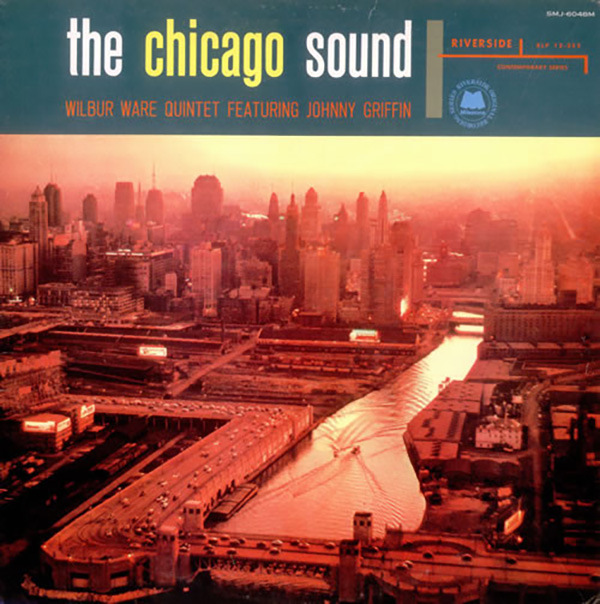 Next up, an old friend: a mono Milestone reissue of Riverside RLP 12-252, The Chicago Sound, by the Wilber Ware Quintet with Johnny Griffin (Milestone SMJ-6048M). This record puts whoever's soloing upfront and (of course) center, whether it's Griffin's tenor sax, Junior Mance's piano, Ware's bass, or any of the other musicians when they solo. This is a decent—not great—mono recording. Via the Lyra cartridge and the XP-27, those solo instruments were portrayed with distinctive tone and touch—specific musicians were easy to recognize—and it was all very pleasant to listen to. This is a bassist's record, and I especially enjoyed the relatively dry, forward sound of Ware's bass. I heard good front-to-back separation between the solo instruments and the instruments playing behind, including drums (except during drum solos; this was either Frank Dunlop or Wilbur Campbell, depending on the track). The amount of the separation varied from track to track, convincing me further that the XP-27 was delivering what's on the record. Relatively fine differences in production were laid bare.
 Because in describing the XP-27's development I took a historical approach, I'll end with a historical review: Michael Fremer's of the Pass Labs Aleph Ono, from early 1999. Mikey was lukewarm in his conclusions, commenting on the pre's "somewhat deficient and perhaps mushy lower midbass, which gives the Ono an overall lean sound." Mikey knows his phono preamps, and the Aleph Ono was an early design, radical for its time, so I don't doubt his conclusions about that Pass Labs phono pre, but in one of the longest-lasting auditions I've experienced, I heard no hint of leanness or midbass mushiness from the XP-27.
Conclusion
Because in describing the XP-27's development I took a historical approach, I'll end with a historical review: Michael Fremer's of the Pass Labs Aleph Ono, from early 1999. Mikey was lukewarm in his conclusions, commenting on the pre's "somewhat deficient and perhaps mushy lower midbass, which gives the Ono an overall lean sound." Mikey knows his phono preamps, and the Aleph Ono was an early design, radical for its time, so I don't doubt his conclusions about that Pass Labs phono pre, but in one of the longest-lasting auditions I've experienced, I heard no hint of leanness or midbass mushiness from the XP-27.
ConclusionThe Pass Laboratories XP-27 is a high-achieving component both technically and musically; if, along with the reference system I auditioned it with, it's leaving any music behind in the grooves, I couldn't detect it. With the XP-27 in the system, specific musicians were easy to identify, and the character of each of the three phono cartridges I used was instantly recognizable.
Footnote 3: In its excellent user guide, the Lyra Etna λ Lambda includes extensive guidance on setting loading, including the admonition, "finalize by listening." Footnote 4: For a more detailed justification of this new approach, see stereophile.com/content/thats-just-how-record-sounds.