I asked Wayne if there had been changes to the power supply: "The new design uses two double-shielded, low-noise toroids in a true dual-mono topology for the gain channels and another transformer and linear power supply dedicated to the control architecture. We changed from the single Plitron [transformer] to the new Avel Lindbergs. ... The use of three fully independent power supplies in the control chassis results in dramatically lower radiated noise and far better THD+noise figures in the gain stages. Power supply regulation in the unit is a bit more complex, with regulators feeding the references. There is one extra stage of RC filtering before the capacitance multipliers. The onboard regulators don't need to reduce ripple; they just fix the voltage. The DC power cable is also improved over the older computer type. I liked the older ones, but they no longer meet current agency approvals."
Listening
After installing the XP-32, I used it for casual listening, internet radio stations and the like streamed with Roon, for a week, before I started serious listening with familiar music.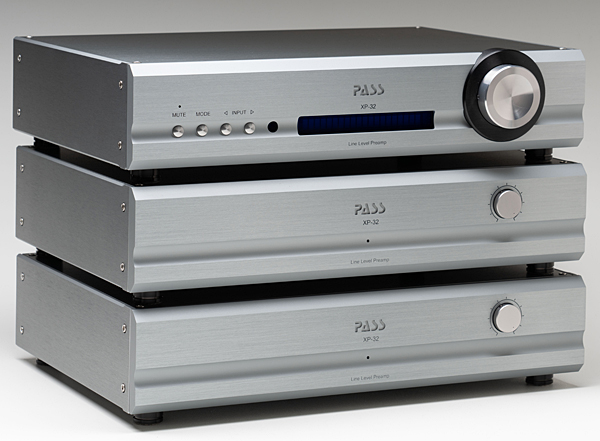 I started with Bravo!, the final recording I made at the Santa Fe Chamber Music Festival in 1998 (16/44.1 ALAC files, Stereophile STPH014-2). As I described in the CD booklet, I had had to close-mike all the instruments due to the fact that I wasn't allowed to turn off the new and noisy climate-control system in Santa Fe's Museum of Fine Arts. I had also recorded the performances with a pair of distant mikes and used those as my reference when I later synthesized the concert hall acoustic with a Lexicon digital reverberation unit and added that to the mix.
Listening to the first work on the album, Mozart's Piano Quartet No.1 in G Minor with Pinchas Zukerman playing the violin part, the XP-32 allowed every detail to be clearly presented. Very clearly, because, as the work progressed, I became increasingly aware of something I had never noticed before, even with the DAC feeding the power amplifiers directly: the piano, which had been behind the violin, viola, and cello on the stage, was positioned in front of them in the recorded soundstage.
Musically, this wasn't too odd, as the work could be considered a mini concerto for the piano. After some reflection, I realized what was happening: While I had placed the pair of microphones on the piano relatively close to the soundboard, the spot mikes were around 48" away from the string instruments, as this gave the most accurate representations of their tone. The XP-32's extraordinary transparency was allowing me to hear that enough of the real hall ambience was captured by each instrument's microphone that, when added to by the synthesized reverberation, it pushed the images behind the piano.
I started with Bravo!, the final recording I made at the Santa Fe Chamber Music Festival in 1998 (16/44.1 ALAC files, Stereophile STPH014-2). As I described in the CD booklet, I had had to close-mike all the instruments due to the fact that I wasn't allowed to turn off the new and noisy climate-control system in Santa Fe's Museum of Fine Arts. I had also recorded the performances with a pair of distant mikes and used those as my reference when I later synthesized the concert hall acoustic with a Lexicon digital reverberation unit and added that to the mix.
Listening to the first work on the album, Mozart's Piano Quartet No.1 in G Minor with Pinchas Zukerman playing the violin part, the XP-32 allowed every detail to be clearly presented. Very clearly, because, as the work progressed, I became increasingly aware of something I had never noticed before, even with the DAC feeding the power amplifiers directly: the piano, which had been behind the violin, viola, and cello on the stage, was positioned in front of them in the recorded soundstage.
Musically, this wasn't too odd, as the work could be considered a mini concerto for the piano. After some reflection, I realized what was happening: While I had placed the pair of microphones on the piano relatively close to the soundboard, the spot mikes were around 48" away from the string instruments, as this gave the most accurate representations of their tone. The XP-32's extraordinary transparency was allowing me to hear that enough of the real hall ambience was captured by each instrument's microphone that, when added to by the synthesized reverberation, it pushed the images behind the piano.
 I followed the Mozart with another album from 1998 that has been in heavy rotation ever since it was recommended to me by Stephen Mejias a few years ago: the late Mark Hollis's eponymous album (16/44.1 ALAC files ripped from CD, Polydor), which built on his work with the band Talk Talk. With engineer Phill Brown, Hollis constructed carefully layered, atmospheric soundscapes, his plaintive vocals centered in front of double bass. Piano, acoustic guitar, and ostinato percussion are placed farther back in the soundstage with occasional solo-instrumental interjections at the sides.
When you stand in front of a truly great painting, the more you look the more you see. With the XP-32 in the system, each track on Mark Hollis had me sitting transfixed. The more I listened, the more I heard.
Some products appear to retrieve more detail from recordings by emphasizing high frequencies or transients, as if a spotlight was shining on the sound. This was not the case with the Pass Labs. Its superb retrieval of recorded detail was not accompanied by undue emphasis in the treble or longer-term listening fatigue. I played the MQA-encoded 24/48k FLAC file of "My Funny Valentine" from Radka Toneff's restored Fairytales album (Odin 9561), with Roon performing the first unfolding and the Grimm MU1 that I review elsewhere in this issue upsampling the 24/96 data to 24/192. I had only been intending to play this one track, but, entranced by the sound, I played the entire album.
I followed the Mozart with another album from 1998 that has been in heavy rotation ever since it was recommended to me by Stephen Mejias a few years ago: the late Mark Hollis's eponymous album (16/44.1 ALAC files ripped from CD, Polydor), which built on his work with the band Talk Talk. With engineer Phill Brown, Hollis constructed carefully layered, atmospheric soundscapes, his plaintive vocals centered in front of double bass. Piano, acoustic guitar, and ostinato percussion are placed farther back in the soundstage with occasional solo-instrumental interjections at the sides.
When you stand in front of a truly great painting, the more you look the more you see. With the XP-32 in the system, each track on Mark Hollis had me sitting transfixed. The more I listened, the more I heard.
Some products appear to retrieve more detail from recordings by emphasizing high frequencies or transients, as if a spotlight was shining on the sound. This was not the case with the Pass Labs. Its superb retrieval of recorded detail was not accompanied by undue emphasis in the treble or longer-term listening fatigue. I played the MQA-encoded 24/48k FLAC file of "My Funny Valentine" from Radka Toneff's restored Fairytales album (Odin 9561), with Roon performing the first unfolding and the Grimm MU1 that I review elsewhere in this issue upsampling the 24/96 data to 24/192. I had only been intending to play this one track, but, entranced by the sound, I played the entire album.
 This is the only track on Fairytales that had been originally recorded in analog, but even with the XP-32's transparency, I couldn't perceive any sonic discrepancy between this track and the ones that had been recorded digitally. Roon's Radio function followed Toneff with "How Do You Stop," from Joni Mitchell's overlooked—overlooked by me, that is—1994 album Turbulent Indigo (16/44.1k MQA-encoded FLAC, unfolded by Roon to 24/88.2 and upsampled by the MU1 to 24/176.4, Tidal/Reprise). Putting to one side the argument about whether a 16-bit PCM recording has enough spectral space beneath the music's noise floor to pack the 2Fs and 4Fs data, this track sounded magnificent, with Joni sounding natural, superb depth on the chiming electric guitars, and the bass guitar both rich and well-defined.
Wondering how much of what I was hearing was due to the Grimm's upsampling and how much to the XP-32's transparency, I switched off the upsampling, so that the DAC was receiving 24/88.2 data. The soundstage flattened, with less reverb apparent on the guitars and a slight edge now apparent to Joni's voice. The sound was still very good, but it had lost some of that magnificence. The XP-32 was readily letting me hear the improvement of the MU1's upsampling algorithm.
Comparing
This is the only track on Fairytales that had been originally recorded in analog, but even with the XP-32's transparency, I couldn't perceive any sonic discrepancy between this track and the ones that had been recorded digitally. Roon's Radio function followed Toneff with "How Do You Stop," from Joni Mitchell's overlooked—overlooked by me, that is—1994 album Turbulent Indigo (16/44.1k MQA-encoded FLAC, unfolded by Roon to 24/88.2 and upsampled by the MU1 to 24/176.4, Tidal/Reprise). Putting to one side the argument about whether a 16-bit PCM recording has enough spectral space beneath the music's noise floor to pack the 2Fs and 4Fs data, this track sounded magnificent, with Joni sounding natural, superb depth on the chiming electric guitars, and the bass guitar both rich and well-defined.
Wondering how much of what I was hearing was due to the Grimm's upsampling and how much to the XP-32's transparency, I switched off the upsampling, so that the DAC was receiving 24/88.2 data. The soundstage flattened, with less reverb apparent on the guitars and a slight edge now apparent to Joni's voice. The sound was still very good, but it had lost some of that magnificence. The XP-32 was readily letting me hear the improvement of the MU1's upsampling algorithm.
Comparing
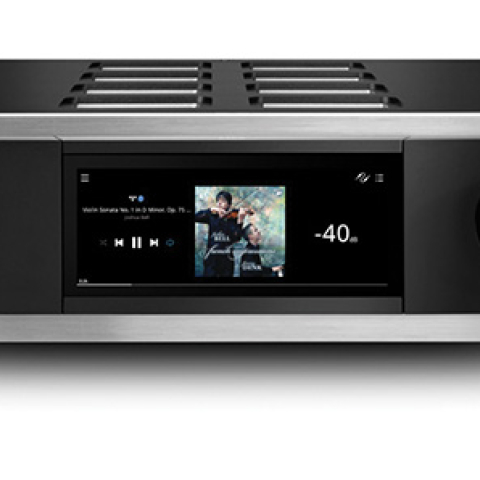
I had two high-performance preamplifiers on hand with which to compare the Pass XP-32: the MBL N11 ($14,600) and the Benchmark LA4 ($2599) that had so impressed Kal Rubinson when he reviewed it in January 2020. First up was the MBL, with sound pressure levels matched within 0.5dB at the listening position. (The N11 was set to its unity gain condition, which limits the maximum gain and which reviewer Jason Victor Serinus had preferred.) With the MBL N31 DAC in front of the preamplifier and the Parasound monoblocks behind it, the back-to-front soundstage on my Mozart Piano Quartet recording was as apparent as it had been on the XP-32, with as much image depth. The tonal balance, however, was a tad warmer and the presentation of acoustic objects within the soundstage was a little more—and how I hate using this word—palpable. For example, toward the end of the Joni Mitchell track, a high tenor voice appears in the center of the stage, floating slightly behind and slightly above Joni The MBL pushed this voice a little farther back than it had been with the Pass Labs, as well as a touch higher. A close-run thing, but like I said, more palpable.
Next up was the Benchmark. While the LA4 is considerably less expensive than the Pass XP-32 and MBL N11, its measured performance is on par with that of those two technical high-fliers. After an evening of warming up, the Benchmark had a somewhat upfront presentation in my system. Even with sound pressure levels matched, it sounded as if it was slightly louder than both the other preamplifiers. Detail like the reverberation on my Mozart recording was fully apparent with the LA4, but, paradoxically, soundstage depth was slightly more restricted than with the XP-32.
The images of the Mozart's violin, viola, and cello were well-defined laterally but were more in the plane of the piano image than behind it, as I had heard with the Pass Labs preamplifier. The Benchmark's reduction in soundstage depth was also apparent with Joni Mitchell's unfolded and upsampled "How Do You Stop." The LA4 is an excellent preamplifier, especially considering its price, but it was outclassed by the XP-32.
Summing up
A great preamplifier will allow through so much information, so much of the music, that the shortcomings of lesser speakers and amplifiers can be forgotten. The Pass Labs XP-32 satisfies that definition. It joins the Ayre KX-R Twenty, MBL N11, and, of course, the XP-30 in the ranks of great preamplifiers. I will miss the XP-32 when it goes back to the manufacturer at the end of the review period and return to my simpler, preamplifier-less system. But for the final two months of 2020's annus horribilis, I was privileged to enjoy my music library with more detail and correspondingly increased enjoyment than I expected, courtesy of the XP-32.
After installing the XP-32, I used it for casual listening, internet radio stations and the like streamed with Roon, for a week, before I started serious listening with familiar music.
I started with Bravo!, the final recording I made at the Santa Fe Chamber Music Festival in 1998 (16/44.1 ALAC files, Stereophile STPH014-2). As I described in the CD booklet, I had had to close-mike all the instruments due to the fact that I wasn't allowed to turn off the new and noisy climate-control system in Santa Fe's Museum of Fine Arts. I had also recorded the performances with a pair of distant mikes and used those as my reference when I later synthesized the concert hall acoustic with a Lexicon digital reverberation unit and added that to the mix.
I followed the Mozart with another album from 1998 that has been in heavy rotation ever since it was recommended to me by Stephen Mejias a few years ago: the late Mark Hollis's eponymous album (16/44.1 ALAC files ripped from CD, Polydor), which built on his work with the band Talk Talk. With engineer Phill Brown, Hollis constructed carefully layered, atmospheric soundscapes, his plaintive vocals centered in front of double bass. Piano, acoustic guitar, and ostinato percussion are placed farther back in the soundstage with occasional solo-instrumental interjections at the sides.
This is the only track on Fairytales that had been originally recorded in analog, but even with the XP-32's transparency, I couldn't perceive any sonic discrepancy between this track and the ones that had been recorded digitally. Roon's Radio function followed Toneff with "How Do You Stop," from Joni Mitchell's overlooked—overlooked by me, that is—1994 album Turbulent Indigo (16/44.1k MQA-encoded FLAC, unfolded by Roon to 24/88.2 and upsampled by the MU1 to 24/176.4, Tidal/Reprise). Putting to one side the argument about whether a 16-bit PCM recording has enough spectral space beneath the music's noise floor to pack the 2Fs and 4Fs data, this track sounded magnificent, with Joni sounding natural, superb depth on the chiming electric guitars, and the bass guitar both rich and well-defined.
I had two high-performance preamplifiers on hand with which to compare the Pass XP-32: the MBL N11 ($14,600) and the Benchmark LA4 ($2599) that had so impressed Kal Rubinson when he reviewed it in January 2020. First up was the MBL, with sound pressure levels matched within 0.5dB at the listening position. (The N11 was set to its unity gain condition, which limits the maximum gain and which reviewer Jason Victor Serinus had preferred.) With the MBL N31 DAC in front of the preamplifier and the Parasound monoblocks behind it, the back-to-front soundstage on my Mozart Piano Quartet recording was as apparent as it had been on the XP-32, with as much image depth. The tonal balance, however, was a tad warmer and the presentation of acoustic objects within the soundstage was a little more—and how I hate using this word—palpable. For example, toward the end of the Joni Mitchell track, a high tenor voice appears in the center of the stage, floating slightly behind and slightly above Joni The MBL pushed this voice a little farther back than it had been with the Pass Labs, as well as a touch higher. A close-run thing, but like I said, more palpable.
A great preamplifier will allow through so much information, so much of the music, that the shortcomings of lesser speakers and amplifiers can be forgotten. The Pass Labs XP-32 satisfies that definition. It joins the Ayre KX-R Twenty, MBL N11, and, of course, the XP-30 in the ranks of great preamplifiers. I will miss the XP-32 when it goes back to the manufacturer at the end of the review period and return to my simpler, preamplifier-less system. But for the final two months of 2020's annus horribilis, I was privileged to enjoy my music library with more detail and correspondingly increased enjoyment than I expected, courtesy of the XP-32.