Sidebar 4: Measurements
I used my Audio Precision SYS2722 system to measure the NuPrime MCX-800AD. Although the amplifier has eight channels, my Audio Precision is a strictly two-channel device, so I measured the analog inputs and loudspeaker outputs for channels 7 and 8, which were closest to the analyzer with the amplifier on the test bench. As the NuPrime has a class-D output stage and class-D amplifiers emit relatively high levels of ultrasonic noise that would drive my analyzer's input into slew-rate limiting, I inserted an Audio Precision AUX-0025 passive low-pass filter between the test load and the analyzer. This filter mitigates noise above 80kHz and eliminates noise above 200kHz. Without the filter, there was 288mV of ultrasonic noise with a center frequency of 601kHz present in the amplifier's output (footnote 1). I used the Audio Precision filter for all the tests other than the frequency response. As the NuPrime is a class-D design, there was no need to precondition it before the testing. Nevertheless, I operated it for 30 minutes at a moderate power into 8 ohms before starting measuring. The chassis remained cool throughout the testing.
Looking first at the behavior of the line-level inputs, the NuPrime amplifier inverted absolute polarity at the loudspeaker outputs with both the balanced and single-ended inputs. The volume control operated in accurate 0.5dB steps. With the control set to the maximum of "99," the maximum voltage gain at 1kHz at the speaker outputs into 8 ohms was 30.25dB on the highest sensitivity setting and 22.25dB on the lowest sensitivity setting, for both the balanced and single-ended inputs.
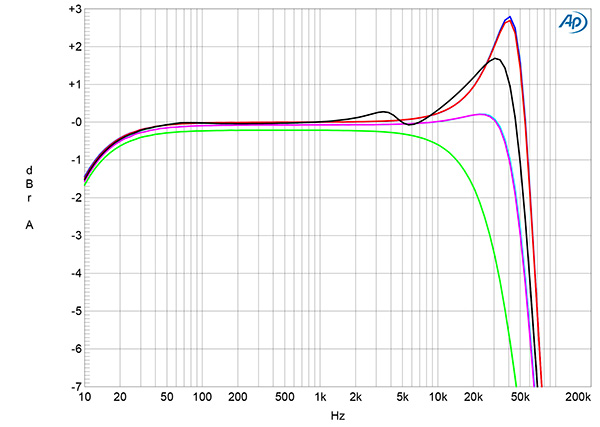
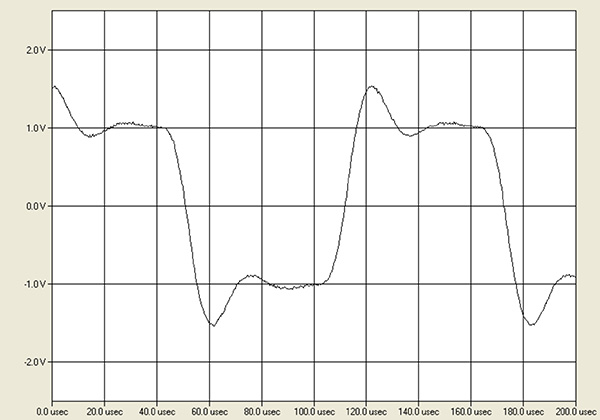
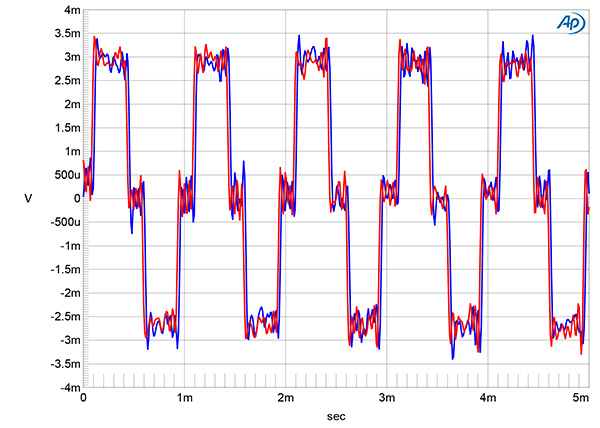
Fig.1 was taken with the volume control set to the maximum and the sensitivity set to high. The channels are well-matched; they were equally well-matched when I repeated the 8 ohm measurement with the control set to –12dB, with low sensitivity. The NuPrime's reproduction of a 10kHz squarewave into 8 ohms, taken with the Audio Precision ultrasonic filter, featured relatively short risetimes (fig.2) with a slight overshoot on the leading edges, presumably associated with the response peak at 40kHz.
KR warned me that the NuPrime MCX-800AD was a "busy little box" when he shipped it to me for measurement. It is indeed, and I had to repeatedly consult the manual during the testing to make sure I was operating it correctly. The crowded rear panel also made it difficult to adjust the sensitivity potentiometers with cables plugged into the single-ended input jacks and to ensure I wasn't accidentally shorting the speaker terminals when I was plugging in different resistive loads. But its respectable measured performance—the very low distortion into resistive loads and the excellent DAC performance in particular—indicates that few compromises were made in packing eight high-power channels into this amplifier's relatively small chassis.—John Atkinson
Footnote 1: The NuPrime emitted enough RF noise to interfere with reception on the portable FM radio I keep in my test lab, something I have occasionally experienced with experienced with other class-D amplifiers.
Fig.1 NuPrime MCX-800AD, frequency response at 2.83V into: simulated loudspeaker load (gray), 8 ohms (channel 7 blue, 8 red), 4 ohms (channel 7 cyan, 8 magenta), and 2 ohms (green) (5dB/vertical div.).
Fig.2 NuPrime MCX-800AD, small-signal 10kHz squarewave into 8 ohms.
The single-ended input impedance was 8.2k ohms at 20Hz and 1kHz, dropping slightly to 6.75k ohms at 20kHz. The balanced input impedance was 9k ohms at 20Hz and 20kHz and 8.2k ohms at 1kHz. The loudspeaker output impedance was a very low 0.065 ohms at 20Hz and 1kHz, though it rose at 20kHz, to 0.5 ohms. The variation in the amplifier's frequency response with our standard simulated loudspeaker (fig.1, gray trace) was negligible in the audioband, but there was a 1.7dB-high peak at 40kHz, presumably due to the output impedance continuing to increase above the audioband. The response into an 8 ohm resistive load (blue and red traces) was flat up to 10kHz but rose to +2.7dB at 40kHz before rolling off, reaching –3dB at 65kHz. This peak was absent with lower impedances.
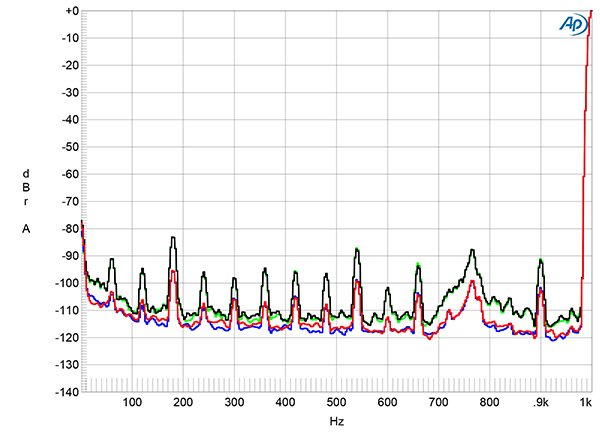
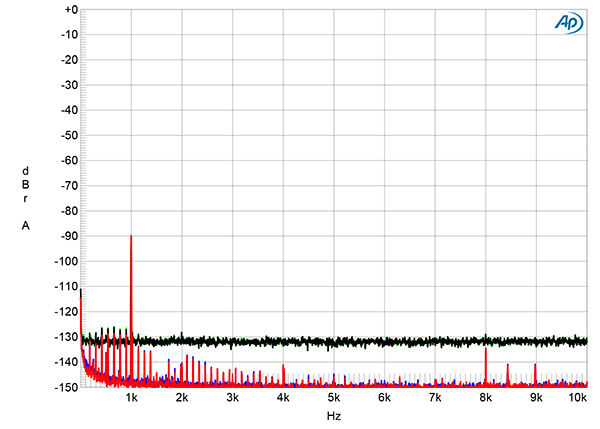
Fig.3 NuPrime MCX-800AD, spectrum of 1kHz sinewave, DC–1kHz, at 1W into 8 ohms with volume control set to the maximum (channel 7 green, 8 gray) and to –12dB (channel 7 blue, 8 red) (linear frequency scale).
Channel separation was a very good 83dB in both directions below 3kHz, and still 70dB at 20kHz. The amplifier's unweighted, wideband signal/noise ratio, taken with the single-ended inputs shorted to ground, the sensitivity set to high, and with the Audio Precision low-pass filter, was an okay 61.3dB ref. 1W into 8 ohms. This ratio improved to a very good 81.6dB when the measurement bandwidth was restricted to the audioband, and to 86.3dB when A-weighted. The ratios with the sensitivity set to low were 2dB greater. Spectral analysis of the low-frequency noisefloor with the NuPrime driving a 1kHz tone at 1W into 8 ohms with the volume control set to the maximum revealed low-level spuriae at the odd and even harmonics of the AC mains frequency (fig.3, blue and red traces). Repeating the analysis with the volume control set to –12dB and the input signal increased by 12dB, so that the output remained at 1W into 8 ohms (green, gray traces), lowered the level of both the supply-related spuriae and the random noisefloor by 7–8dB.
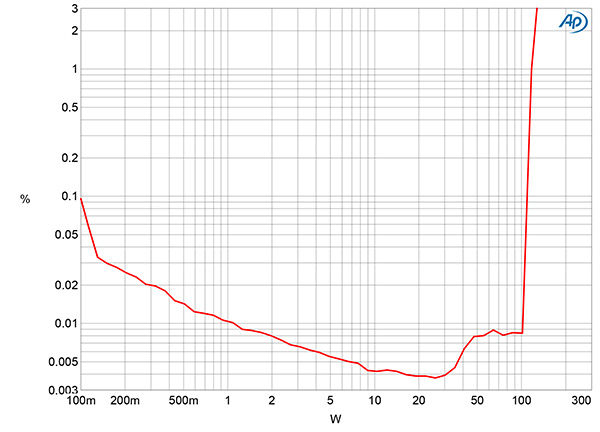
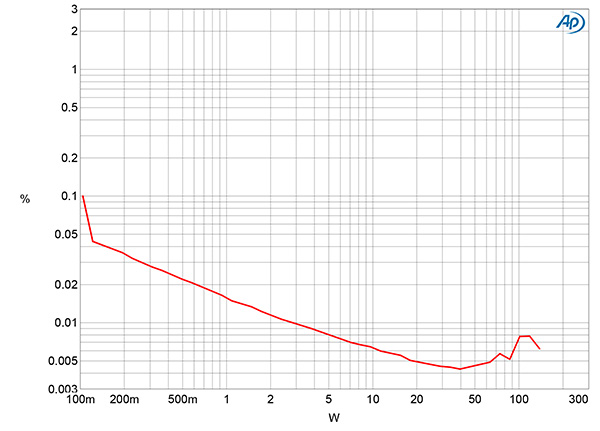
Fig.4 NuPrime MCX-800AD, THD+N (%) vs 1kHz continuous output power into 8 ohms (two channels driven).
Fig.5 NuPrime MCX-800AD, THD+N (%) vs 1kHz continuous output power into 4 ohms (two channels driven).
NuPrime specifies the MCX-800AD's maximum continuous power as 120W into 8 ohms (20.8dBW) and 220W into 4 ohms (20.4dBW). Stereophile defines clipping as when the THD+noise reaches 1%. The NuPrime amplifier didn't quite meet the specified power into 8 ohms with a 1kHz signal, clipping with two channels driven at 117Wpc (20.7dBW, fig.4). When I examined how the THD+N varied with power into 4 ohms, again with both channels driven, the amplifier went into protection at 139W (18.4dBW, fig.5). The THD+N at that power was 0.006%. The amplifier's outputs reactivated when I lowered the input signal. The FTC's updated "Amplifier Rule" states that maximum power should also be assessed at frequencies other than 1kHz. I therefore repeated the clipping test with a 20kHz signal, but the amplifier went into protection at 147W into 8 ohms with this frequency. The THD+N at that power was 0.35%.
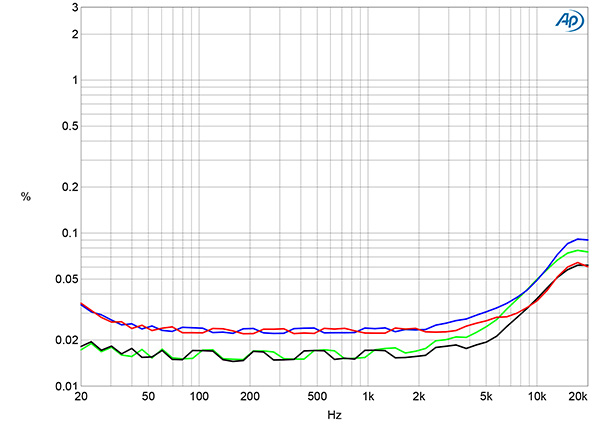
Fig.6 NuPrime MCX-800AD, THD+N (%) vs frequency at 12.65V into: 8 ohms (channel 7 blue, 8 red) and 4 ohms (channel 7 green, 8 gray) (two channels driven).
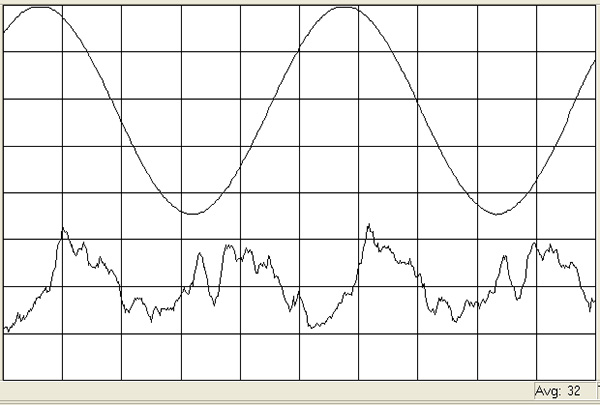
Fig.7 NuPrime MCX-800AD, 1kHz waveform at 20W into 8 ohms, 0.022% THD+N (top); distortion and noise waveform with fundamental notched out (bottom, not to scale).
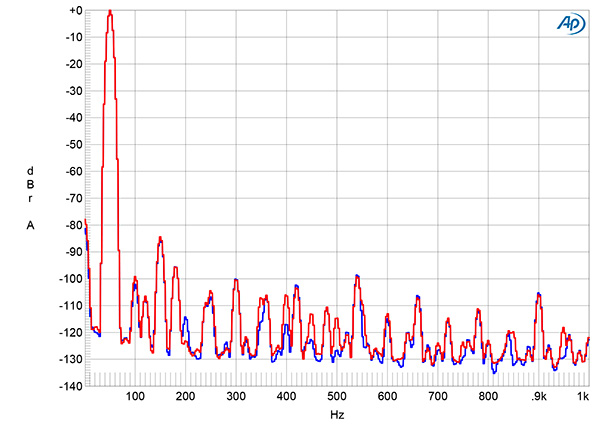
Fig.8 NuPrime MCX-800AD, spectrum of 50Hz sinewave, DC–1kHz, at 20W into 8 ohms (channel 7 blue, 8 red) (linear frequency scale).
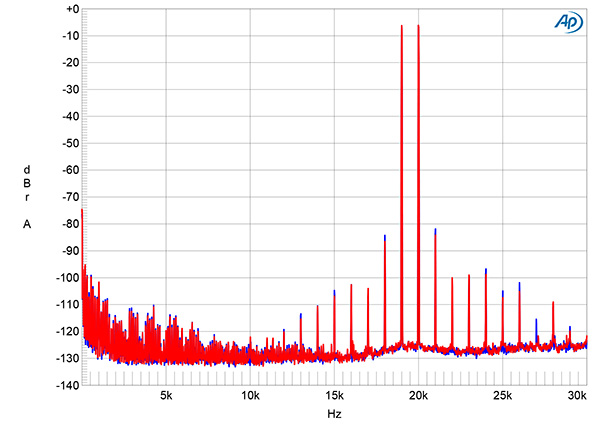
Fig.9 NuPrime MCX-800AD, HF intermodulation spectrum, DC–30kHz, 19+20kHz at 20W peak into 8 ohms (channel 7 blue, 8 red) (linear frequency scale).
I examined how the THD+N percentage varied with frequency at 12.65V, equivalent to 20W into 8 ohms and 40W into 4 ohms. The THD+N was very low over most of the audioband into both loads (fig.6). To my surprise, it was lower into 4 ohms (green, gray traces) than it was into 8 ohms (blue, red traces). With both loads, THD+N rose in the top two octaves. The bottom trace in fig.7 shows the distortion waveform at 20W into 8 ohms, which appears to comprise low-order harmonics. Spectral analysis with a 50Hz signal (fig.8) reveals that the third harmonic was the highest in level but lay at a very low –86dB (0.005%). While higher-order harmonics were present, these all lie at or below –100dB (0.001%). Repeating the analysis with a 1kHz signal at the same power into 8 ohms (not shown) revealed that the second harmonic was now the highest in level but at a very low –90dB (0.003%). The 1kHz difference product with an equal mix of 19kHz and 20kHz tones at 20W peak into 8 ohms lay below –100dB (fig.9), and the higher-order, higher-frequency intermodulation products were higher in level.
I used USB data sourced from my MacBook Pro to examine the performance of the NuPrime's DAC, selecting the "U8" input with the remote control. Apple's USB Prober app identified the MCX-800AD as "Nuprime Multi CH System A" from "Comtrue-inc" with the serial number "CTUA250419A001," and indicated that the USB port operated in the optimal isochronous asynchronous mode. The AudioMIDI utility revealed that the MCX-800AD's USB port could be set to two, six, or eight channels; I set it to two channels and examined the behavior at the channel 1 and 2 outputs. In two-channel mode, the USB port accepted 24- and 32-bit integer data sampled at all rates from 44.1kHz to 768Hz, but in six- and eight-channel modes it was limited to a maximum sample rate of 192kHz.
The NuPrime's USB input inverted absolute polarity from both the loudspeaker output and from the single-ended jacks when these were set to Output. With the volume control set to the maximum and the sensitivity set to high, the output level from the speaker output with a 1kHz tone at –20dBFS was 6.4V into 8 ohms. This is 13.6dB below the clipping voltage into that load; on the face of it, it looks as if the MCX-800AD's DAC offers 6.4dB higher gain than is strictly necessary. However, with the sensitivity set to low, the output level with the 1kHz tone dropped by 7.5dB, meaning that the gain architecture is well managed in this condition. The output level from the single-ended jack with a 1kHz signal at –20dBFS was 191mV, high, 81mV, low. To avoid overloading the amplifier's output stage, I performed all the subsequent digital input testing at the loudspeaker output with the volume control set to "79"—the high-sensitivity output level with full-scale 1kHz data at this setting was 20.3V, well below the 8 ohm clipping voltage of 30.6V.
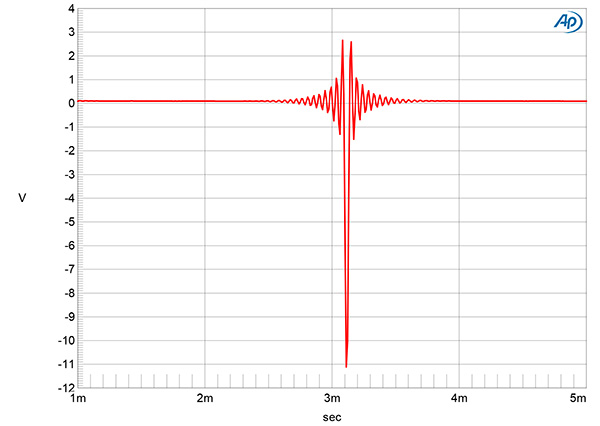
Fig.10 NuPrime MCX-800AD, USB input, impulse response (one sample at 0dBFS, 44.1kHz sampling, 4ms time window).
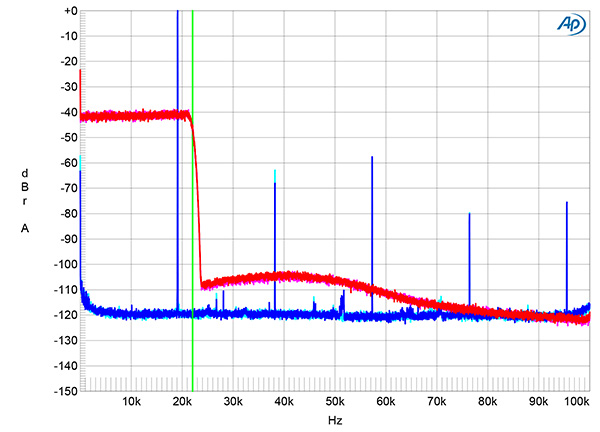
Fig.11 NuPrime MCX-800AD, USB input, wideband spectrum of white noise at –4dBFS (channel 1 red, 2 magenta) and 19.1kHz tone at 0dBFS (channel 1 blue, 2 cyan) into 100k ohms with data sampled at 44.1kHz (20dB/vertical div.).
The NuPrime MCX-800AD's impulse response (fig.10) was typical of a long linear-phase reconstruction filter, with equal amounts of ringing before and after the single sample at 0dBFS. The magenta and red traces in fig.11 show the NuPrime's ultrasonic rolloff with data sampled at 44.1kHz. They reach full stop-band attenuation just above half the sample rate (this indicated by the vertical green line), with the aliased image at 25kHz of a 19.1kHz tone at 0dBFS (cyan, blue) suppressed by almost 110dB. The harmonics associated with the 19.1kHz tone all lie at or below –60dB (0.1%), with the third the highest in level.
Fig.12 NuPrime MCX-800AD, USB input, spectrum with noise and spuriae of dithered 1kHz tone at –90dBFS with: 16-bit data (channel 1 green, 2 gray), 24-bit data (channel 1 blue, 2 red) (20dB/vertical div.).
Fig.13 NuPrime MCX-800AD, USB input, waveform of undithered 1kHz sinewave at –90.31dBFS, 16-bit data (channel 1 blue, 2 red).
An increase in bit depth from 16 to 24, with dithered data representing a 1kHz tone at –90dBFS, dropped the MCX-800AD's random noisefloor by almost 20dB (fig.12), which implies a measured resolution between 18 and 19 bits. With undithered data representing a tone at exactly –90.31dBFS, the waveform was symmetrical, with negligible DC offset, and the three DC voltage levels described by the data were clearly defined (fig.13).
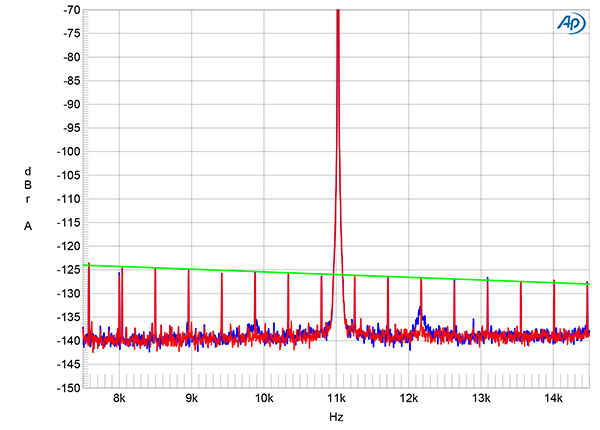
Fig.14 NuPrime MCX-800AD, USB input, high-resolution jitter spectrum of analog output signal, 11.025kHz at –6dBFS, sampled at 44.1kHz with LSB toggled at 229Hz: 16-bit data (channel 1 blue, 2 red). Center frequency of trace, 11.025kHz; frequency range, ±3.5kHz.
As it had with the analog inputs, the NuPrime produced very low levels of harmonic and intermodulation distortion with USB data. The MCX-800AD's USB input also offered superb rejection of data-related jitter. Fig.14 shows the output spectrum with high-level 16-bit J-Test data. The odd-order harmonics of the undithered low-frequency, LSB-level squarewave all lie at the correct levels, indicated by the green line, and the central spike that represents the high-level tone at one-quarter the sample rate (Fs/4) is narrow.
Footnote 1: The NuPrime emitted enough RF noise to interfere with reception on the portable FM radio I keep in my test lab, something I have occasionally experienced with experienced with other class-D amplifiers.