The February 2009 issue of
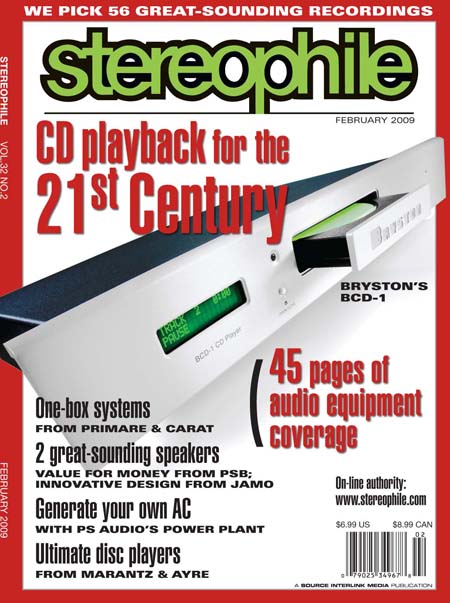
Stereophile is now on newsstands. On the cover, we feature the first CD player to come from Canadian manufacturer, Bryston.
A company better known for their pro and consumer audio amplification, Bryston takes an interesting step into the digital playback arena at a time when compact discs seem to be going out of fashion. Nevertheless, they did it with style and grace: Larry Greenhill was impressed by the BCD-1's ability to "reveal the most subtle sonic details," and John Atkinson noted measured performance that was "close to the state of the art for a CD player."
You'll notice that we chose a bright red border and a lime green logo for the cover color scheme. We hadn't used red in awhile. The green
Stereophile logo matches the green display on the Bryston's front panel, and also matches the compact disc that rests in the player's drawer. That was cover photographer, Eric Swanson's, idea. The compact disc belongs to Eric, and contains the work of a little-known band from New Jersey called The Multi-Purpose Solution—my old band. The album is called
How Can A Man Be Tougher Than The World? Affectionately known simply as
Tougher.
I got a real kick out of it when Eric showed me the proof.
Also in this issue, Bob Deutsch offers an interesting "As We See It," which ponders the perceptual theme of Sharpening
vs Leveling. With our aspirations to enjoy the subtlest nuances of a musical performance and our tendencies to discern the smallest differences between components, audiophiles must necessarily lean towards the Sharpening paradigm. I, however, am more of a Leveler by nature.
And you?
Meanwhile, music editor
Robert Baird had something of a tough time coming up with a "Recording of the Month" for February. As time wore down, and with a little nudge, he finally decided on Ryan Adams'
Cardinology—a very fine choice,
I think. Of all the albums to be released in 2008,
Cardinology had the greatest emotional impact on me. Adams' songwriting has never been so efficient. There is a raw beauty to these tracks, emphasized by the intimate sound of the recording which took place at Electric Lady Studios. It was produced and engineered by Tom Schick and mastered by Bob Ludwig. I think this album has a distinct
sound, unlike anything else that Adams has released.
Robert disagrees with me altogether. I can almost knock him out for it.
Besides 45 pages of awesome audio equipment coverage, the February issue also holds our annual "
Records to Die For" feature. Each of our writers presents two albums they would not want to live without. For me, selecting the albums is just too damn easy. I'd have to live for an eternity before I ran out of albums to nominate, and even then, I'm pretty sure something would come up. Writing about the albums, though, is always a royal pain in the ass.
Words. They never seem good enough.
It's also always a bit difficult to come up with a good theme for the "R2D4" layout. We've done cemeteries, skeletons, zombies, battle grounds, you name it. This year, graphic designer, Natalie Baca, used a sort of heart-shaped fireball theme. I get the impression that we're in hell. But we've got our records. So, it's okay. I subtly vetoed a few other designs involving brain scans and compact discs. (Don't be surprised if you see something like that in a future "R2D4.") I had also asked Nat if she could place a slab of molten vinyl in the center of the flaming heart, but I suppose that would've been a bit over-the-top.
Like Sylvester Stallone.
It's always interested to see which records our writers select. I hope you think so, too. John Atkinson is bowled over by Mike Garson's
Jazz Hat; Robert Baird brings back Aztec Camera; Larry Birnbaum discusses Eddie Palmieri's
Azucar Pa' Ti;
Art Dudley picks
Hot Jazz by the Quintet of the Hot Club of France (on 78rpm shellac!); Michael Fremer goes for Rachel's
Handwriting; Jon Iverson likes the Fleet Foxes;
Fred Kaplan pulls a Charlie Parker box set; Robert Levine surprises me with Radiohead;
Wes Phillips and Bob Reina both select Cantus'
While You Are Alive;
Kal Rubinson praises Schonberg; Jason Victor Serinus digs Strauss; and so much more.
Really. I'm not just saying that.
I've already received a couple of very nice e-mails congratulating me on finding John Handy's
Projections and alerting me to an upcoming Mosaic release containing all of Handy's Columbia work from 1965 through 1968. On the downside, it'll be CD-only. What's up with that? I'm sure the music is phenomenal—I already own some of it on vinyl—but I can't imagine dying for a compact disc.
Can you?