I almost forgot to mention the outer box, a very attractive slipcase. Right out of it, the D 3020 sounded clean, clear, and resolving, if a bit small and bass shy. After only a day or so of use, however, the D 3020 sounded far bigger and more powerful than its size and weight would suggest.
For the most part, I partnered the D 3020 with small, affordable loudspeakers—PSB Alpha B1 ($299/pair), Pioneer SP-BS22-LR ($129/pair), Wharfedale Diamond 10.1 ($349/pair)—but toward the end of the listening period I hooked it up to a pair of glorious KEF LS50s ($1499/pair) and turned the volume up high. I was bowled over by the sound, which easily matched the best I'd ever heard at home, and reminded me in many ways of what I'd recently experienced with the tubed Croft Phono Integrated ($1895).
If there was a weakness in my system, it was not the NAD.
Digital ins and outs
The D 3020 is a decidedly modern integrated amplifier for the modern listener. With its coaxial and optical digital inputs, users can connect satellite and cable receivers, integrate content-management devices such as the Apple TV media streamer, or process the digital signal from a CD or DVD player. But if you really want to get the best sound from your CDs, you should rip them to your computer using something like X Lossless Decoder (for Macs) or Exact Audio Copy (for PCs), then send the signal to the D 3020's 24-bit/96kHz–capable asynchronous-mode USB input, thus bypassing your laptop's own compromised audio circuitry. Or forget about CDs altogether and instead take advantage of the growing number of online retailers now providing music in high-resolution and CD-quality digital formats. A few of my favorite download sites are Bleep, Boomkat, and HDtracks, but there are many others. Specialized media-player softwares, such as Amarra (Macs) or JRiver Media Center (PCs), should work seamlessly with Apple's ubiquitous iTunes, but will provide automatic sample-rate conversion and better sound (footnote 3). You'll want to know that you're getting out of the NAD D 3020 exactly what you're putting in.
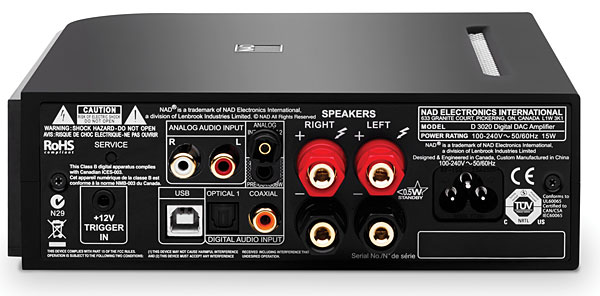 The D 3020's rear-panel iPod input is a sign of our times, but is also the amplifier's least impressive feature. I suspect NAD thought so, too, which is why they've included a TosLink mini-adapter to convert it to an additional optical input, which will also accept the digital-audio output from a MacBook Pro. The D 3020 has only one traditional (RCA) analog input, a fact that I at first mourned—until I realized that one was all I really needed. Do I need a Disc input? No. Do I need an Aux input? No. Do I even know what a Tape input is? No.
I do want a headphone output. Do I need one? Not really, no—for the most part, I listen to headphones outdoors, on the go. The D 3020 has one—a front-panel minijack, perfect for use in a desktop system with today's popular headphones. You won't be able to use the D 3020 to drive old-fashioned cans that have ¼" phone plugs (unless you employ an adaptor), but you can use it right away with your Skullcandy Aviator, B&W P3, Harman/Kardon CL, Grado SR60i, Sennheiser Momentum, Monster DNA, Beats Solo HD, or any of the other exotic, colorful, celebrity-endorsed 'phones.
There's also a preamp/subwoofer output, for mating the D 3020 to additional amplification or connecting a powered sub. If you want even more bass, you can tap the D 3020's Bass EQ button to "boost the overall bass response by at least 6dB," according to the user manual. I didn't try this, if only because I was too preoccupied with everything else the D 3020 offers. Anyway, I didn't need more bass.
The D 3020 does not have a phono stage. To include one would have required a bigger case, some exceedingly clever design to properly shield the analog circuit from the D 3020's switch-mode power supply, and a higher retail price. In short, it would have essentially defeated this model's purpose. But I know you: You want to build your first real system, you want to play LPs, and you don't want to worry about a phono preamplifier. You can still consider the D 3020. Use it with something like the Music Hall USB-1 turntable ($249), which has its own built-in phono preamp. That'll get you started, and keep you happy for a good long while. When you're ready for something more, you can buy an outboard phono preamp and consider another Music Hall 'table, or look to Pro-Ject, Rega, or VPI. Imagine partnering the NAD D 3020 with your laptop, a Music Hall USB-1, Pioneer SP-BS22-LR speakers, and some affordable AudioQuest cables. You can easily have a sweet-looking, awesome-sounding, crazily versatile and forward-looking hi-fi for under $1000.
When I wanted to spin LPs, I sent the audio signal from my Rega P3-24 turntable through either the Parasound ZphonoUSB or NAD's own PP3i phono preamp, and then to the D 3020's analog input. That way, I had a number of inputs remaining for digital playback. I tried them all. I used AudioQuest Cinnamon optical and coaxial cables ($79/1.5m) and Big Sur analog interconnects ($109/m). I heard differences among the D 3020's various inputs, but they were small. I'm not entirely convinced that I wasn't imagining them, and I can't tell you whether the differences had to do with the inputs themselves or the cables I was using.
Occasionally, when sending digital signals from the NAD C 316BEE CD player to the D 3020's coaxial input, I heard a glitchy mechanical noise—sort of like the sound a CD transport makes when a disc skips. Fortunately, this happened only between tracks, never during music. Music passed through the optical input lacked the slightest amount of body and maybe had a less accomplished sense of momentum, but never exhibited any mechanical noise. Ultimately, I preferred the sound of CDs and LPs when played through the D 3020's RCA analog input. I thought it was ever so slightly warmer and bolder, with a more accomplished sense of musical force and touch. Or I might've just been psyching myself out.
In a move that was perhaps as symbolic as it was purposeful, I closed the lid on my turntable, placed my laptop directly atop it, and, using an AudioQuest Cinnamon USB cable ($69/1.5m) to connect the computer to the D 3020's asynchronous-mode USB input, went crazy streaming a ton of music from iTunes.
Daft Punk's Random Access Memories is today's Dark Side of the Moon: immensely popular, and musically and sonically excellent. I couldn't get enough of it through the D 3020 (footnote 4). I began with a low-resolution rip (192kbps from CD, Columbia 88883716862) of "Lose Yourself to Dance." The jubilant handclaps sounded like jubilant real handclaps—a whole crowd of them, fleshy and wet with reverb, and growing larger and larger as the song went on. And the silly robot voices sounded ridiculously awesome. And the drums sounded solid and funky and forceful. And the electric guitar sounded simultaneously clean and dirty—just as it should. And when I couldn't take it anymore, I got up from my seat and did what Pharrell Williams had been imploring me, over and over, to do. I lost myself to dance.
Seriously? This was the most fun I've ever had with hi-fi.
In the middle of my dance, I took a screenshot of my iTunes playlist and posted it to Instagram with the hashtag "work" and a comment: "Sounds way better than it should. WTF?!" I received 23 "likes" in about five seconds. I felt more popular, and way cooler, than Lena Dunham, Zooey Deschanel, or even Duck Dynasty.
In one marathon listening session, I played crappy MP3s of songs by Justin Timberlake, Raime, A$AP Rocky, Earl Sweatshirt, Jenny Hval, Marina Rosenfeld, Moderat, Wale, Zomby, Julia Holter, Julianna Barwick, and Lucrecia Dalt. They all sounded excellent: smooth, warm, detailed, and compelling. Compared to their CD-quality counterparts, MP3s sounded a bit edgier and grainer, with a less accomplished sense of musical force and momentum, but they were still easily enjoyable.
Finally, I played the absolute lowest-quality recording I own: a mono 24kbps AAC iPhone recording of "Strap It On Me," the first single by my new band, Lip Action. Through the D 3020, even this sounded surprisingly spacious and clear. I could easily envision the rehearsal studio and hear exactly how well the guitar, keys, bass, drums, and voices lock in together and complement one another. Pretty impressive—on our parts, and the NAD's.
I 3 Bluetooth
The D 3020's rear-panel iPod input is a sign of our times, but is also the amplifier's least impressive feature. I suspect NAD thought so, too, which is why they've included a TosLink mini-adapter to convert it to an additional optical input, which will also accept the digital-audio output from a MacBook Pro. The D 3020 has only one traditional (RCA) analog input, a fact that I at first mourned—until I realized that one was all I really needed. Do I need a Disc input? No. Do I need an Aux input? No. Do I even know what a Tape input is? No.
I do want a headphone output. Do I need one? Not really, no—for the most part, I listen to headphones outdoors, on the go. The D 3020 has one—a front-panel minijack, perfect for use in a desktop system with today's popular headphones. You won't be able to use the D 3020 to drive old-fashioned cans that have ¼" phone plugs (unless you employ an adaptor), but you can use it right away with your Skullcandy Aviator, B&W P3, Harman/Kardon CL, Grado SR60i, Sennheiser Momentum, Monster DNA, Beats Solo HD, or any of the other exotic, colorful, celebrity-endorsed 'phones.
There's also a preamp/subwoofer output, for mating the D 3020 to additional amplification or connecting a powered sub. If you want even more bass, you can tap the D 3020's Bass EQ button to "boost the overall bass response by at least 6dB," according to the user manual. I didn't try this, if only because I was too preoccupied with everything else the D 3020 offers. Anyway, I didn't need more bass.
The D 3020 does not have a phono stage. To include one would have required a bigger case, some exceedingly clever design to properly shield the analog circuit from the D 3020's switch-mode power supply, and a higher retail price. In short, it would have essentially defeated this model's purpose. But I know you: You want to build your first real system, you want to play LPs, and you don't want to worry about a phono preamplifier. You can still consider the D 3020. Use it with something like the Music Hall USB-1 turntable ($249), which has its own built-in phono preamp. That'll get you started, and keep you happy for a good long while. When you're ready for something more, you can buy an outboard phono preamp and consider another Music Hall 'table, or look to Pro-Ject, Rega, or VPI. Imagine partnering the NAD D 3020 with your laptop, a Music Hall USB-1, Pioneer SP-BS22-LR speakers, and some affordable AudioQuest cables. You can easily have a sweet-looking, awesome-sounding, crazily versatile and forward-looking hi-fi for under $1000.
When I wanted to spin LPs, I sent the audio signal from my Rega P3-24 turntable through either the Parasound ZphonoUSB or NAD's own PP3i phono preamp, and then to the D 3020's analog input. That way, I had a number of inputs remaining for digital playback. I tried them all. I used AudioQuest Cinnamon optical and coaxial cables ($79/1.5m) and Big Sur analog interconnects ($109/m). I heard differences among the D 3020's various inputs, but they were small. I'm not entirely convinced that I wasn't imagining them, and I can't tell you whether the differences had to do with the inputs themselves or the cables I was using.
Occasionally, when sending digital signals from the NAD C 316BEE CD player to the D 3020's coaxial input, I heard a glitchy mechanical noise—sort of like the sound a CD transport makes when a disc skips. Fortunately, this happened only between tracks, never during music. Music passed through the optical input lacked the slightest amount of body and maybe had a less accomplished sense of momentum, but never exhibited any mechanical noise. Ultimately, I preferred the sound of CDs and LPs when played through the D 3020's RCA analog input. I thought it was ever so slightly warmer and bolder, with a more accomplished sense of musical force and touch. Or I might've just been psyching myself out.
In a move that was perhaps as symbolic as it was purposeful, I closed the lid on my turntable, placed my laptop directly atop it, and, using an AudioQuest Cinnamon USB cable ($69/1.5m) to connect the computer to the D 3020's asynchronous-mode USB input, went crazy streaming a ton of music from iTunes.
Daft Punk's Random Access Memories is today's Dark Side of the Moon: immensely popular, and musically and sonically excellent. I couldn't get enough of it through the D 3020 (footnote 4). I began with a low-resolution rip (192kbps from CD, Columbia 88883716862) of "Lose Yourself to Dance." The jubilant handclaps sounded like jubilant real handclaps—a whole crowd of them, fleshy and wet with reverb, and growing larger and larger as the song went on. And the silly robot voices sounded ridiculously awesome. And the drums sounded solid and funky and forceful. And the electric guitar sounded simultaneously clean and dirty—just as it should. And when I couldn't take it anymore, I got up from my seat and did what Pharrell Williams had been imploring me, over and over, to do. I lost myself to dance.
Seriously? This was the most fun I've ever had with hi-fi.
In the middle of my dance, I took a screenshot of my iTunes playlist and posted it to Instagram with the hashtag "work" and a comment: "Sounds way better than it should. WTF?!" I received 23 "likes" in about five seconds. I felt more popular, and way cooler, than Lena Dunham, Zooey Deschanel, or even Duck Dynasty.
In one marathon listening session, I played crappy MP3s of songs by Justin Timberlake, Raime, A$AP Rocky, Earl Sweatshirt, Jenny Hval, Marina Rosenfeld, Moderat, Wale, Zomby, Julia Holter, Julianna Barwick, and Lucrecia Dalt. They all sounded excellent: smooth, warm, detailed, and compelling. Compared to their CD-quality counterparts, MP3s sounded a bit edgier and grainer, with a less accomplished sense of musical force and momentum, but they were still easily enjoyable.
Finally, I played the absolute lowest-quality recording I own: a mono 24kbps AAC iPhone recording of "Strap It On Me," the first single by my new band, Lip Action. Through the D 3020, even this sounded surprisingly spacious and clear. I could easily envision the rehearsal studio and hear exactly how well the guitar, keys, bass, drums, and voices lock in together and complement one another. Pretty impressive—on our parts, and the NAD's.
I 3 Bluetooth
There's more. The NAD D 3020's most important feature is likely to be its most polarizing. It can wirelessly stream music from any Bluetooth-enabled device—smartphone, laptop, or tablet. Why is this important? Because people, in general, love Bluetooth. Why would it be polarizing? Because audiophiles, in general, hate Bluetooth. This hatred, I guess, has something to do with Bluetooth's history of sucking (footnote 5). Fortunately, audiophiles perfect what the mass market selects, and audio engineers are working hard to improve Bluetooth's capabilities (footnote 6). Like the Musical Fidelity M6DAC ($3000), reviewed by John Atkinson in our June 2013 issue, the NAD D 3020 uses CSR's audio-optimized aptX technology for Bluetooth streaming. One night, I casually switched the D 3020's input to BT (for Bluetooth) and asked Ms. Little if she had any music on her iPhone.
"Yeah."
"This amplifier is awesome. You can do that thing where you make your iPhone speak to it. You know what I'm talking about? Without wires? Tap-tap-tap?"
"It's called pairing."
It's called pairing. Your girlfriend knows how to do it, your mom and dad know how to do it, your little brothers and sisters know how to do it, your best friends know how to do it.
Ms. Little opened her iPhone's Settings menu, activated Bluetooth, and connected to the NAD, which showed up on her iPhone's screen as "D3020 0105FA." This took two seconds. She knew how to do it.
"Okay," she said.
"Now pick a song."
Very deliberately, she scrolled through her music. The picking of the song took far longer than the pairing of the phone and the D 3020. When she finally tap-tap-tapped, I was not at all surprised to hear Bruno Mars's "Treasure" burst through the hi-fi. It had speed, presence, and detail, and in no way resembled the threadbare, brittle sound you'd expect to get from a phone.
"Wow!" exclaimed Ms. Little. "That was easy! And very cool!"
Compared to CDs, LPs, or digital files streamed via USB, Bluetooth still has a way to go. There were intermittent dropouts. And if Ms. Little's phone went to sleep while wirelessly streaming music from the Internet, the music, too, took a nap. I noted some lower-midrange grit, a more mechanical overall sound. It was as if the music were entering the world reluctantly, instead of pouring forth effortlessly and overwhelmingly. There could have been more body, more stage depth, more air, but there could not have been more fun. Bluetooth isn't yet the quietest, cleanest, most natural playback medium, but it's very cool, very convenient, and it filled our home with joy. Bear in mind, too, that we were listening to lo-rez MP3s. You can easily achieve better sound using lossless files.
Most significant, the D 3020's Bluetooth feature accomplished something that I'd previously assumed was nearly impossible: It got my girlfriend excited about the hi-fi. On a number of occasions, I walked into the apartment to find her happily dancing about.
Weeks later, I told Ms. Little that I had to pack up the D 3020 and send it to Sam Tellig for coverage in his column, "Sam's Space." She sighed. "No more Bluetooth for me?"
I felt horrible.
If there's one high-tech, gadgety feature that's going to get the average consumer interested in high-end audio, it's Bluetooth. The NAD D 3020 has it, and implements it far better than any other audio component I've heard.
The New Audio Geeks
Can the success of NAD's 3020 be replicated today? Steven Kurutz's article "The New Audio Geeks," in the July 24, 2013 edition of the New York Times, argues that today's growing high-tech audience is catching on to the appeal of high-fidelity sound. "For years," Kurutz writes, "the typical high-end audio customer has been a white-haired classical music aficionado or an aging rock fan for whom listening to 'Aja' in 1977 on a pair of Altec Lansings was a spiritual experience."
He's right. Kurutz continues, "But recently, veteran audio companies have started adapting their products to the changing tastes of younger listeners."
Right again—and thank goodness. Kurutz cites McIntosh, Music Hall, and Thiel as traditional high-end companies who have in various ways formally acknowledged the importance of a pretty appearance and the popularity of digital music. But this doesn't mean that high-end audio is selling out; it only means that it's getting smart. It wants to survive, and it sees a marketplace in which it can, in fact, thrive.
It's too bad Kurutz overlooked NAD—the D 3020 digital integrated amplifier may be just the thing for the new audio geek. Demonstrating its superiority over mass-market audio components should be as easy today as it was in 1978 to demonstrate the superiority of the original 3020. "Hear how much better your music sounds!" In some ways, it should be even easier. Today's customers walk into stores with their music libraries tucked into their pockets and purses. It doesn't matter that they're carrying MP3s. Through the D 3020, even MP3s will sound good—especially to someone who hasn't yet heard better.
Will $499 seem prohibitively expensive to the average consumer? I'm afraid so. If the D 3020 sold for $100 less, I think it'd have a better chance in today's crowded and competitive consumer-electronics market. That's not to say that the D 3020 is a poor value. At $499, I doubt that NAD is making much of a profit on it. And I can't think of another high-end audio product that combines this many digital inputs, does 24/96 asynchronous USB, is Bluetooth-capable, and looks and sounds as good. It's also fair to note that, adjusted for inflation, the price of the original 3020 would be about $535 today.
There are plenty of other things you can buy with $499. A flatscreen TV. A soundbar. An iPad. A Bose Wave Radio. NAD's D 3020 should easily outlive them all. More than just a great value, it's made to provide lasting enjoyment. In an ideal world, it would even be a sort of status symbol. You'd walk into someone's home, see an NAD D 3020, and know that the owner had audio discernment.
Looked at from every angle, the D 3020 intelligently reflects today's musical landscape. Will it be the component that introduces a new generation of music lovers to true high-fidelity sound?
I don't know, but it has every right to be.—Stephen Mejias
Footnote 3: For a comprehensive list of download sites and invaluable information about digital-music hardware and software, visit the "How-To" sections at AudioStream. Footnote 4: I think that every purchase of the D 3020 should come with a free hi-rez download of Random Access Memories. Both amplifier and album honor the past while handily exceeding it. Somebody, get on this. Footnote 5: See Art Dudley's January 2011 review of one of the earliest implementations of Bluetooth for music, the Chord Chordette Gem D/A processor.
Footnote 6: See "Audiophiles Perfect What the Mass Market Selects," Jon Iverson's "As We See It" for the June 2007 issue.
The D 3020 is a decidedly modern integrated amplifier for the modern listener. With its coaxial and optical digital inputs, users can connect satellite and cable receivers, integrate content-management devices such as the Apple TV media streamer, or process the digital signal from a CD or DVD player. But if you really want to get the best sound from your CDs, you should rip them to your computer using something like X Lossless Decoder (for Macs) or Exact Audio Copy (for PCs), then send the signal to the D 3020's 24-bit/96kHz–capable asynchronous-mode USB input, thus bypassing your laptop's own compromised audio circuitry. Or forget about CDs altogether and instead take advantage of the growing number of online retailers now providing music in high-resolution and CD-quality digital formats. A few of my favorite download sites are Bleep, Boomkat, and HDtracks, but there are many others. Specialized media-player softwares, such as Amarra (Macs) or JRiver Media Center (PCs), should work seamlessly with Apple's ubiquitous iTunes, but will provide automatic sample-rate conversion and better sound (footnote 3). You'll want to know that you're getting out of the NAD D 3020 exactly what you're putting in.
The D 3020's rear-panel iPod input is a sign of our times, but is also the amplifier's least impressive feature. I suspect NAD thought so, too, which is why they've included a TosLink mini-adapter to convert it to an additional optical input, which will also accept the digital-audio output from a MacBook Pro. The D 3020 has only one traditional (RCA) analog input, a fact that I at first mourned—until I realized that one was all I really needed. Do I need a Disc input? No. Do I need an Aux input? No. Do I even know what a Tape input is? No.
I do want a headphone output. Do I need one? Not really, no—for the most part, I listen to headphones outdoors, on the go. The D 3020 has one—a front-panel minijack, perfect for use in a desktop system with today's popular headphones. You won't be able to use the D 3020 to drive old-fashioned cans that have ¼" phone plugs (unless you employ an adaptor), but you can use it right away with your Skullcandy Aviator, B&W P3, Harman/Kardon CL, Grado SR60i, Sennheiser Momentum, Monster DNA, Beats Solo HD, or any of the other exotic, colorful, celebrity-endorsed 'phones.
There's also a preamp/subwoofer output, for mating the D 3020 to additional amplification or connecting a powered sub. If you want even more bass, you can tap the D 3020's Bass EQ button to "boost the overall bass response by at least 6dB," according to the user manual. I didn't try this, if only because I was too preoccupied with everything else the D 3020 offers. Anyway, I didn't need more bass.
There's more. The NAD D 3020's most important feature is likely to be its most polarizing. It can wirelessly stream music from any Bluetooth-enabled device—smartphone, laptop, or tablet. Why is this important? Because people, in general, love Bluetooth. Why would it be polarizing? Because audiophiles, in general, hate Bluetooth. This hatred, I guess, has something to do with Bluetooth's history of sucking (footnote 5). Fortunately, audiophiles perfect what the mass market selects, and audio engineers are working hard to improve Bluetooth's capabilities (footnote 6). Like the Musical Fidelity M6DAC ($3000), reviewed by John Atkinson in our June 2013 issue, the NAD D 3020 uses CSR's audio-optimized aptX technology for Bluetooth streaming. One night, I casually switched the D 3020's input to BT (for Bluetooth) and asked Ms. Little if she had any music on her iPhone.
Can the success of NAD's 3020 be replicated today? Steven Kurutz's article "The New Audio Geeks," in the July 24, 2013 edition of the New York Times, argues that today's growing high-tech audience is catching on to the appeal of high-fidelity sound. "For years," Kurutz writes, "the typical high-end audio customer has been a white-haired classical music aficionado or an aging rock fan for whom listening to 'Aja' in 1977 on a pair of Altec Lansings was a spiritual experience."
Footnote 3: For a comprehensive list of download sites and invaluable information about digital-music hardware and software, visit the "How-To" sections at AudioStream. Footnote 4: I think that every purchase of the D 3020 should come with a free hi-rez download of Random Access Memories. Both amplifier and album honor the past while handily exceeding it. Somebody, get on this. Footnote 5: See Art Dudley's January 2011 review of one of the earliest implementations of Bluetooth for music, the Chord Chordette Gem D/A processor.