I downloaded the app and read the manual, but still had no idea how to integrate my hard drives into the network. Another call to Goodfield produced the answer, which was provided (sort of) in the list of MiND streaming capabilities. But really, a product like the 780D needs a manual that holds your hand, not a list of bulleted "capabilities"! I don't care if the dealer does the setup. Better that the customer learns how it all works, and how best to integrate sources into the MiND network. Don't you think?
Using the MiND app with an iPad
Again, I won't try to describe something that's best experienced visually, other than to write that, like magic, all of the files on my two hard drives, plus what's in my iTunes library and available via my Tidal subscription, were easily accessed via the app. Up popped all those 24/96 DVD-A files, 24/192 files, and iTunes 16/44.1 files.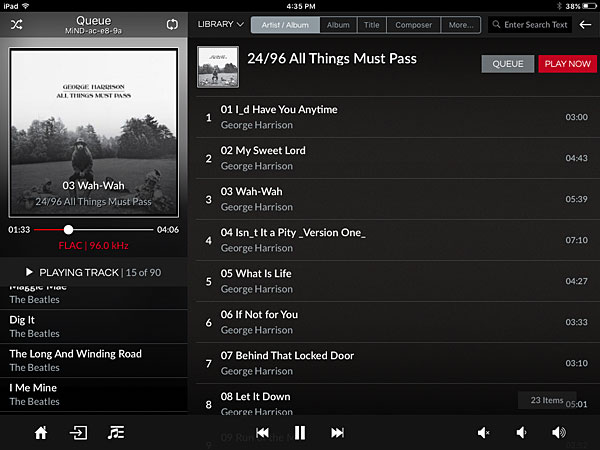 You can search for files by artist, title, composer, genre, style, playlist, etc. If there's album art, it appears. Via my iPad screen I could select a track to play immediately, or put the entire album at the top or bottom of the queue. Everything that's played goes in the queue, where it can be saved and recalled—or the entire queue can be erased.
There were glitches. The Search function didn't produce some albums I know to be on those hard drives. Sometimes, the drives would "disappear," and I'd have to go back to the main computer and remove and reinstall the UPnP Renderer to get them to reappear. There were other problems that probably were solvable but that don't merit detailed description in the context of a review, especially given the safe assumption that software upgrades will always be forthcoming.
Sound
You can search for files by artist, title, composer, genre, style, playlist, etc. If there's album art, it appears. Via my iPad screen I could select a track to play immediately, or put the entire album at the top or bottom of the queue. Everything that's played goes in the queue, where it can be saved and recalled—or the entire queue can be erased.
There were glitches. The Search function didn't produce some albums I know to be on those hard drives. Sometimes, the drives would "disappear," and I'd have to go back to the main computer and remove and reinstall the UPnP Renderer to get them to reappear. There were other problems that probably were solvable but that don't merit detailed description in the context of a review, especially given the safe assumption that software upgrades will always be forthcoming.
Sound
The Moon Evolution 780D took a long while to break in. It sounded good out of the box, but over time its sound relaxed a bit, loosened and opened up. I'm glad this review was delayed for a month or two: as good as the sound was during the initial listening period, it's since gotten much better. Between that paragraph and this I selected "Box of Rain," from the 24/96 edition of the Grateful Dead's American Beauty (DVD-A, Warner Brothers), and there it was. I still prefer the LP. The bass from the hi-rez file is astonishingly deep and tight, but sounds a bit pushed, and the top doesn't sing as on the original vinyl. This isn't the 780D's fault. It's a computer, after all: garbage in, garbage out—and a lot of garbage went into many of those early DVD-A files, whose mastering engineers were clearly trying to make a point about bass. That said, Miles Davis's Kind of Blue (24/96, Columbia/Legacy/HDtracks) demonstrated the 780D's sweet, detailed, spacious side.
It's already old news for anyone who already has a streaming DAC, so pardon my enthusiasm, but: We're finally getting the convenience long promised by digital audio. Especially exciting was the ability to seamlessly switch between hi-rez 24/192 PCM and DSD. I played a 24/192 rip I'd made of an LP of The Sound of Jazz, with Billie Holiday, Count Basie, Red Allen, Lester Young, and others, all recorded in stereo in 1957 (Columbia CS 8040). I've played this file many times, at audio shows and at home, and this was as open, precise, and analog-like relaxed as I've heard it—the spaciousness was similar to what I heard from Kind of Blue, but with a far more natural spread of instruments and voices across the stage. Billie Holiday sings "Fine and Mellow" backed by Mal Waldron's All-Stars, including Lester Young (her former beau), Coleman Hawkins, Ben Webster, Doc Cheatham, Jo Jones, and others. The edge usually present in Holiday's voice in the digital version, which is not there when I play the LP, was gone, yet the top end—especially the reverb of Columbia's 30th Street Studio—was undiminished, as on the LP: more so than I'm used to hearing from digital playback, and with greater refinement and delicacy than from the already very fine 650D, in comparisons with the 780D. Particularly excellent were the delicacy, sweetness, and textural resolution of the cymbals in "Fine and Mellow."
Among the 780D's strongest suits were the solidity of its soundstaging and its generous reproduction of space. With recordings that include such information, it produced stages of widths, depths, and heights that, a decade ago, seemed impossible from digital sources.
Of course, the 780D's abilities to decode up to DSD4x (DSD256), and to seamlessly switch between PCM and DSD, are major. I played a wide variety of DSD files from my laptop via JRiver, including Jeff Buckley's Grace (Columbia), Rod Stewart's Every Picture Tells a Story (Mercury), Pink Floyd's Wish You Were Here (Columbia), and John Coltrane's Giant Steps (Atlantic).
Not that playback was glitchless. More than a few times while playing DSD files, JRiver had a meltdown and went into buffering mode. Spinning rainbow circles ensued, and then the program refused to close, even with a forced quit. Sometimes it would quit when forced, but then the only way to open it again was to shut down and restart the computer. None of this was the fault of the Moon Evolution 780D, but it's a reality of computer audio. Maybe my laptop lacked sufficient RAM.
 Having instant access to so much great music was a musical power trip that was only intensified by yet another improvement in digital sound. This is not to say that CDs suddenly sounded texturally supple and three-dimensional. Switching between 16/44.1 and 24/96 (and up) files was like removing a glass wall from in front of the speakers.
Sonic Upgrade
Having instant access to so much great music was a musical power trip that was only intensified by yet another improvement in digital sound. This is not to say that CDs suddenly sounded texturally supple and three-dimensional. Switching between 16/44.1 and 24/96 (and up) files was like removing a glass wall from in front of the speakers.
Sonic Upgrade
Playing the highest-resolution recordings, whether 24/192 or DSD, the Moon Evolution 780D sounded like an evolutionary rather than a revolutionary improvement (though a genuinely major one) over the sound of the 650D. It was easy enough to compare the two—I still have the 650D—by revisiting many of the same files.
I never heard the Moon Evolution 750D, which a few owners and writers described to me as sounding somewhat more detailed than the 650D, but at the cost of being overly analytical, a tad harsh and bright, and almost too revealing of less-than-perfectly recorded and/or mastered music; overall, the 650D was said to be more pleasant to listen to. I reviewed the 650D in the November 2011 issue, and now I listened again to many of the recordings I'd used for that review, including Markus Schwartz & Lakou Brooklyn's superbly recorded and musically engaging Equinox (24/96 WAV, Soundkeeper).
The 650D sounded warmer but also "thicker"—as if I were playing an LP of the album with a spherical rather than a line-contact stylus. The 650D sounded "slower," the 780D "faster"—but not so fast that it missed the music's point.
The 780D's reproduction of Equinox was remarkably more transparent, with far more precise and delicate initial transients, even using the Moon Evolution 820S outboard power supply with the 650D but not with the 780D. In fact, while the 820S produced a big sonic improvement with the 650D, it wasn't really necessary with the 780D—at least, not in my system.
With the best hi-rez recordings, the 780D's transparency and graceful yet superbly detailed transient performance combined with an absence of glare, grain, and other digital artifacts to produce what was among the most transparent, if not the most transparent digital sound I've heard. It didn't sound at all thin or forward or bright—at least not on good source material.
 Yet in no way would I describe the sound as unpleasantly analytical or lacking in texture. The 24/192 file of Joni Mitchell's For the Roses produced, along with delicacy and flow, an in-the-studio immediacy and transparency that I've rarely experienced from a digital source. It rivaled the original LP. And though the sounds were very different, in this case they were different but equal: Even after 44 years of play, the vinyl still had more there there, if not the 24/192 file's spooky, in-the-studio transparency.
I imagine that the 750D produced a similar immediacy and transparency, but minus the delicacy and flow, which could be why some people preferred the less-resolving 650D. But given a good recording, the 780D delivered both, without sounding analytical or unpleasant in any way.
However, not even the finest DAC can make me appreciate the sound of 16-bit/44.1kHz CDs. Through the 780D they sounded about as good as they can, but that's not good enough for me to sit down and pay full attention—especially when, at the push of the MiND control, I can hear a high-resolution file. Or I can put on an LP.
From bottom to top, the Moon Evolution 780D bettered the already-pleasing 650D. The 780D is another step forward for digital sound quality, and especially in terms of access and convenience of music. I'm not sure if I'm ready to say that the 780D is "the promise of digital fulfilled," but it's brought us more than a few steps closer.
Conclusions
Yet in no way would I describe the sound as unpleasantly analytical or lacking in texture. The 24/192 file of Joni Mitchell's For the Roses produced, along with delicacy and flow, an in-the-studio immediacy and transparency that I've rarely experienced from a digital source. It rivaled the original LP. And though the sounds were very different, in this case they were different but equal: Even after 44 years of play, the vinyl still had more there there, if not the 24/192 file's spooky, in-the-studio transparency.
I imagine that the 750D produced a similar immediacy and transparency, but minus the delicacy and flow, which could be why some people preferred the less-resolving 650D. But given a good recording, the 780D delivered both, without sounding analytical or unpleasant in any way.
However, not even the finest DAC can make me appreciate the sound of 16-bit/44.1kHz CDs. Through the 780D they sounded about as good as they can, but that's not good enough for me to sit down and pay full attention—especially when, at the push of the MiND control, I can hear a high-resolution file. Or I can put on an LP.
From bottom to top, the Moon Evolution 780D bettered the already-pleasing 650D. The 780D is another step forward for digital sound quality, and especially in terms of access and convenience of music. I'm not sure if I'm ready to say that the 780D is "the promise of digital fulfilled," but it's brought us more than a few steps closer.
Conclusions
The price of the Moon Evolution 780D is high. If, like me, you have a wall full of SACDs, it's beyond frustrating to know that all that hi-rez music is still locked out, unable to be decoded by this well-built, well-engineered, superb-sounding, and otherwise versatile DAC. Nor is it (yet) compatible with Roon or MQA. Perhaps Simaudio will say something about these limitations in a Manufacturer's Comment.
But otherwise, Simaudio has upped its digital game in every way. If it meets your needs, and you have the hi-rez digital source material now or plan to get it soon—and if you can afford it—the Moon Evolution 780D Streaming DSD DAC is well worth a listen.
Again, I won't try to describe something that's best experienced visually, other than to write that, like magic, all of the files on my two hard drives, plus what's in my iTunes library and available via my Tidal subscription, were easily accessed via the app. Up popped all those 24/96 DVD-A files, 24/192 files, and iTunes 16/44.1 files.
You can search for files by artist, title, composer, genre, style, playlist, etc. If there's album art, it appears. Via my iPad screen I could select a track to play immediately, or put the entire album at the top or bottom of the queue. Everything that's played goes in the queue, where it can be saved and recalled—or the entire queue can be erased.
The Moon Evolution 780D took a long while to break in. It sounded good out of the box, but over time its sound relaxed a bit, loosened and opened up. I'm glad this review was delayed for a month or two: as good as the sound was during the initial listening period, it's since gotten much better. Between that paragraph and this I selected "Box of Rain," from the 24/96 edition of the Grateful Dead's American Beauty (DVD-A, Warner Brothers), and there it was. I still prefer the LP. The bass from the hi-rez file is astonishingly deep and tight, but sounds a bit pushed, and the top doesn't sing as on the original vinyl. This isn't the 780D's fault. It's a computer, after all: garbage in, garbage out—and a lot of garbage went into many of those early DVD-A files, whose mastering engineers were clearly trying to make a point about bass. That said, Miles Davis's Kind of Blue (24/96, Columbia/Legacy/HDtracks) demonstrated the 780D's sweet, detailed, spacious side.
Having instant access to so much great music was a musical power trip that was only intensified by yet another improvement in digital sound. This is not to say that CDs suddenly sounded texturally supple and three-dimensional. Switching between 16/44.1 and 24/96 (and up) files was like removing a glass wall from in front of the speakers.
Sonic UpgradePlaying the highest-resolution recordings, whether 24/192 or DSD, the Moon Evolution 780D sounded like an evolutionary rather than a revolutionary improvement (though a genuinely major one) over the sound of the 650D. It was easy enough to compare the two—I still have the 650D—by revisiting many of the same files.
Yet in no way would I describe the sound as unpleasantly analytical or lacking in texture. The 24/192 file of Joni Mitchell's For the Roses produced, along with delicacy and flow, an in-the-studio immediacy and transparency that I've rarely experienced from a digital source. It rivaled the original LP. And though the sounds were very different, in this case they were different but equal: Even after 44 years of play, the vinyl still had more there there, if not the 24/192 file's spooky, in-the-studio transparency.
I imagine that the 750D produced a similar immediacy and transparency, but minus the delicacy and flow, which could be why some people preferred the less-resolving 650D. But given a good recording, the 780D delivered both, without sounding analytical or unpleasant in any way.
The price of the Moon Evolution 780D is high. If, like me, you have a wall full of SACDs, it's beyond frustrating to know that all that hi-rez music is still locked out, unable to be decoded by this well-built, well-engineered, superb-sounding, and otherwise versatile DAC. Nor is it (yet) compatible with Roon or MQA. Perhaps Simaudio will say something about these limitations in a Manufacturer's Comment.