WP returned to the Metaphor 2 in April 1996 (Vol.19 No.4):
Around September, I began to hear rumblings out of Chantilly, VA that changes were in the cards for the Metaphor 2 loudspeakers I reviewed last July. Accordingly, I had a new pair shipped to Santa Fe so we could find out what Metaphor had wrought. They'd been busy—totally revamping the design. Bill Peugh regaled me with a list of over ten changes/refinements, encompassing everything from the cabinet to the shipping cartons. Only the price, it seems, is unchanged at $5950/pair.
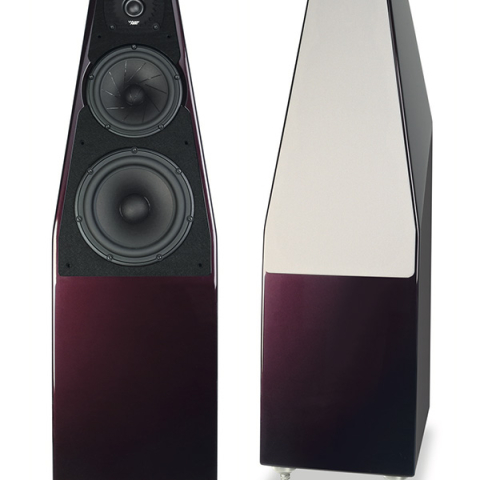
First off, while the enclosure is still constructed on the rigid, layered model of the original, it is now precision-cut, with all internal edges rounded and all joints interlocking. The baffle is 2" thick, the rear wall 1", and side walls vary in thickness from 1" to 1½". Internal damping has been reduced (a by-product of greater cabinet rigidity) and the enclosure has even less of a vibrational "signature" than before, according to Peugh. The wedge-shaped side panels are now meticulously constructed from solid wood, veneer, and MDF—they serve as an essential component of the cabinet tuning—and there is a new, more attractive finish, as well.
The drivers have been modified (Metaphor doesn't say how, only that the noise floor has been reduced), the internal wiring has been changed, and the grille is now nonremovable. The crossover is unchanged—it is still housed in a separate enclosure within the speaker cabinet—but it no longer rests on its own set of spikes. It remains decoupled from the cabinet, but moving the speaker has been made much simpler—thank goodness! And these days, there's even an owner manual.
Reading the manual, I was struck by the phrase, "Final tuning of room position should only be done after a minimum of 200 hours of playing time." Two hundred hours! Who are they kidding? I thought, I've never had to spend that much time breaking in a speaker. So I set 'em up in Stereophile's listening-room—about 25" from the rear wall and toed-in to focus 2' behind my listening position—and played 'em through the weekend. Come Monday morning, I was squirming in my listening seat—obviously finding it hard to concentrate on the music—when JA walked through on his way to his office. He stopped and listened for a minute, then opined, "Kind of stiff, aren't they? Why don't we give them a good kick in the arse?"
Chortling his evil, editorial chortle, he pulled out a copy of the Stereophile Test Disc 3 (STPH 006-2) and cued the burn-in track onto infinite repeat. This is a fun track: the assembled Stereophile staff banging on whatever came to hand, shouting, and playing kazoos. It's noise, random and persistent, overlaid with deep bass-synthesizer sweeps that can really rattle your foundation—even that of your house. For the next week, I ran that track at a fairly high level. Each day I'd come in and check on the Metaphors, each day they sounded looser and more limber—and much more coherent. I may well have put those 200 hours on them before I began to feel they were equal to the speakers I'd heard originally. (By the way, I could never have done this quick'n'dirty break-in at home. The burn-in track is fun, but I can't guarantee anyone's sanity after prolonged exposure to it.)
At this point, I got down to serious listening with a system consisting of a Krell KPS-20i CD player, an Audio Research LS-7 preamplifier, a VAC 80/80 or a Krell KSA-250 power amplifier, and TARA Labs RSC Master interconnects and speaker cables.
The VAC had been one of the amplifiers I'd used to good effect in my audition of the original Metaphor 2, but something didn't sound right when I began my serious listening. The midrange was glorious and the highs were sweet and liquid—but the low-end bloomed all over the place, lacking pitch definition and impact. O-tay, I thought, I've given the speakers a lot of time to break in, now let's fine-tune their placement. By pulling the speakers further into the room, I got rid of the boomy, under-damped bass, but at the expense of considerable extension. I liked the basic sound I was getting, but felt I was giving up too much potential. The earlier 2s had been a cinch to drive. Perhaps, I thought, these new guys aren't quite as sensitive. I grunted the KSA-250 into place and booted it up. Better. Much better.
The Krell really took charge, and the bass response was astonishingly deep and fast, but it wasn't quite as extended as I thought it could be, so I moved the speakers toward the rear wall again. Almost, but not quite, back to their original position, to be precise. Ahhhh. Now we were cooking!
As I listened to more music, I began to sense that the Metaphors I knew and respected were in the room at last. The top-end was extended, but not etched. The midrange was glorious. I couldn't get enough of vocal music—I played pre-Gregorian chant, gospel, sensitive singer/songwriter types, and an assortment of my usual favorite country songwriters. It was sounding pretty good. Yup. Pretty darn...Oh, who was I kidding? Something was still wrong: As good as the system sounded, I felt removed from the music.
As this auditioning was going on while we were preparing "Recommended Components," I'd been rereading Steven Stone's recent preamp reviews, in which he kept maintaining that the best preamp is the least preamp. I had also reread Martin Colloms's October '95 review of the Krell KPS-20iL—which includes a FET-switched attenuator. Hey, we have a '20iL at Stereophile! I took the LS-7 out of the circuit, installed the KPS-20iL, and started over.
OH MY STARS AND GARTERS! It's alive! It's alive! Music now had its dance-like properties restored and the Metaphors presented it with detail and clarity. The bass, while not subterranean, was extended, rock-solid, and well-defined in pitch. With discs featuring well-developed ambient information, the speakers disappeared into the different acoustic of the recording venue in a most satisfying way. Transient speed was exceptional—up there with the best I've heard. And, as always when you break through the good-sound barrier, I just wanted to play disc after disc after disc.
MC called it right, the Krell '20iL is a phenomenally transparent, dynamic, involving component and the Metaphor 2 revised reflected those properties—no, assumed them. Steven may be on to something, as well; I'm going to have to rethink my assumptions about preamplifiers, as a result of this experience.
I whipped out one of my favorite torture tests, Corigliano's Symphony 1 (Erato 2292-61132-2). The third movement starts rather sedately—there are passages first with muted cello, then with a piano heard offstage in the distance—but then builds, inexorably, to a shattering climax that will tax any system's dynamic limits. The Metaphors handled it with aplomb. The cello was warm and slightly nasal, as it should be, and the distant piano was clear and perfectly articulated, although...uh...distant. As the orchestra lumbered along in fits and starts toward the climax, the 2s kept their composure; at increasing loudness levels, they remained uncongested and open. Even during the massed cacophony of the penultimate measures, the Metaphors sounded as though they could continue to play even louder and louder. I've heard very few speakers that can match this level of dynamic performance—and most of them cost far more than $5950/pair.
Guy Clark's Boats To Build (Asylum/American Explorer 61442-2) features a duet with Emmy Lou Harris, "I Don't Love You Much," that stands as one of my tests for natural vocal timbre. Clark sings in a gruff, almost (not to put too fine a point on it) croaking baritone and Ms. Harris's silvery soprano sparkles above it. The sound is intimate—you almost feel like you're eavesdropping on pillow-talk—and the acoustic instruments are right there in the room (a small one) with the singers. It was all there. Perhaps there was a shade more distance between myself and the performers than I have grown accustomed to, but Stereophile's listening room is a lot larger than my living-room, where I listen in the nearfield. That said, we were all in the same room and, emotionally, on the same page.
I did become aware, over time, of some hardness in the 5–7kHz region. Mild, to be sure, and not consistent over the entire region, it was more a feeling that notes would sometimes pop out of passages with an emphasis that seemed ever-so-slightly misplaced. JA, on one of his trips through the listening room, suggested that piano music might tell the tale, so I played Cecille Ousset's artful interpretation of Ravel's Piano Concerto in G (EMI 7 54158-2) (footnote 1). As I listened to the Adagio, I felt that some of the notes in the long, lyrical piano line were emphasized in a way that had nothing to do with Ousset's interpretation. This was subtle, to be sure; if I were less familiar with the performance, I might have missed it completely. It was as though she were playing some keys with more emphasis than others—as though she were having to play around the limitations of a balky instrument. As that long, mournful, melodic line comes to a close, right before the orchestra enters, the score calls for a trill: the speaker's emphasis of specific notes turned the trill from smooth ornamentation into a ragged one.
I don't want to make too much of this flaw; piano is really, really hard to reproduce properly and, in my experience, most speakers in Class B have colorations of similar intensity. This one just happened to fall into an area where I am particularly sensitive. I'm not beyond suspecting the revisions in the Metaphor 2 have significantly lowered the noise floor of the speaker itself. It's quite possible the original shared this mild flaw, but masked it with its cabinet signature.
On the whole, my experiences with the Metaphor 2 revised were immensely enjoyable. Like its predecessor, it made me want to listen to music—all types of music—from morn until late, late night. It has astounding dynamic range for a speaker at this price point and, while not plumbing the bottom-most depths, its articulate bass is profound. I found it extended on top: easy to listen to, but not overly sweet.
From my experiences with the VAC PA80/80, I suspect that Metaphor has sacrificed some sensitivity in the revised version. Careful system matching is, as always, advised. This reads like a cautionary note and in a way it is, but it is also an acknowledgement of the very high payoff in listening pleasure that such attention to detail can offer. Place the 2s properly, pair them with an amplifier that has authority, and never, never compromise their transparency—I discovered the hard way that they take on the personality of whatever is upstream from them—then the Metaphor 2 will transport you to the realm of music. And ultimately, that is what it is all about.—Wes Phillips
Footnote 1: I'm a sucker for this work and urge everyone not familiar with it to find a copy immediately. The classic Michelangeli performance on EMI has just been reissued by Testament Records on LP (ASD 255) and is available from Acoustic Sounds. Not only is that performance rightly considered among the finest interpretations the work has ever received, but (mild tape hiss aside) it's an audiophile-quality demonstration disc to boot.
Footnote 1: I'm a sucker for this work and urge everyone not familiar with it to find a copy immediately. The classic Michelangeli performance on EMI has just been reissued by Testament Records on LP (ASD 255) and is available from Acoustic Sounds. Not only is that performance rightly considered among the finest interpretations the work has ever received, but (mild tape hiss aside) it's an audiophile-quality demonstration disc to boot.