Sidebar 2: Measurements
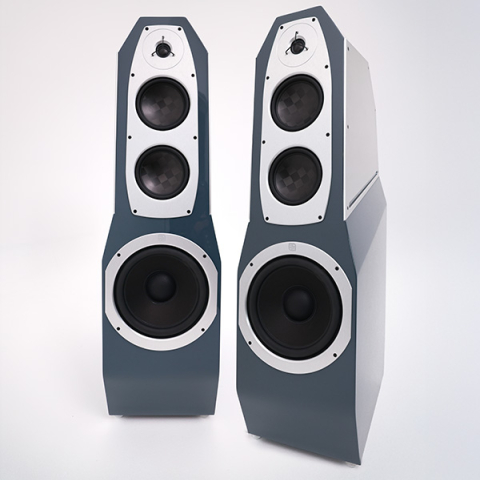
The Metaphor 2 will go loud with only a few watts of input power, my B-weighted measurement confirming the specified 91dB/2.83V/m. It is a moderately demanding load for the partnering amplifier, however, as can be seen from its plot of electrical impedance magnitude and phase against frequency (fig.1). The impedance drops below 6 ohms through the midrange and reaches 3 ohms in the mid-treble. Tube amplifiers are best used from their 4 ohm output transformer taps. The reflex port tuning for the twin woofers is revealed by the impedance saddle at 39Hz. A couple of wrinkles are noticeable in the impedance traces, just below 500Hz and at 850Hz. These indicate the presence of cabinet resonances of some kind.
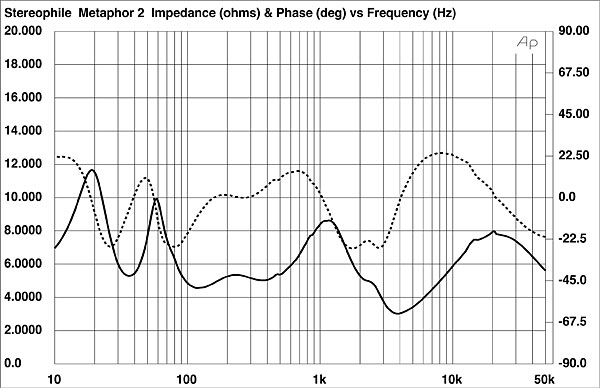
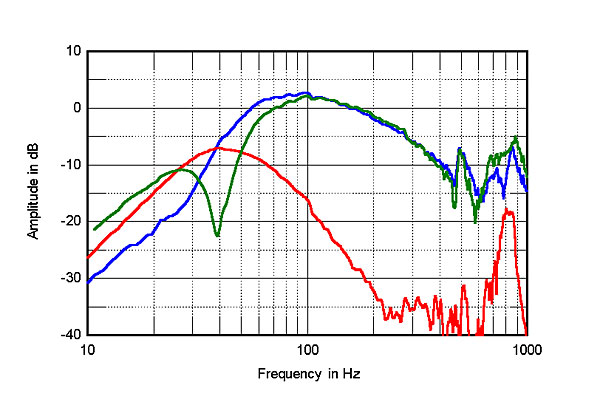
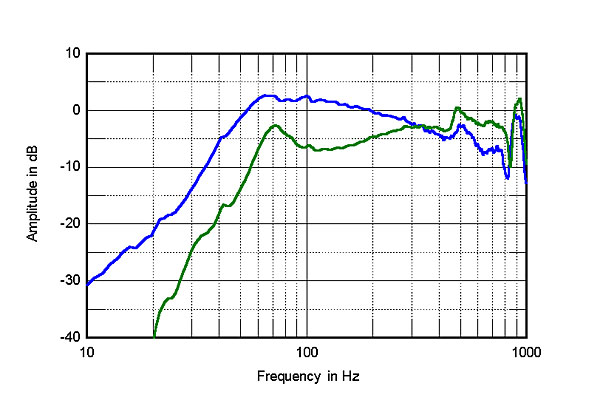
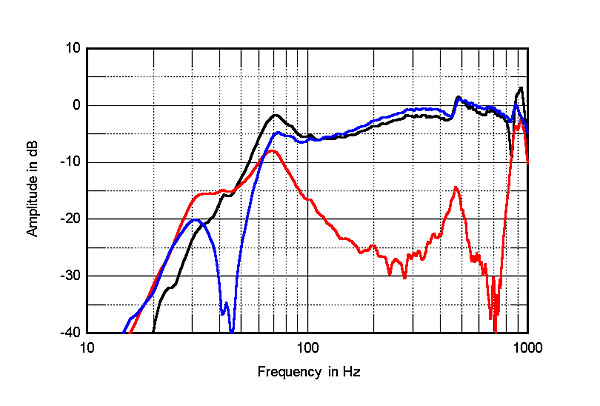 Fig.4 shows the overall woofers/lower-port and midrange/upper-port responses, together with their complex sum (the top curve), again weighted in the ratio of the root of the radiating areas. The midrange unit and port add a little bit of reinforcement to the woofers below 100Hz, but more importantly, make the combined response a little ragged between 500Hz and 1kHz.
 Regarding lateral dispersion, shown in fig.7, the output of the recessed tweeter does fall off quite rapidly in the top octave to the speaker's sides, though the speaker does have wide dispersion at the bottom of the tweeter passband. Bill Peugh recommends toeing-in the speakers so that the axes cross just behind the listener. This means that the on-axis dip at 5kHz fills in, giving a more evenly balanced mid-treble output. Note, however, the deep notch off-axis to the side at 2600Hz, presumably due to the midrange unit being asked to go a little too high in frequency. Predicting the effect of this kind of dispersion in a room is difficult. In all but very lively rooms, it will tend to make the balance sound rather polite. However, if the speaker's on-axis output is a bit peaky in the same region, as is the Metaphor's, then it might all balance out nicely.
 In the time domain, the Metaphor 2's impulse response (fig.8) is hard to interpret other than to note that the slow rise just before the 4ms mark implies a degree of time alignment. However, a look at the step response (fig.9) suggests that this is not so. The initial positive-going rise is the midrange unit, but then its slope is cut by the negative-going output of the tweeter, followed by the broad, slow rise of the woofers—except that these, too, are connected with negative polarity. I was so surprised by this that I checked the crossover connections and the step responses of the individual drive-units. Yup, this is how things appear to be connected. And the late arrival of the tweeter's output suggests that its baffle recess is slightly too deep, or that the baffle slope is a little too extreme.
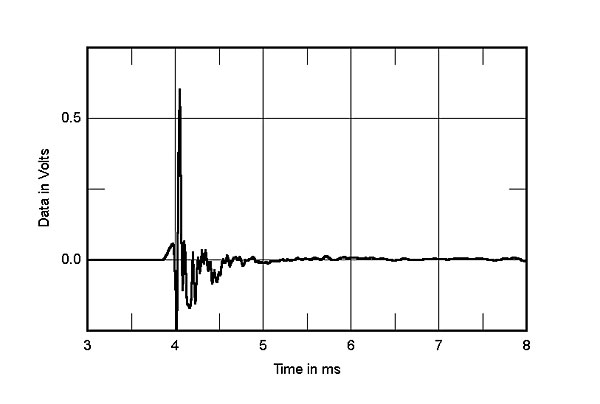
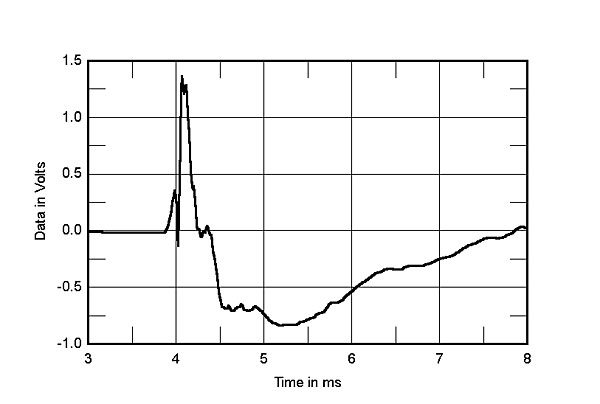
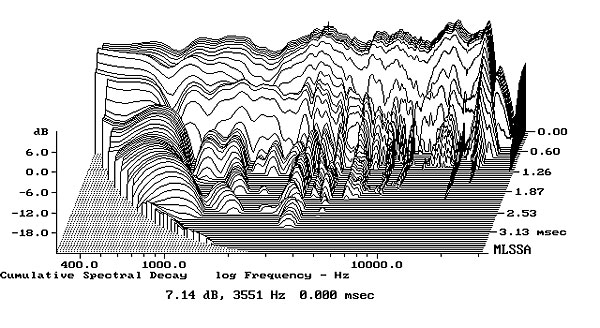
Fig.1 Metaphor 2, electrical impedance (solid) and phase (dashed) (2 ohms/vertical div.).
My usual test routine is to perform nearfield-response measurements on a loudspeaker system's low-frequency drive-units and ports, calculate the overall farfield low-frequency response from these nearfield responses, and splice them to the quasi-anechoic midrange and treble responses taken at a typical distance of 50" on the intended listening axis. To take these measurements, I use a B&K 4006 ½" omnidirectional microphone calibrated to be flat on-axis at my typical measurement distance, coupled with the DRA Labs MLSSA system, which I find to be both fast and accurate. With the Metaphor 2, however, I did a little more analysis than usual because the crossover performance turned out to be quite complex.
Fig.2 shows both the individual nearfield responses of the woofers (the trace plunging to a minimum at the port-tuning frequency of 39Hz) and of the lower, 3" port on the speaker's rear (the bandpass response centered on 39Hz). The farfield woofer response was calculated by taking the complex sum of these individual responses, allowing for the greater distance of the port and weighting the responses in the ratio of the square roots of their areas. This is the top trace in fig.2, and gently rolls off below 70Hz to reach a –6dB point at 45Hz. This is just above the lowest note of the four-string double bass or bass guitar, and is quite high for a speaker this large. The Metaphor design team obviously chose to utilize the enclosure size to achieve a highish sensitivity, relying on a relatively close boundary placement to reinforce and extend the low frequencies. (Bill Peugh recommends a distance of just 25.5"–28" from the inside rear corner of each speaker to the wall behind them.)
Fig.2 Metaphor 2, nearfield responses of woofers and lower port, plotted below 1kHz, with complex sum of woofer and port responses (top at 80Hz).
Note that the woofers have a sharp spike in their output at 490Hz, while the lower port features a large resonant peak centered on 800Hz. The overall rollout is marred by this behavior, with residual midrange energy present just a few dB down in the overall woofer response. I note that WP did not remark on any problems in the midrange, however, which suggests that this woofer behavior looks worse than it actually is.
Fig.3 shows a similar set of response curves for the midrange unit and its port: the upper, 2" one on the rear panel. The first surprise is that the midrange unit—the trace with the sharp minimum at 45Hz—is allowed to significantly overlap the woofers' output. The midrange port output is the bandpass response centered on 70Hz, with a plateau between 30Hz and 45Hz. When summed with the midrange output, it gives a 3dB peak between 65Hz and 75Hz; WP did notice an occasional "ripeness" in this approximate frequency region. The next surprise is the sharp peak just below 500Hz in the port output, coinciding with a notch in the midrange unit's nearfield response. This coincides both with a peak in the lower port output and a wrinkle in the impedance trace at the same frequency. It is presumably due to a standing-wave problem within the enclosure, but I found it actually quite hard to hear with a pink-noise signal.
Fig.3 Metaphor 2, nearfield responses of midrange unit and upper port, plotted below 1kHz, with complex sum of midrange and upper-port responses (top at 80Hz).
What I did find easy to hear using band-limited noise was the massive peak in the port output at 900Hz, which added a distinct whistling character to the sound. The graph is perhaps a bit pessimistic because it assumes a lack of masking by the enclosure. Nevertheless, this behavior is something that Metaphor should look into.
I had mislaid my accelerometer during the period I had the Metaphors in the Stereophile listening room, so I couldn't perform a detailed analysis of the enclosure's resonant behavior. However, listening to the enclosure walls with a stethoscope while I swept a sinewave tone up and down revealed that the veneered side walls vibrated strongly between 400Hz and 500Hz, coinciding with the peaks in the outputs of both ports. The back panel also vibrated strongly at 150Hz, adding a slightly buzzy quality to the speaker's reproduction of a pure tone. None of the cabinet surfaces seemed very lively at 900Hz, but pure tones revealed that the output of both ports could be heard to have an emphasis in this region. I would expect the effect on music will be to make treble instruments and female voices acquire a bit of a hooty overhang as they pass through this region, but only if they hit the exact frequencies of the port modes.
Fig.4 Metaphor 2, acoustic crossover between midrange/upper-port nearfield output and woofers/lower-port output, plotted below 1kHz.
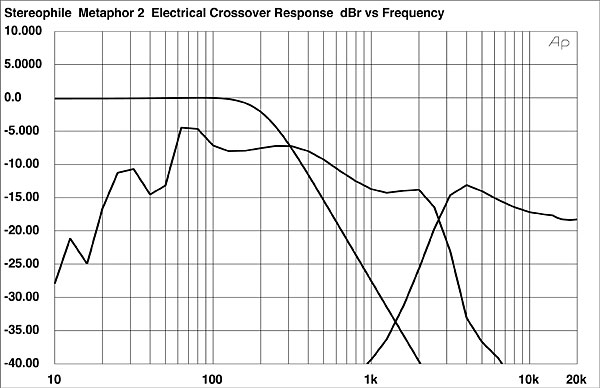
Because I was puzzled by the overlap between the midrange unit and the woofers, I graphed the electrical drive signals from the crossover filters, driving the speaker with a 1V signal and taking my signals from the points where the drive-unit cables are attached to the hard-wired crossover circuitry. The result is shown in fig.5. It appears that the woofers set the Metaphor 2's overall sensitivity, as both the midrange unit and tweeter are significantly padded down to match them. (The padding is achieved by paralleled bundles of low-wattage premium-quality resistors.) At the low end of its passband, the midrange unit is not rolled off until below its enclosure resonant frequency of around 63Hz. Higher up in frequency, its output is gently tilted down above 300Hz, presumably to compensate for what would otherwise be a rising on-axis response. The electrical crossover between the midrange unit and tweeter can be seen to be set to 2.6kHz, with initial slopes of approximately 12dB/octave on the tweeter and 18dB/octave on the midrange unit. The tweeter's output is also tilted down a little with rising frequency.
Fig.5 Metaphor 2, crossover electrical drive signals at 1V input level, measured at the cables to the drive-units (5dB/vertical div.).
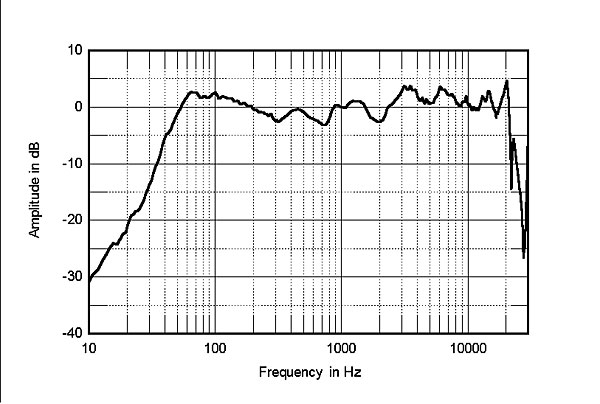
So how does this all add up? Fig.6 shows the Metaphor 2's quasi-anechoic response 50" away on the recommended axis, which is just below the tweeter, 37" from the floor. (Bill Peugh recommends the listener's ears be level with the tweeter but with the speaker tilted "a hair back from level.") The LF end of this graph is the overall complex sum of the nearfield midrange, woofer, and upper and lower port responses. The upper bass is raised a little, again as suggested by WP's auditioning, with a typical reflex rollout below 60Hz. The response is both rather uneven and tilted up between the lower midrange and the mid-treble, rising by a total of around 6dB. As with the Meret Audio Ay reviewed by Russ Novak elsewhere in this issue, this might be expected to make the Metaphor 2 rather intolerant of problems upstream of the speaker.
Fig.6 Metaphor 2, anechoic response on optimum axis at 50", averaged across 30° horizontal window and corrected for microphone response, with complex sum of nearfield midrange, woofer, and port responses plotted below 300Hz.
Fig.7 Metaphor 2, horizontal response family at 50", normalized to response on tweeter axis, from back to front: differences in response 90°–5° off-axis; reference response; differences in response 5°–90° off-axis.
Vertically (not shown), the Metaphor appears to be relatively uncritical regarding listening axis as long as you sit between the tweeter axis and the top of the upper woofer. Sit too high or stand, however, and a deep notch appears, again at the 2.6kHz midrange/tweeter crossover frequency.
Fig.8 Metaphor 2, impulse response on tweeter axis at 50" (5ms time window, 30kHz bandwidth).
Fig.9 Metaphor 2, step response on tweeter axis at 50" (5ms time window, 30kHz bandwidth).
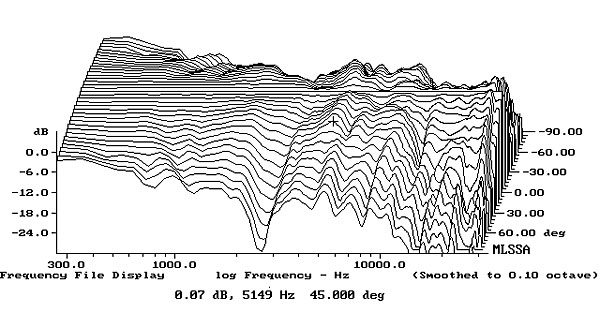
Finally, the Metaphor 2's cumulative spectral-decay, or waterfall, plot (fig.10) is generally very clean throughout the treble—this is an excellent tweeter—with just a few resonant modes present at the bottom of the tweeter's passband. These are coincident in frequency with the on-axis peak seen in fig.6. While this behavior might be due to midrange-cone breakup, it is possible that they are due to the cavity in front of the tweeter, which is about the right size to have such an effect.
Fig.10 Metaphor 2, cumulative spectral-decay plot at 50" (0.15ms risetime).
All in all, I was puzzled by the Metaphor 2's measured performance. While the overall response and balance are quite good—WP loved the sound of the speaker—there are aspects of the design that don't appear to make sense. Why, given the opportunity by the staggered front baffle and the recessed tweeter to achieve a time-aligned output, did the Metaphor design team connect the woofers and tweeter with inverted polarity? Why did they allow so much overlap to occur between the midrange unit and the woofers? This will compromise the design's ultimate dynamic range as the midrange unit is being asked to handle high levels of bass frequencies, though the 2's high sensitivity will compensate somewhat for this. Why spend so much effort on making the enclosure as rigid as possible, but not do anything about the midband resonant behavior of the ports? And why does the midrange unit need to be reflex-loaded at all? I hope that Metaphor addresses at least some of these questions in their Manufacturer's Comment. As good as the Metaphor 2 sounds, I suspect that there might be an even better loudspeaker hiding within.—John Atkinson