Sidebar 3: Measurements
I performed the measurements of the LKV PWR-3 with my Audio Precision SYS2722 system. Because the amplifier has a class-D output stage, I inserted an Audio Precision AUX-0025 passive low-pass filter between the test load and the analyzer. This filter mitigates RF noise that would otherwise drive the SYS2722's input circuitry into slew-rate limiting. Without the filter, 210mV of ultrasonic noise with a center frequency of 500kHz was present at the amplifier's output terminals. I used the filter for all the tests other than frequency response.
Because the PWR-3 is a class-D design, there was no formal need to precondition it before the testing. However, after operating the amplifier at 1/8 the specified power into 8 ohms for 20 minutes, the top panel was slightly warm, its temperature measuring 94.2°F/34.6°C.
The LKV PWR-3 preserved absolute polarity, ie, was noninverting, and its voltage gain at 1kHz into 8 ohms was slightly higher than the specified 26dB, at 26.36dB. The single-ended input impedance is specified as a very high 200k ohms. I measured 290k ohms at 20Hz and 1kHz, decreasing inconsequentially to a still very high 156k ohms at 20kHz.
The PWR-3's output impedance was impressively low, at 0.04 ohms at low and middle frequencies, 0.07 ohms at the top of the audioband. (These values include the series resistance of 6' of speaker cable.) The variation in the amplifier's small-signal frequency response into our standard simulated loudspeaker (fig.1, gray trace) response was therefore inconsequential. The LKV amplifier rolled off sharply above 30kHz, the –3dB frequency lying close to 60kHz. The PWR-3's reproduction of a 10kHz squarewave into 8 ohms (fig.2) featured a critically damped overshoot but no ringing.
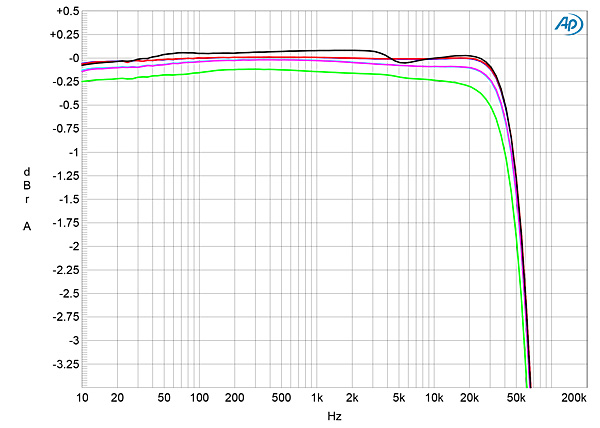
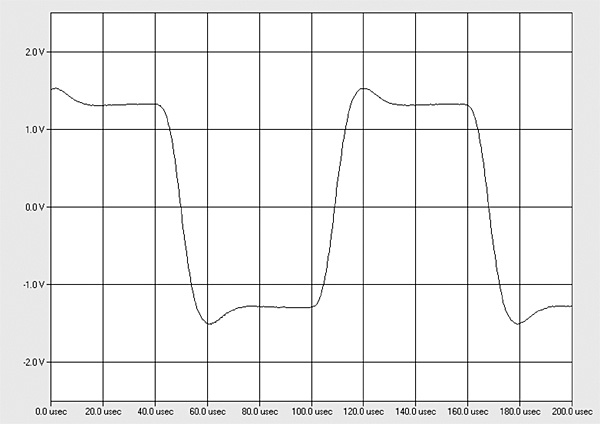
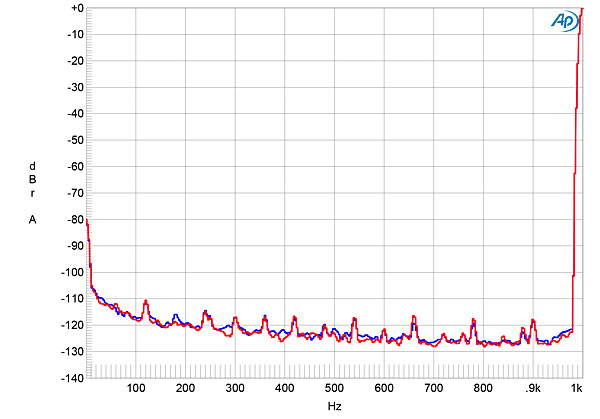
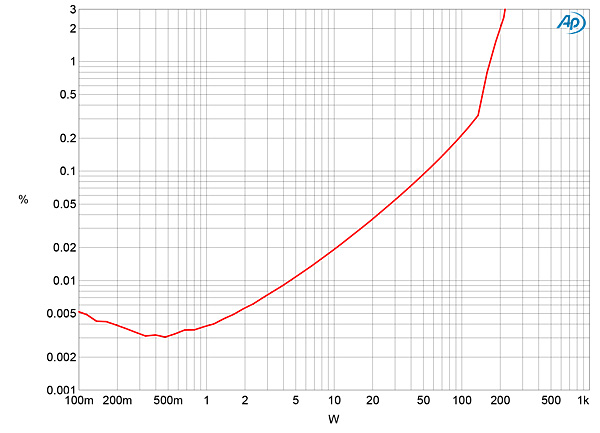
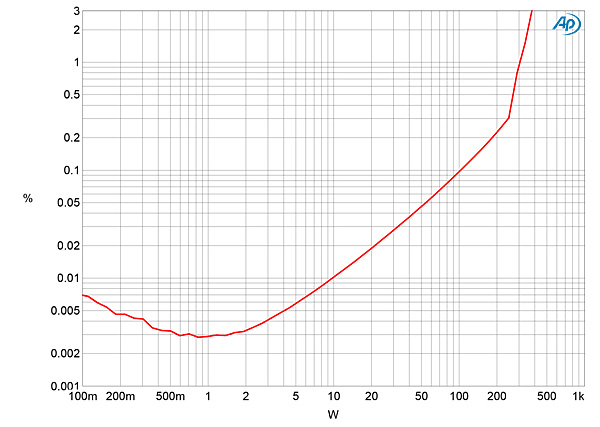
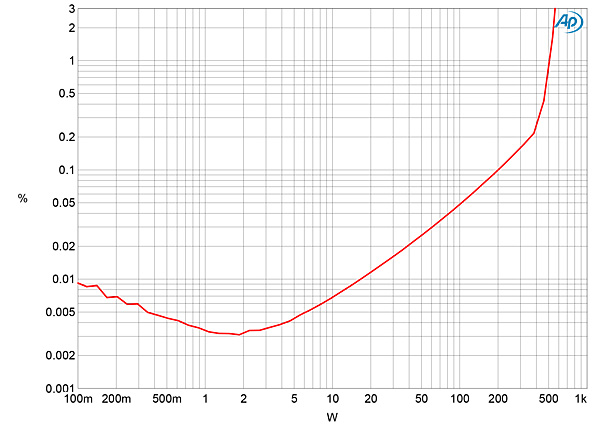
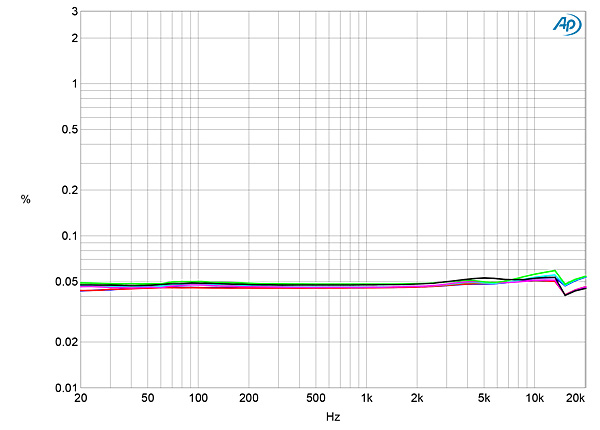
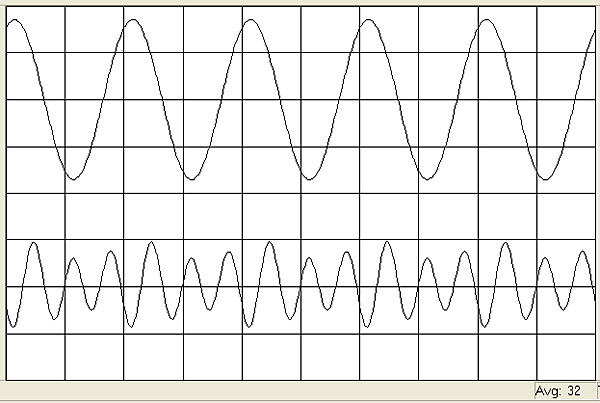
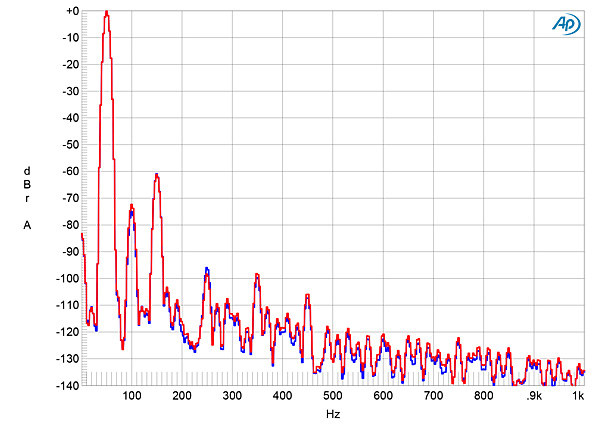
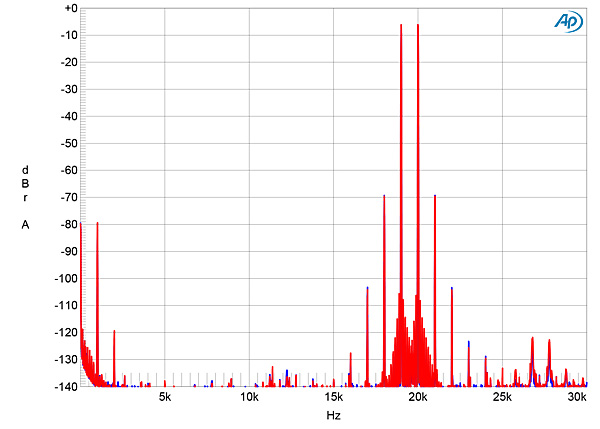
Fig.1 LKV PWR-3, frequency response at 2.83V into: simulated loudspeaker load (gray), 8 ohms (left channel blue, right red), 4 ohms (left cyan, right magenta), and 2 ohms (green) (0.5dB/vertical div.).
Fig.2 LKV PWR-3, small-signal 10kHz squarewave into 8 ohms.
The PWR-3's channel separation (not shown) was modest, at 63–70dB in both directions. The unweighted, wideband signal/noise ratio (ref.1W into 8 ohms with the auxiliary filter and measured with the input shorted to ground) was excellent, at 81dB (average of the two channels). This ratio improved to a superb 95.8dB when the measurement bandwidth was restricted to 22Hz–22kHz and to 99.75dB when A-weighted. Spectral analysis of the low-frequency noisefloor while the LKV amplifier drove a 1kHz tone at 1Wpc into 8 ohms (fig.3) revealed that as well as the very low level of random noise, AC-related spuriae lay at or below –110dB. This is a very quiet amplifier!
Fig.3 LKV PWR-3, spectrum of 1kHz sinewave, DC–1kHz, at 1W into 8 ohms (left channel blue, right red; linear frequency scale).
LKV specifies the PWR-3's maximum continuous power (at 1% THD+noise) as 175W into 8 ohms (22.43dBW), 360W into 4 ohms (22.55dBW—it is unusual for this to be higher than the 8 ohm figure), and 225W into 2 ohms (17.5dBW). With our usual definition of clipping—when the THD+noise reaches 1%—and with both channels driven, I measured a clipping power of 172Wpc into 8 ohms (22.35dBW, fig.4) and 305Wpc into 4 ohms (21.83dBW, fig.5). With one channel driven, the PWR-3 clipped at 500W into 2 ohms (21dBW, fig.6). The increase in THD+N above powers of 1–2W in these graphs suggests that the amplifier uses a limited amount of loop negative feedback.
Fig.4 LKV PWR-3, distortion (%) vs 1kHz continuous output power into 8 ohms.
Fig.5 LKV PWR-3, distortion (%) vs 1kHz continuous output power into 4 ohms.
Fig.6 LKV PWR-3, distortion (%) vs 1kHz continuous output power into 2 ohms.
Fig.7 shows how the percentage of THD+noise varies with frequency into 8, 4, and 2 ohms at 14.14V (equivalent to 25W into 8 ohms, 50W into 4 ohms, and 100W into 2 ohms). Commendably, the THD+N percentage was low and didn't increase as the load impedance was reduced.
Fig.7 LKV PWR-3, THD+N (%) vs frequency at 14.14V into: 8 ohms (left channel blue, right red), 4 ohms (left cyan, right magenta), and 2 ohms (left green, right gray).
The third harmonic was the highest in level (fig.8), with the second harmonic about 12dB lower (fig.9). Even at the high power into 4 ohms I used to create this graph, the third harmonic lay at a relatively low –60dB, with higher-order odd harmonics all below –96dB. With the PWR-3 driving an equal mix of 19 and 20kHz tones at 50Wpc peak into 8 ohms (fig.9), the 1kHz difference product lay at –80dB (0.01%). While the higher-order products at 18 and 21kHz were 10dB higher, that is still relatively low in level.
Fig.8 LKV PWR-3, left channel, 1kHz waveform at 50W into 8 ohms, 0.09% THD+N (top); distortion and noise waveform with fundamental notched out (bottom, not to scale).
Fig.9 LKV PWR-3, spectrum of 50Hz sinewave, DC–1kHz, at 100Wpc into 4 ohms (left channel blue, right red; linear frequency scale).
Fig.10 LKV PWR-3, HF intermodulation spectrum, DC–30kHz, 19+20kHz at 50Wpc peak into 8 ohms (left channel blue, right red; linear frequency scale).
Not only does LKV's PWR-3 offer high power coupled with very low noise and primarily low-order distortion; its linearity is independent of load impedance. This is unusual and commendable.—John Atkinson