Sidebar 1: Classy
Whenever a designer claims to be doing something fundamentally new—like "low-temperature class-A"—it makes one suspicious. True class-A is hot and wastes a lot of power, more than 50% of the total; there's no way around it. So how can you do class-A without heating up the room?
Variations on class-A that aim to derive some (or all) of class-A's benefits do exist. The variations that come immediately to mind are old-fashioned class-AB and various "sliding-bias" topologies, which typically track input (but sometimes output) and keep the bias current as large as it needs to be to keep the transistors from ever switching off (which causes crossover distortion).
Is "low-temperature class-A" a variation on sliding bias, like, for example, the approach used in the Krell K-300i integrated amplifier? "There are a lot of sliding-bias class-A amplifiers out there," Looman told Jason. "I think I've found a unique way to add a constant amount of power to the signal which allows me to run cooler than most other class-A with sliding bias." As I edited Jason's review, I inquired further.
"In sliding-bias class-A amplifiers, there are a couple of ways to set the bias such that all transistors are always conducting," Looman wrote in an email. "The traditional (first developed) method is a 'tracking' bias based on the input signal; other methods measure the output current (which is related to the music) and in real time change the bias to ensure optimum setting (such as the iBias system by Krell, for instance). Infigo's method is new in the way that it adds a constant amount of power independent of the music signal, to keep all transistors conducting. Because of this, the bias circuit is decorrelated from the music and there will be no undesired interaction to the music resulting from this.
"It is different from 'sliding' in the sense that the changes in bias are caused by the audio signal adding to a constant bias instead of a variable feedback based on the audio signal adding to an initial bias.
"There is of course a feedback system in Infigo's method to keep the added power a constant value, but it's decorrelated from the music."
That description reminds me of old-school class-AB. Is that all it is?
"In class-AB, the transistors that are on the half of the amplifier that is not contributing to the output current switch off above a certain setting." True. "In Infigo's approach, each half is separately biased to always keep conducting regardless of the cycle of the output signal." I'm no scholar of amplifier topology, but to me it does sound like something new, though experts may disagree.—Jim Austin
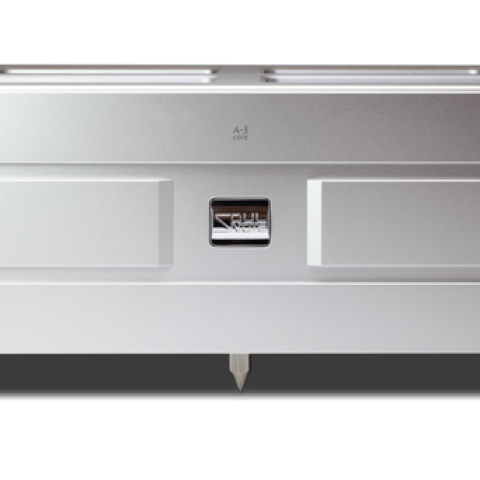
Infigo Method-3 monoblock power amplifier Classy

Company Info
ARTICLE CONTENTS
- Log in or register to post comments