

Sidebar 1: The Noise Cone
Although Hegeman no longer uses his "lily tweeter" in current designs, there are some other systems on the market now whose tweeters work in essentially the same manner, so it's worthwhile to examine just how these devices produce their 360-degree radiating pattern.
A conventional tweeter has its axis aimed forward, and the diaphragm movements push and pull the air in front of it. So how does a lily cone and its ilk manage to produce 360-degree air-pressure waves in a horizontal plane with its axis facing upwards?
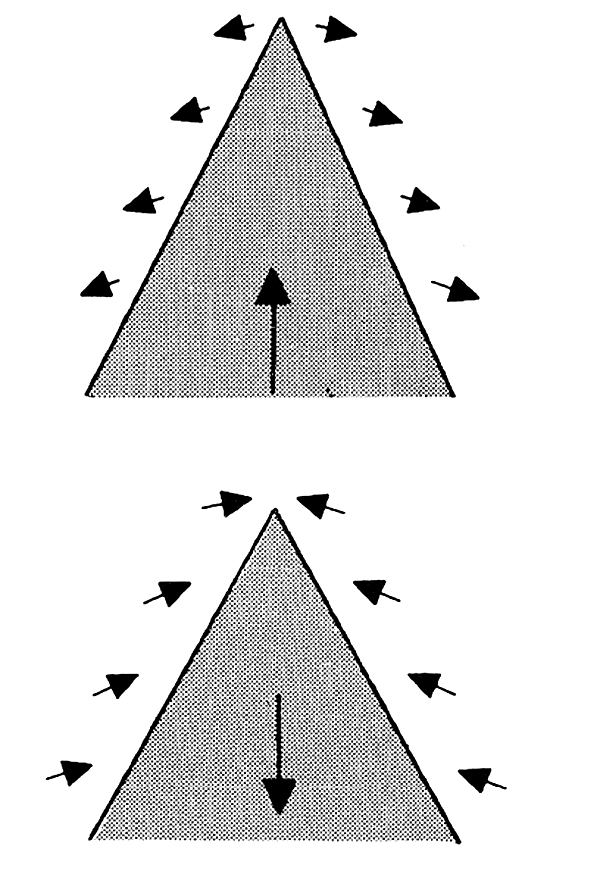 Forget for a moment that the lily cone is vibrating, but think of it as the nose cone of an aircraft, moving forwards. The air around it is (relatively) stationary, so as the cone passes through it, the air is first "pierced" by the point of the cone, and is then displaced more and more to the sides as the tapered cone opens an increasingly large "hole" in the air. The result is an air-pressure wave travelling out wards at a right angle to the direction of the cone's movement.
Now, if the cone reverses direction and starts to withdraw, the displaced air moves inwards to fill the diminishing "hole," and a rarefaction wave is produced. Vibration of the cone along its axis creates a series of compressions and rarefactions, radiating in all directions at a right angle to the axis of the cone. Stand the cone on end, with its axis vertical, and you have perfectly omnidirectional radiation throughout the horizontal plane around the tweeter.
Forget for a moment that the lily cone is vibrating, but think of it as the nose cone of an aircraft, moving forwards. The air around it is (relatively) stationary, so as the cone passes through it, the air is first "pierced" by the point of the cone, and is then displaced more and more to the sides as the tapered cone opens an increasingly large "hole" in the air. The result is an air-pressure wave travelling out wards at a right angle to the direction of the cone's movement.
Now, if the cone reverses direction and starts to withdraw, the displaced air moves inwards to fill the diminishing "hole," and a rarefaction wave is produced. Vibration of the cone along its axis creates a series of compressions and rarefactions, radiating in all directions at a right angle to the axis of the cone. Stand the cone on end, with its axis vertical, and you have perfectly omnidirectional radiation throughout the horizontal plane around the tweeter.
Forget for a moment that the lily cone is vibrating, but think of it as the nose cone of an aircraft, moving forwards. The air around it is (relatively) stationary, so as the cone passes through it, the air is first "pierced" by the point of the cone, and is then displaced more and more to the sides as the tapered cone opens an increasingly large "hole" in the air. The result is an air-pressure wave travelling out wards at a right angle to the direction of the cone's movement.















