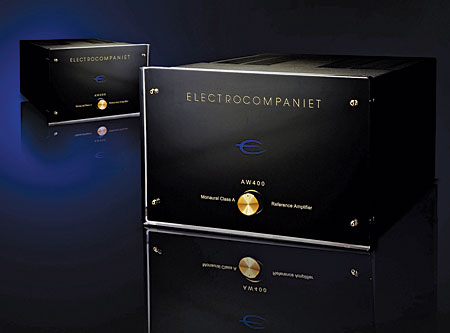
But I'm getting ahead of myself: The first song I actually listened to through the AW400s was Procol Harum's "Strangers in Space," from the newly reissued (and exceptionally well done) Something Magic (CD, Salvo SALVOCD029). Unrepentant tube snob and digiphobe that I am, I listened through the opening bars of Pete Solley's analog synth sounds, bracing myself for steely highs that didn't come. But I was still unprepared when Gary Brooker's voice entered, dead-center and sounding more whole than I'd ever heard it in my room. I listened on: His breathing was apparent, but neither that nor the sense of air around his mike was audio-nerdily exaggerated. (In my listening notes I scribbled the admittedly unoriginal observation, "It's like he was there," and emphasized it with a juvenile profanity.) No, Something Magic wasn't Procol at their best, but to hear it played back that well was to fervently wish that that particular lineup had made more than one album.
After several weeks with the AW400s—and, again, with the Electrocompaniet-Wilson combination in particular—I'm here to tell you: There is, quite simply, no earthly substitute for listening to the last 90 seconds of Mahler's Symphony 3 with a very powerful amplifier and a full-range loudspeaker. The version recorded in 2002 by Michael Tilson Thomas and the San Francisco Symphony Orchestra (AIFF/CD, San Francisco Symphony 821936-0003-2) is the one that actually precipitated that observation, but you might also try the very good Bernstein/New York Philharmonic (LP, Columbia M2S 675) and, for my money, the best of all, by Jascha Horenstein and the London Symphony (LP, Nonesuch HB-73023). As Hud says near the end of Cloverfield: "Yeah, that's the shit!"
So, too, might fans of classic rock believe that few combinations are more capable of putting across the force in their favorite music. Never mind that most of the genre's classic recordings are wildly overcompressed and exhibit a dynamic range that never strays far from 85–100mph—there are some wildly fine exceptions, and that's where the Electrocompaniet shone. Among them is a wonderful gem by the Who, Live at the Isle of Wight Festival 1970, containing a complete performance of Tommy (AIFF/CD, Columbia/Legacy C2K 65084). My usual combination of low-power Shindo tube amps and high-efficiency Audio Note loudspeakers is dramatic and fun on that and similar recordings, but there's a quality to the attack of each of those power chords and electric-bass notes—some facet of their overall sense of impact—that my reference combination misses. The Electrocompaniet amps driving the Wilson Sophia 2s nailed that impact, that punch, and the music was more enjoyable for it. But the AW400s did more well than just that: Their openness and clarity were a joy throughout that recording, from the subtlest stage banter through the downright sweet, singing tone of some of John Entwistle's bass lines—what a flexible, inventive performer he was!—to the wonderfully uncompressed sound (at least on this recording) of Keith Moon's drumming. Absolutely riveting stuff.
That brings to mind a final performance note: I spent a fair amount of time listening to the Electrocompaniets through my old Quad ESLs, and, as so often happens when the subject turns to Quads, the results were often surprising. To revisit a description I offered a moment ago, the combination didn't have the same easy, organic sense of note-flow as with a good tube amp, especially the 20Wpc Shindo Haut-Brion. Nor did the AW400s reproduce all of the deep textures of various reed and string instruments, such as Julie Price's beautifully played bassoon in Elgar's Romance for Bassoon and Orchestra, Op.62, with Paul Goodwin and the English Chamber Orchestra (CD, Harmonia Mundi HMU 907258). That said—and you can accept this or not, as you wish—the combination of high-power solid-state amp and Quad ESL sounded tighter and punchier than I imagined would be possible. Perhaps obviously, the sound wasn't nearly as forceful as with the Wilsons—but it was fun nonetheless! (NB: I wouldn't dream of trying the combination without a voltage-limiting protection circuit on my Quads; see my "Listening" column in the June issue of 2006.)
Conclusions
In a perfect world there would be enough room, enough time, and enough money that we could sample everything under the sun, anytime we liked. To an audio enthusiast, that's no small matter: There are thousands of different products available to us—special emphasis on different—and yet we're allowed to change our philosophies only once or twice in a lifetime, lest we run afoul of The Rules. What the hell: Do it anyway. I know a good place to start: The Electrocompaniet AW400 is a sweet, fun, and unabashedly powerful-sounding amp. It's an easy recommendation for listeners who need this combination of force and musicality, and a potential ear-opener for those who haven't tried such a thing in a while. Surprised though I was in a philosophical way, the AW400 is an expectedly great amp from a company with a remarkable history.
In a perfect world there would be enough room, enough time, and enough money that we could sample everything under the sun, anytime we liked. To an audio enthusiast, that's no small matter: There are thousands of different products available to us—special emphasis on different—and yet we're allowed to change our philosophies only once or twice in a lifetime, lest we run afoul of The Rules. What the hell: Do it anyway. I know a good place to start: The Electrocompaniet AW400 is a sweet, fun, and unabashedly powerful-sounding amp. It's an easy recommendation for listeners who need this combination of force and musicality, and a potential ear-opener for those who haven't tried such a thing in a while. Surprised though I was in a philosophical way, the AW400 is an expectedly great amp from a company with a remarkable history.