Sidebar 3: Measurements
Paul Miller measured the F-Dur turntable and its F-Note tonearm for sister publication Hi-Fi News. PM found the F-Dur superior to its predecessor, the older EAT Forte S, with its TPE-damped alloy platter, "continuous polymer belt with carbon fiber, and low-noise AC motor."
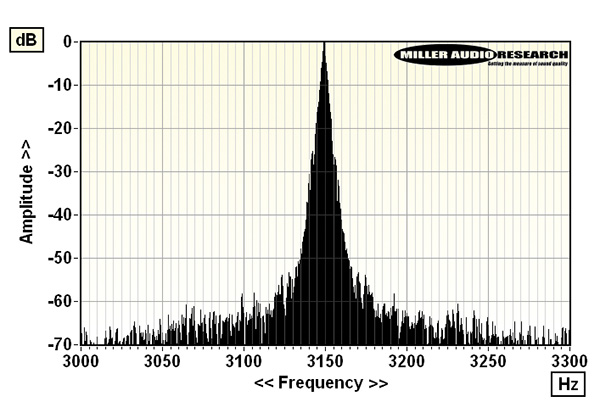
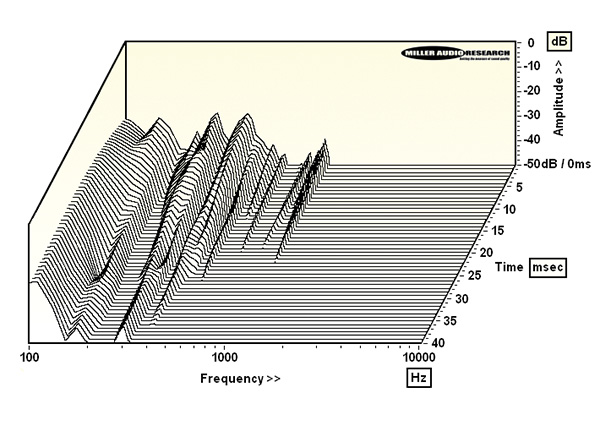
Fig.1 Wow and flutter ref. a 3150Hz tone at 5cm/s, plotted ±150Hz, 5Hz per minor division.
Paul found very low through-groove noise, at –74dB (DIN B-weighted), and very good absolute speed accuracy—just 0.045% slow. Peak wow was very low, at 0.02%, and flutter—higher-frequency fluctuations—added up to 0.05% and consisted mainly of random noise rather than discrete sidebands (see fig.1).
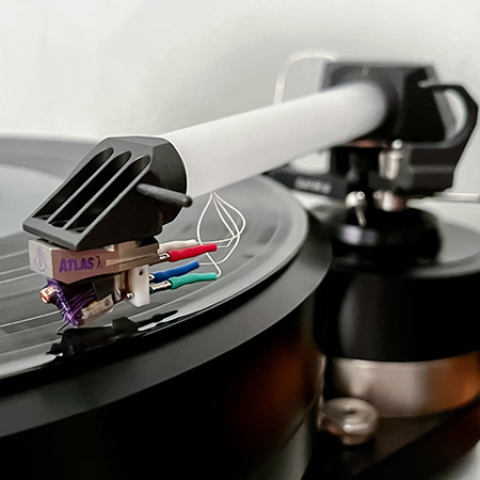
Turning to the tonearm, PM noted that its high effective mass means it is suited best for low-compliance cartridges. The provided cartridge, Jo No.5, which is based on an Ortofon Quartet Bronze, is a pretty good compliance match but also quite heavy at 15gm. Its compliance of 11–12cu results in an arm/cartridge resonance of about 7Hz, a bit below the optimal range—though Paul notes that the heavy record weight supplied with the F-Dur should squash the warps that could cause resonance problems in that range.
Fig.2 Cumulative resonant decay spectrum for the F-Note arm illustrating various structural, headshell, and tube vibration modes, 100Hz–10kHz over 40ms.
Paul detected a fairly typical variety of resonances in the F-Note armtube, starting with a primary bending mode that's "respectably high" in frequency at 96Hz. The CSD waterfall plot (fig.2) shows a complex set of resonances typical of a curved armtube, most prominently at 160Hz, 290Hz, and 430Hz. Bearing friction was very low both vertically and horizontally, at ~5mg in both planes. The 12" arm length, adjustable azimuth and VTA, and provided laser alignment tool will allow for very accurate setup, PM concluded.—Jim Austin