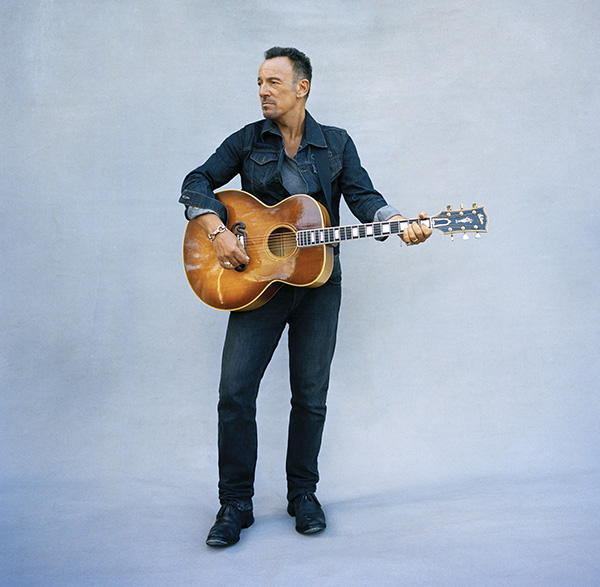
Photo by Danny Clinch
Seeing Bruce Springsteen perform live in the 1970s and early '80s, pre–
Born in the U.S.A., could be a life-changing experience. Bruce was the hungry leader of a relentless, turn-on-a-dime R&B band. A burning star streaking across the rock'n'roll sky, he threw his fiery young self into maximum shows full of urgency (to invoke one of his best rhymes) and those wordy, anthemic pleading/strutting urban fairy tales. He was leagues beyond almost everything and everyone else in those days.
The reality of creatives and creativity, however, is that the muse is fickle. No one can hope to function at their highest level of inspiration forever. Since 2002's
The Rising—or if I'm being generous, 2020's
Letter to You—the once untouchable singing and songwriting dynamo has been floundering through fallow fields. Albums like 2009's
Working on a Dream and 2014's
High Hopes are at least as forgettable as that earlier low point, the 1992 pairing of
Human Touch and
Lucky Town, two albums released on the same day.
Most of what's on the new box set,
Tracks II: The Lost Albums, was recorded after Bruce had passed the peak of his creativity. These seven albums (though one's more a collection of tracks than a coherent album) and 82 tracks that make up this bounty (the first
Tracks set was released in 1998) are the sound of the maturing Springsteen after the waves of passion had passed. It's noticeable here, for example, how female characters are invariably referred to as "wives." Rosalita and Sandy are distant memories.
A problem for Springsteen completists at least is that the credits on
Tracks II are not granular enough. They don't tell us what players are playing on each track or exactly which take of the track you are hearing. Other than Springsteen's own essays, which accompany each album and mention where in his discography these sessions fit, precise dates are lacking.
These albums also mark the time when instead of assembling the band and working it out in the studio, Springsteen was getting better at recording tracks at home. As writer Erik Flannigan notes in his excellent introductory essay, "In the winter of 1981–82, Springsteen began working on a TEAC 144 Portastudio multitrack cassette recorder, ... [which] enabled him to craft a song's arrangement, structure, and tone, as well as allow for bounces and vocal effects."
I auditioned this album using prerelease WAV files. Despite the fact that most of this material was recorded in a home studio, the sound is good to excellent. Four of the albums hold worthy discoveries. The 18 tracks of
LA Garage Sessions '83 are basically the demos for
Born in the U.S.A., although only one tune, "My Hometown," made it onto the album. While much from these sessions has, according to the liner notes, "emerged on B-sides and anthologies," several tunes from the '83 sessions are not well known, including "Jim Deer," a charming, compact slice of Americana in the vein of
Nebraska and
The Ghost of Tom Joad.
Recorded in his second Los Angeles–area house (after the first was damaged in an earthquake), the
Streets of Philadelphia Sessions is the Springsteen album most coveted by Bruce cognoscenti because it was built on West Coast hip-hop drum loops. Eventually, Zack Alford (drums), Tommy Sims (bass), and Shane Fontayne (guitar), all of whom toured with Bruce during the
Human Touch/Lucky Town tour in 1992–'93, went into A&M Studios in 1994 and added their instrumental voices to six of the 10 songs. Despite that, this is still mostly the sound of Bruce playing all the instruments himself, including a lot of Yamaha DX7 and Korg M1 synthesizer. The biggest revelation from these sessions is the easygoing "Waiting on the End of the World." The upbeat "One Beautiful Morning" is worth a second listen.
Springsteen's "country" album,
Somewhere North of Nashville, was tracked after the 1995 release of
Greatest Hits and at the same time as the sessions for
The Ghost of Tom Joad. Here is old-time rocker Springsteen cutting loose on rockabilly rock-outs "Repo Man" and "Detail Man," both in the same bloodline as "Pink Cadillac."
For those with a high tolerance for cheese, the West Coast–influenced
Twilight Hours is hands down the most astonishing discovery within
Tracks II. In his liner-note essay, Bruce attributes this music to listening to "Glen Campbell, Jimmy Webb, Burt Bacharach, those kinds of records. I don't know if people will hear those influences, but that was what I had in my mind." Recorded in 2012, this is Bruce writing, singing, and becoming a reasonable facsimile of the suave pop of Sinatra-meets– Burt Bacharach. Smooth, string-heavy arrangements and lyrics from the guy who wrote "Thunder Road" are nothing short of mind-bending. "Late in the Evening," on which he croons "Come late in the evening/Drive home in my car/'Neath a sky without a star/And wonder where you are," seems convincing and heartfelt, but coming from Bruce it is also profoundly strange. But it is no stranger, it must be said, than Bob Dylan growling his way through "Here Comes Santa Claus."
Artists need to grow to stay vital. This surprising turn from Springsteen into an unexpected stylistic quarter is remarkable, and it's the best reason to own
Tracks II: The Lost Albums. In his liner essay, Boss crooner exclaims, "Andy Williams! I'm a fan. All this stuff could have come right off of those Sixties albums. It's for lovers only."
Thanks to Neil Young and Bob Dylan, the concept of rock giants unveiling vaults of previously unknown recordings is no longer a revelation.
Tracks II: The Lost Albums is for dedicated fans who'll be grateful that, as Bruce explains in his notes to the
Streets of Philadelphia Sessions, "I always put them away, but I don't throw them away."