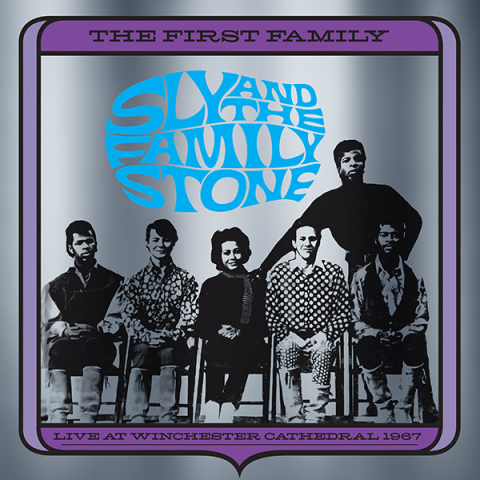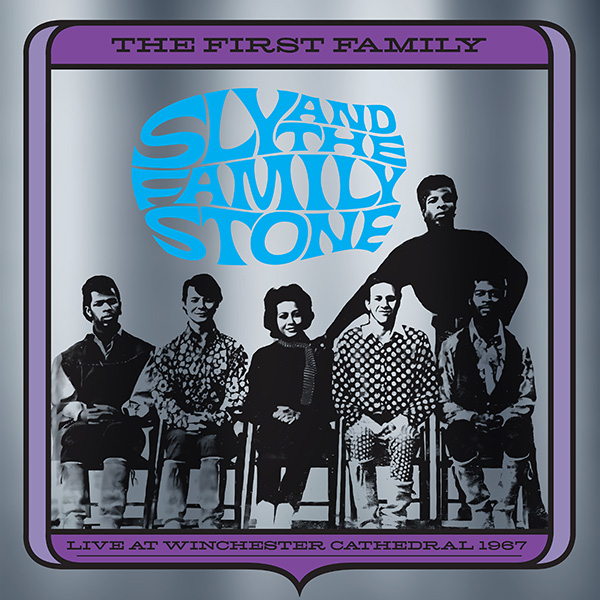
Super fans who dig deeper into a favorite artist's recording catalog eventually come to the crossroads of performance versus sonics. In the case of Sly Stone, who died this past June at age 82, that question has new relevance with the release on CD and vinyl of a "new" Sly and the Family Stone record, The First Family: Live at Winchester Cathedral 1967.
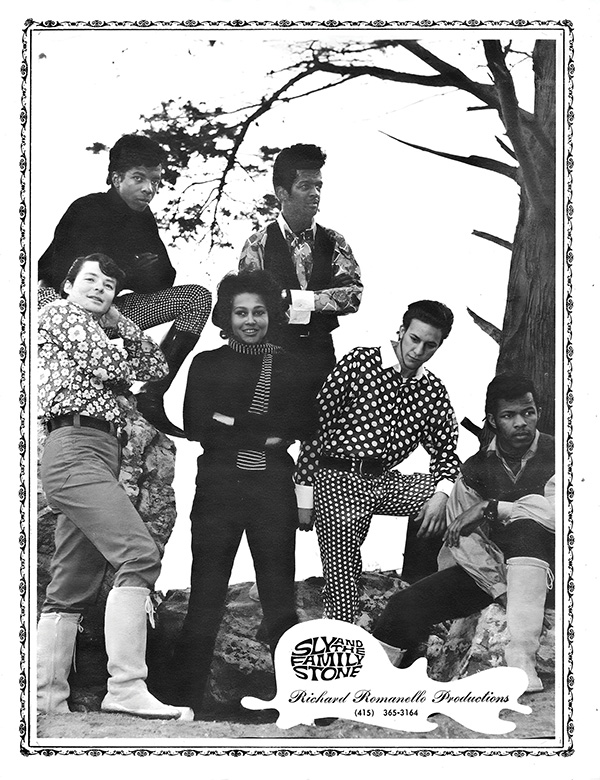
The audio document of an afterhours performance at a teen club in Redwood City, California, that was named after the 1966 novelty hit by the New Vaudeville Band, this performance is described in the liner notes (with slight hyperbole) as: "The grooves are consummate with the state of R&B in early 1967, but the arrangements are different and complex, the routines less facile, the vibe intrinsically creative." This is the sound of the embryonic Sly & the Family Stone, a band that would soon go on to change popular music forever. Sly Stone (keys and vocals), Freddie Stone (guitar and vocals), Rose Stone (keyboards and vocals), Cynthia Robinson (trumpet and vocals), Greg Errico (drums), Jerry Martini (saxophone), and Larry Graham (bass and vocals) were a can't-miss mass of musical talent.
Sly, born Sylvester Stewart, from Vallejo, California, was a popular if unconventional deejay at KSOL, San Francisco, where he used to sing and play piano along with R&B singles as well as discs by The Stones, The Beatles, and Bob Dylan. At the time he was also playing in his own bands, including Sly & The Mojo Men and The Stoners. In 1966, he and younger brother Freddie merged the best players from all their current bands to form Family. The 2025 documentary Sly Lives! (aka the Burden of Black Genius), by Ahmir "Questlove" Thompson, is a wonderful exploration of Sly's history and influence.
From the start, Stone talked and practiced the equal participation needed to be a "family." "Everybody's got an ego, they like to be heroes when they go home, and a lot of guys who lead groups don't realize that," Sly said, quoted in the liner notes of Live at Winchester Cathedral 1967. "Even the guys in the back, let them get up front, let them lead some parts, let everybody know their names as well. It makes them feel secure. That's the way I look at it. It will always be that way with me." In those liner notes, Errico, the drummer who formed the integrated group's rock-solid rhythm section with bassist Larry Graham, recalls the hard work of the Family's early days. "This is gonna be boot camp. It's not just getting all the right people or putting this magic combination together. You still have to physically, mentally, and emotionally go through all the processes. If it was easy, everybody would be doing it—but it's not easy."
According to the liner notes by producer Alec Palao, the biggest sonic hurdle in this project was vocals missing or only audible via bleed into nearby microphones. Palao, a Sly fan and practicing musician, has worked on previous reissues for Rhino Records, Craft Records, Light in the Attic Records, Omnivore Recordings, and the Numero Group. In his liner notes for this release, Palao recalls, "It seemed that any direct feed from the vocal PA system, where singers Freddie and Larry would have been heard, is the victim of sloppy engineering and left their voices only to be picked up by the mics on the drums, horns, and Leslie cabinet for the organ."
At first Palao thought this was a two-track recording, but eventually he discovered that the recording had been captured on a Crown portable ¼" four-track machine, by Action Recorders of San Mateo, California. At the center of both the playing and songwriting, Sly played a Farfisa Combo Compact organ and a Hammond B3 with a Leslie amplification unit.
"In those days, when they used to do live recordings, even if it was sort of crude multichannel, occasionally a major label might cart along a three-track or a four-track to a gig, but generally for smaller things a multitrack recording is unusual," Palao told me in an interview from his Bay Area home. "Here, the miking was bad. The bass, which was a very important part of the Family Stone sound, was under-recorded, and the guitars were intermittent. But luckily, the recording was very strong on keys, horns, and drum signals across the tape. And there was enough ambient bleed to be able to present the whole ensemble sound. Whatever vocals there were on this tape were kind of ambient. The signal was coming from the speaker columns for the PA but going through the mikes on the drums.
"Once I did a proper transfer and extracted as much as I could from the actual tape, I set to work using the various tools we have now. I'm generally an iZotope guy, but I've also gone into SpectraLayer. I think they do a simple, straightforward separation thing." The "separation" Palao refers to is the process of isolating individual sound sources from a mixed audio recording. This involves techniques and software to extract distinct signals like vocals, drums, etc. "Separation has come a long way since I worked on this. It seems like every other month there's some amazing [new] way to split stuff up. But I'm always wary of that, because I still haven't heard anything that even with a studio recording can split it cleanly, without any kind of weird artifacts or that kind of watery, MP3-type sound."
"The thing to remember is that these might have been soul covers, contemporaneous material, stuff the crowd would have recognized from the radio, but they're sitting down because it's an after-hours show. They're not dancing. They're actually paying attention to the arrangements and the performance.
"This was a performance worth working on," Palao concludes. "It was fairly clean overall. There was a little bit of 60-cycle hum, which you normally get when you have a Leslie, but it wasn't that noisy, and it wasn't that hissy either. There was good headroom there.
"It's amazing when you hear something like this that demonstrates that this was a band that had it all. It was just a matter of time before they became successful."
Usually blamed on drugs and his capricious nature, Sly's descent into obscurity shortened a brilliant career and left the world wondering what might've been. His twin studio masterpieces with the Family, Stand! (1969) and There's a Riot Goin' On (1971), still divide fans between those who lean toward the pop songcraft and social commentary of Stand! and those drawn to the darker funk and acidic, addictive haze of Riot. Both have been reissued innumerable times on CD, vinyl, and digital. For Stand!, I prefer the 180gm vinyl reissue on Epic from 2014. While there are also many versions of Riot—the Sundazed reissues of both albums are worth hearing—the 2013 ORG 180gm, 45rpm vinyl cut of Riot still edges out the competition.
For those seeking a broader survey, the 2013 Epic box set Higher!, on four CDs or eight LPs, which begins and ends with Sly solo tracks, is definitive.
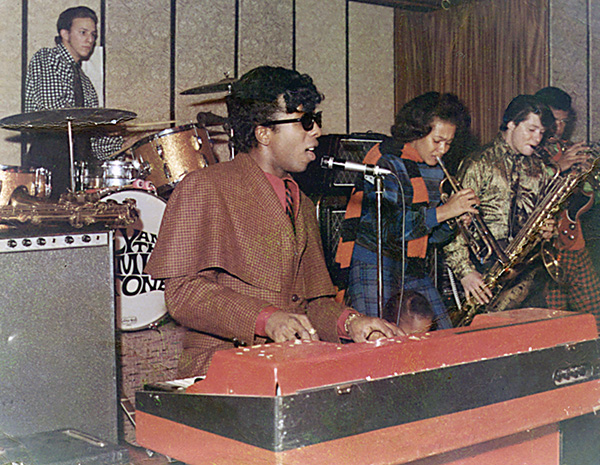
Sly and the Family Stone performing at the Winchester Cathedral, 1967: (L–R) Greg Errico, Sly Stone, Cynthia Robinson, Jerry Martini. Photo courtesy of Cynthia Robinson.
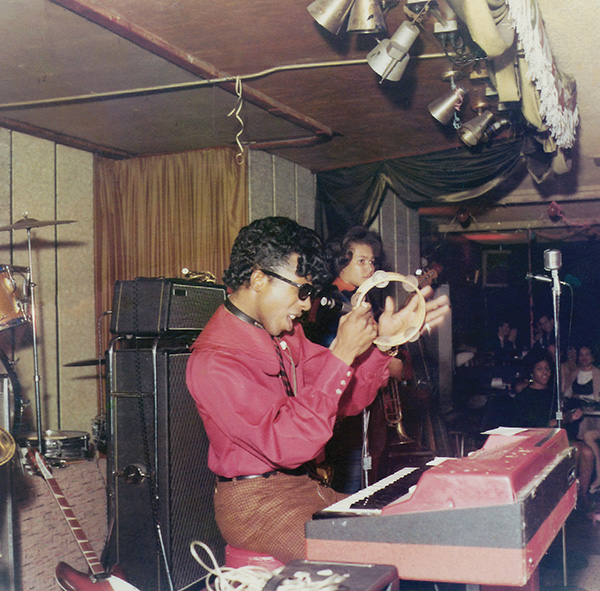
Once they started playing live shows, the Family Stone was quickly drawn into the orbit of local club promoter Rich Romanello, who was managing another Bay Area band, The Beau Brummels, and later took over the club he renamed Winchester Cathedral. As Romanello remembers in the notes, "The club looked great. Red carpet, red wallpaper, the big mosaic, the big stained-glass window. We might have jammed 300 in there on a couple of nights. But this was not a sweaty dance hall; you got tables and chairs. This was a night club." In those days at that time, an after-hours club didn't need a liquor license, but the tables and chairs (filled by teenaged white girls in the photos inside the Winchester 1967 package) were necessary to abide by a law that made it illegal to dance after hours.
Live at Winchester Cathedral 1967 is another example of how patience, liberal lucre, and the continued advancement in manipulating ones and zeros can produce audio near-miracles. While the recording has been a known commodity for years, fresh advances in audio technology finally allowed this performance, made even more essential by Sly's passing, to emerge finally in listenable form. While still nowhere near studio quality, it captures a particularly early and enthusiastic performance of one of the most talented American soul and rock bands of all time.
Sly Stone performing at the Winchester Cathedral, 1967. Photo courtesy Of Cynthia Robinson.
Opening with "I Ain't Got Nobody," the only Sly original in the set, the leader's vocals on the restored recording still aren't entirely clear, but it's immediately obvious that the band is on fire. That's followed by "Skate Now," which has many similarities to the band's hit-to-come, "Dance to the Music." A superfast version of the Joe Tex hit "Show Me," with Larry Graham on vocals, is next. This electrically charged gig, led by drummer Greg Errico, whose playing is the recording's most prominent feature, continues in a fast cover of the Otis Redding hit "I Can't Turn You Loose" and a slow, dramatic reconstruction of The Four Tops' "Baby I Need Your Loving." Cynthia Robinson struts her way with a trumpet mute through a slow cover of the jazz standard "St. James Infirmary." A bouncy mashup of "I Gotta Go Now (Up on the Floor)" and the Dyke and the Blazers hit "Funky Broadway" closes the show. A version of Freddie Stone singing "Try a Little Tenderness" is only available on the CD version. The vinyl version, cut by Kevin Gray at Cohearent Audio, was pressed at Cleveland's Gotta Groove Records.
"I tried not to be dramatic about it," Palao continues. "I just tried to pull as much of the vocal up as I could and just kind of balance it out and get a stereo image that could communicate the sort of electricity that you can definitely hear.
Promotional photo of Sly and The Family Stone, 1967, courtesy Of Rick Webster.