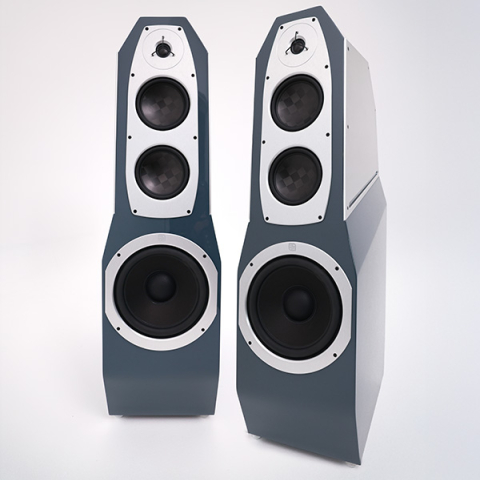
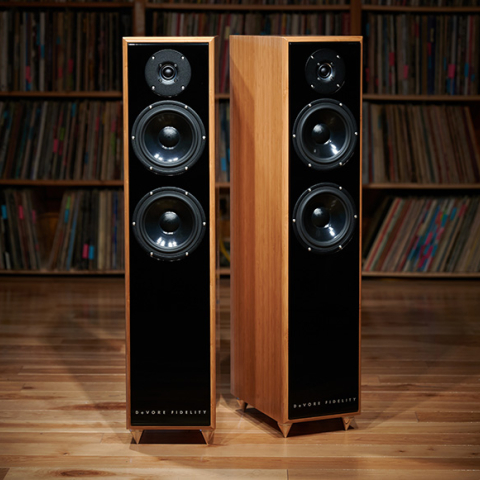
Art Dudley returned to the DeVore Fidelity O/96 in January 2015 (Vol.38 No.1):
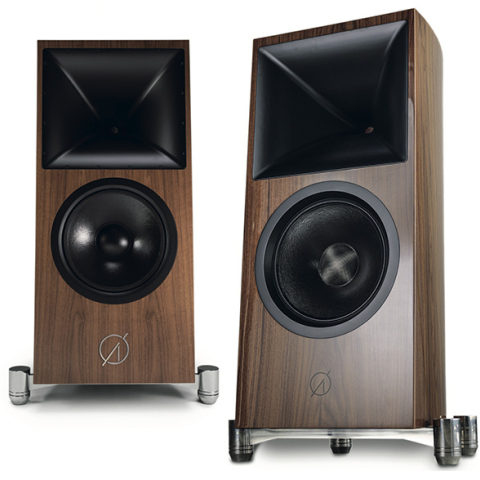
A few months ago, I finally got around to putting self-adhesive felt pads on the bottoms of the stands that support my review pair of DeVore Fidelity Orangutan O/96 loudspeakers ($12,000/pair; see my review in the December 2012 issue). Those solid-maple stands aren't fitted with adjustable spikes or adjustable anything else, and because few hardwood floors are dependably, perfectly flat—including the ones I've installed, such as the Jatobá floor in my listening room—loudspeakers and equipment supports are often in need of the slightest shimming. Handily, pliant pads allow heavy items to adjust themselves on surfaces that are mildly uneven. Besides, I tend to prefer their influence on a speaker's sound to that of metal spikes, which often sound fussy, unnatural, and unrelaxed (footnote 1).
Felt pads are also good for enhancing loudspeaker movability. Given my line of work, I'm forever swapping audio components into and out of the far end of my listening room, which is about 60' from the entranceway where incoming shipments linger. Thankfully, most of the floors in our home are hardwood, over which felted feet can be pushed with relative ease by one person (ie, me).
The downside of felt pads is that they're the very devil to remove, and tend to leave behind a real mess of adhesive and fibers. But now I don't care, because I bought our review pair of DeVores: I can do with their stands as I please.
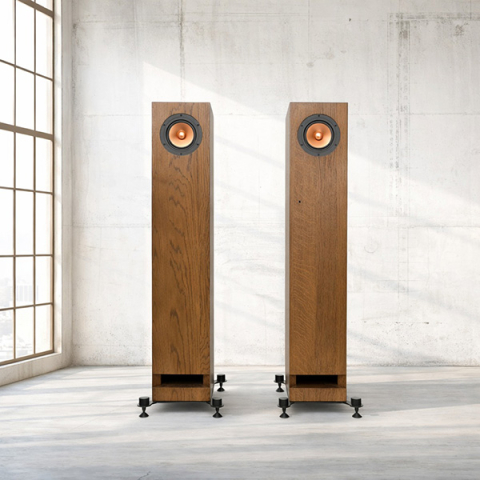
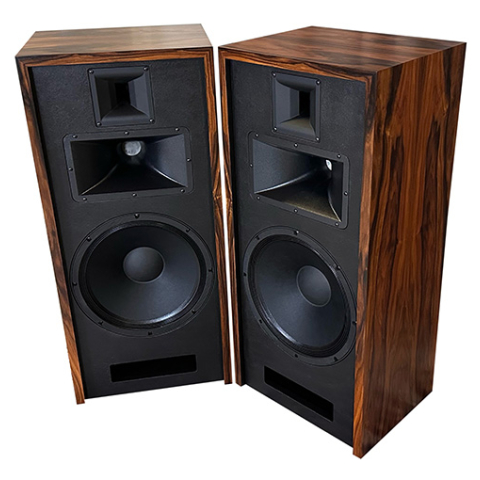
These days, when my attention isn't required by loudspeakers in for review, I divide my listening time between the DeVore O/96s and my nearly 50-year-old Altec Valencias. The Altec and DeVore share a few traits. Both are more efficient (footnote 2) than average, notably fine at playing music with a believable sense of scale, and both have larger-than-average bass drivers for two-way loudspeakers: 13" for the Altec, 10" for the DeVore. Otherwise, they're different sides of a rarely traded coin. The Altec is all about touch, texture, impact, presence, and directness, yet it funds some of those accomplishments with sacrifices in tonal neutrality—at its worst, the Valencia can be slightly shrieky. The DeVore doesn't have quite the same texture and touch—though it's better than average in those departments—and embodies much that is good about more decidedly modern hi-fi, including notably wide bandwidth and a sophisticated way with the spatial characteristics of good stereo recordings. The O/96 also manages the neat trick of sounding simultaneously substantial and open—but never overtly "airy."
The DeVore and Altec share one more quality: Each allows recorded music to retain the momentum and flow of the real thing, which not all loudspeakers do. Even some unambiguously great ones—the BBC-designed LS3/5a comes to mind—can confound in that regard. To me, that sort of musicality is worth all of the other characteristics put together, and the DeVore O/96 has it in spades.
While the Altec Valencia suffers no shortage of convincingly saturated tonal colors, it doesn't eclipse the O/96 in that category. As I write this, I'm luxuriating in the sound of Dexter Gordon's richly toned tenor sax in "Don't Explain," from a recent reissue of his A Swingin' Affair (45rpm LP, Blue Note/Music Matters 84133)—which is to say nothing of the sound of Sonny Clark's piano, which the DeVores reproduce with exceptional substance and scale, and a believably human sense of touch (if a bit too much timbral thickness).
In my 2012 review of the O/96, I mentioned its need for greater-than-average attention to positioning, in order to get the right combination of old-fashioned mono-era tone and force while pulling off the modern-day stereo disappearing act. To those ends I have refined my own O/96 installation, moving each speaker farther from its sidewall, and minimizing the influence of unfortunate room characteristics with some John DeVore–inspired asymmetry: One O/96 is now 32" from the closest sidewall, while the other is 35" from its nearest wall (all dimensions measured from center of front baffle).
I have also, in a small way, altered the rest of my system. In the two years since reviewing the DeVores, Starting in October of 2013, and for just over a year after, I borrowed a sample of the 10Wpc single-ended Shindo Cortese amplifier, to use in place of my 20Wpc push-pull Shindo Haut-Brion amplifier. (My 25Wpc Shindo Corton-Charlemagne mono amps remain, as does my 4Wpc Fi 421A stereo.) The combination of O/96s and Cortese sounds wonderful, especially with such rock fare as Neil Young and Crazy Horse's Live at the Fillmore East (LP, Reprise 44429-1). The pairing doesn't compress or sand the rough edges from this raucous performance, but rather communicates the music's drive and rhythmic randomness, while opening up the sound to find such buried details as Jack Nitzsche's electric-piano playing in "Come On Baby Let's Go Downtown" without reverting to brightness to do so.
The combination of DeVore O/96s and Shindo Cortese also nails the sounds of Bill Bruford's drums and John Wetton's electric bass throughout the recent reissue of King Crimson's Larks' Tongues in Aspic (LP, Discipline Global Mobile KCLP 5), especially evident in "Easy Money." The DeVores presented those sounds with proper weight and force—and with as much punch, color, and convincing sense of resonance as I've heard from a domestic playback system. Notably, the DeVores also put across the intensity of the many unexpected instrumental outbursts in "Larks' Tongues in Aspic, Part Two." The manner in which the big-but-not-huge O/96s communicate the scale and the sheer dynamic chaos of Bruford's percussion onslaught near the end of the piece is a delight—and this on just 10Wpc.
In his "Manufacturer's Comment" on that earlier review, John DeVore wrote that the Orangutan O/96, which began shipping in mid-2011, was a "clean-slate design." One might wonder: In a marketplace that had conferred on his earlier and very different products a measure of success, how did something so different fare? DeVore describes an uncertain beginning: "[The O/96] is so unlike what people were ready to see from me, or to see in mainstream high-end shops. People who had never heard the new speakers would say, 'This can't work! DeVore needs to take a class!'" Indeed, immediately after my review went up on www.stereophile.com, two Internet denizens who had not heard the O/96—and who proclaimed no need to do so as a prerequisite for trashing it—altered the normal level of discourse until it no longer fell within the pH range of healthy audio enthusiasts.
As is virtually always the case, the most aggressive (and anonymous) people on our Internet forum were not representative of real-life enthusiasts or consumers. John DeVore says that, in 2013, the O/96 was his best-selling model "by a clear margin. I wouldn't be surprised to see that it did that again in 2014."
It appears that DeVore Fidelity's Orangutan O/96 is here to stay—as both a commercial product and as a well-loved part of my playback system.—Art Dudley
Footnote 1: Notable exceptions included the Audio Note AN-E loudspeakers I enjoyed for so long. And I seriously doubt if speakers such as Naim Audio's enduringly interesting IBL and SBL, long discontinued, would sound nearly as engaging without their spikes. Footnote 2: For our purposes, efficiency is defined as having high electrical sensitivity as well as a combination of high electrical impedance and benign impedance-curve phase angle.
Footnote 1: Notable exceptions included the Audio Note AN-E loudspeakers I enjoyed for so long. And I seriously doubt if speakers such as Naim Audio's enduringly interesting IBL and SBL, long discontinued, would sound nearly as engaging without their spikes. Footnote 2: For our purposes, efficiency is defined as having high electrical sensitivity as well as a combination of high electrical impedance and benign impedance-curve phase angle.