Sidebar: Measurements (from January 2019, Vol.42 No.1)
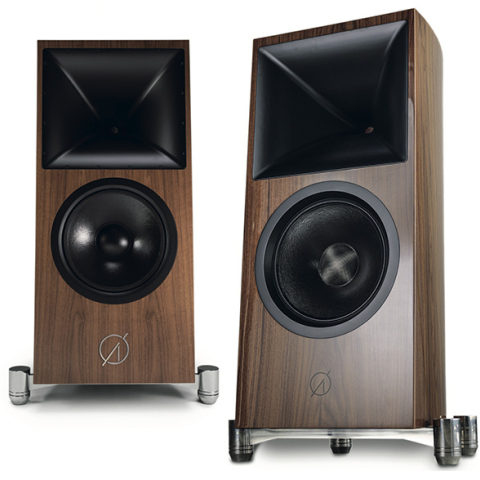
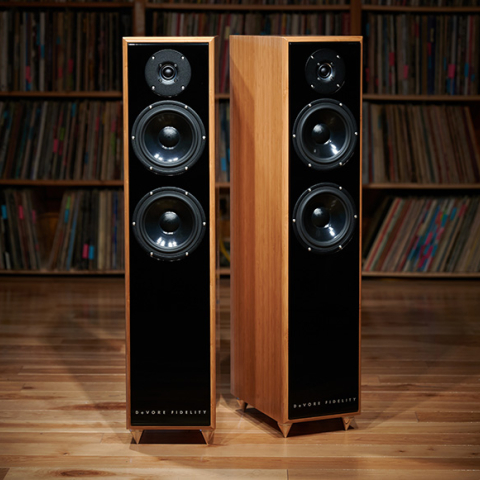
This relatively affordable, high-sensitivity, two-way floorstanding loudspeaker has been a firm favorite with Stereophile's writers since Sam Tellig reviewed it in January 2014. Herb Reichert wrote Follow-Ups in December 2015 and July 2016, as did Art Dudley in May 2018. Ken Micallef also uses a pair of O/93s, and the DeVore was a finalist in our 2016 and 2018 Loudspeaker of the Year categories. (The Orangutan O/93 costs $8400/pair; DeVore Fidelity's larger Orangutan O/96, which costs $12,000/pair, was one of our Joint Loudspeakers of 2017.)
I don't usually measure the products written about in our regular columns, but it had been on my mind for some time that I should measure the Orangutan O/93 when, last September, I received an e-mail from Herb Reichert: "I am listening to the DeVore O/93s, and every time I listen I feel there is something amiss in the presence region, like a narrow-band suckout." As I was about to drive over to Herb's Bed-Stuy bothy to pick up the Cary amplifier he reviewed in our December 2018 issue, I suggested that I pick up one of the DeVores at the same time, so that I could take it home and examine its measured performance.
In most respects, the Orangutan O/93's measured performance shows the same careful balance of behavior that John DeVore achieved with his Orangutan O/96. Nor was there anything obvious that correlated with HR's later comment that he felt there was something like "a hole in the response." Herb's room is relatively small, so I don't think it was the response's slight depression in the presence region that bothered him. However, I was concerned by the port resonances and that lively cabinet—perhaps it was those that led him to request that I measure the speakers. Next time I visit Herb, I'll listen for myself.—John Atkinson
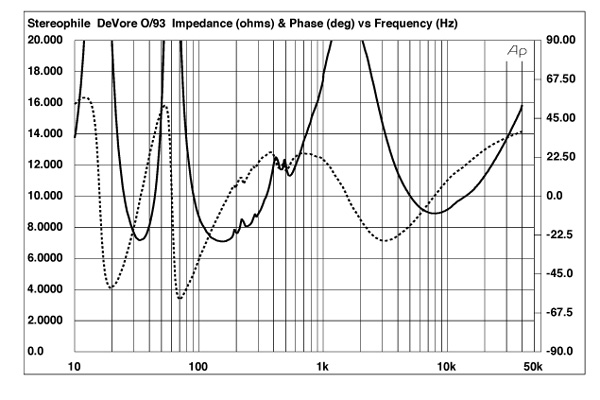
Fig.1 DeVore Fidelity Orangutan O/93, electrical impedance (solid) and phase (dashed) (2 ohms/vertical div.).
I used DRA Labs' MLSSA system and a calibrated DPA 4006 microphone to measure the O/93's frequency response in the farfield, and an Earthworks QTC-40 for the nearfield and in-room responses. The DeVore's specified sensitivity is 93dB/2.83V/m; my estimate was slightly lower, at 90.1dB(B)/2.83V/m. However, as the speaker's impedance is specified as 10 ohms, it will draw less than 1W at this voltage. Fig.1 shows how the O/93's impedance and electrical phase vary with frequency. The magnitude remains above 10 ohms for most of the audioband, and the minimum value is a still-high 7.1 ohms between 150 and 160Hz. Though the electrical phase angle is occasionally severe, this is only when the magnitude is high, mitigating any drive difficulty. With its combination of high sensitivity and high impedance, the O/93 will work well with low-powered tube amplifiers, even from their 8 ohm transformer taps.
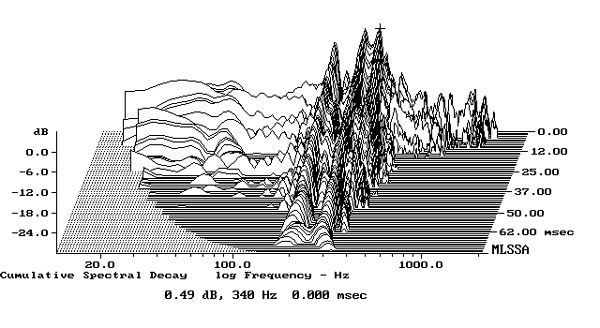
Fig.2 DeVore Fidelity Orangutan O/93, cumulative spectral-decay plot calculated from output of accelerometer fastened to center of rear panel (MLS driving voltage to speaker, 7.55V; measurement bandwidth, 2kHz).
The impedance traces reveal a number of sharply defined discontinuities between 180 and 520Hz that suggest that the enclosure is affected by panel resonances. I investigated the panels' vibrational behavior with a plastic-tape accelerometer and found several resonant modes on all of them, the highest in level lying at 223, 280, 340, and 430Hz. Fig.2, for example, is a waterfall plot calculated from the accelerometer's output while it was fastened to the center of the rear panel, directly behind the woofer. Predicting the effect of this behavior on sound quality is a somewhat hit-or-miss affair, as the audibility of the resonances will depend on the Quality factor (Q) of the resonances and the affected areas of the panels, as well as the difference between the phase of the radiated sound and that emitted by the drive-units. But as the frequencies of these resonances coincide with the frequency region in which lie a lot of musical fundamentals, I would have expected the Orangutan O/93's midrange to sound somewhat congested.
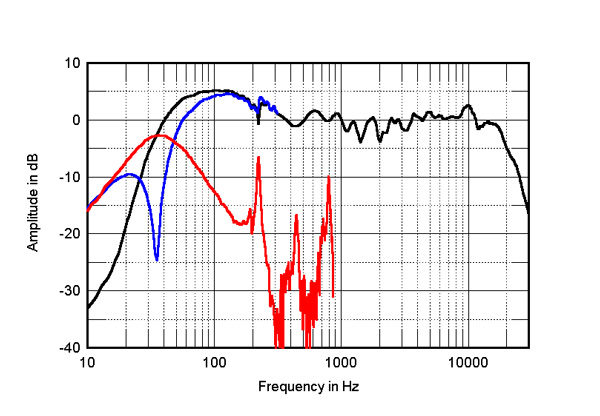
Fig.3 DeVore Fidelity Orangutan O/93, anechoic response on tweeter axis at 50", averaged across 30° horizontal window and corrected for microphone response, with nearfield woofer (blue) and port (red) responses and their complex sum (black) respectively plotted below 300Hz, 850Hz, 300Hz.
The saddle centered at 35Hz in the impedance-magnitude trace suggests that this is the tuning frequency of the twin 2"-diameter ports on the rear panel; examining the woofer's output in the nearfield (fig.3, blue trace) revealed that it has the expected minimum-motion notch at that frequency. (This is where the pressure from the port resonance holds the woofer cone stationary.) The output of the ports (red trace) peaks in textbook fashion between 20 and 70Hz, but its upper-frequency rolloff is marred by high-Q, high-amplitude resonances at 222, 441, and 794Hz, the first two resonances suspiciously close to the frequencies of some of the panel resonances. I could hear these port resonances with the pseudo-random noise signal generated by MLSSA, though it's fair to note that, as the ports are on the speaker's rear panel, the audibility of these resonances will be reduced. Nevertheless, the lowest-frequency resonance gives rise to a sharply defined suckout in both the woofer's nearfield response and that of the sum of the woofer and port outputs (black trace below 300Hz).
The boost in the upper bass and midbass in fig.3 is due almost entirely to the nearfield measurement technique. The O/93's low frequencies extend down to the 35Hz tuning frequency of the ports, where the anechoic output is down by 6dB. Higher in frequency in fig.3, the black trace shows the DeVore's farfield response, averaged across a 30° horizontal window centered on the tweeter axis. There is a slight depression between 1 and 3kHz, though I doubt this will be audible as the "narrow-band suckout" noted by HR; other than that, the response in the midrange and treble is impressively flat up to 17kHz or so, where the soft-dome tweeter begins to roll off.
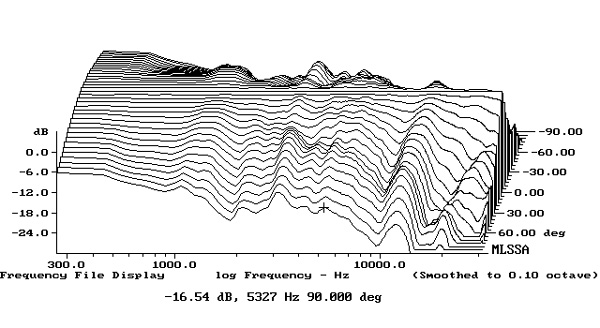
Fig.4 DeVore Fidelity Orangutan O/93, lateral response family at 50", normalized to response on tweeter axis, from back to front: differences in response 90–5° off axis, reference response, differences in response 5–90° off axis.
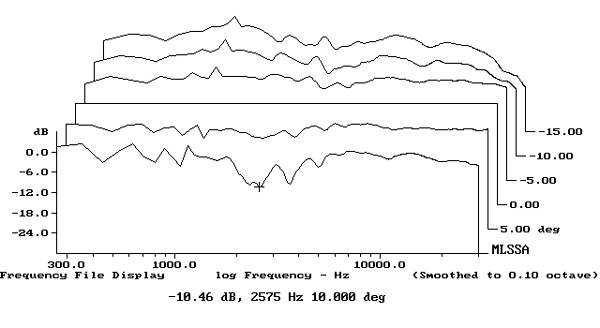
Fig.5 DeVore Fidelity Orangutan O/93, vertical response family at 50", normalized to response on tweeter axis, from back to front: differences in response 15–5° above axis, reference response, differences in response 5–10° below axis.
The plot of the O/93's horizontal dispersion (fig.4) indicates that the presence-region gully does deepen to the speaker's sides, and that the tweeter is more directional than usual for a 1" dome throughout its passband, this due to the wide baffle and the waveguide loading. The DeVore O/93 will thus tend to sound rather dull in large or overdamped rooms. In the vertical plane (fig.5), the presence-region depression deepens more than 5° below the tweeter axis, but if you sit more than 5° above the tweeter axis, the midrange starts to become accentuated.
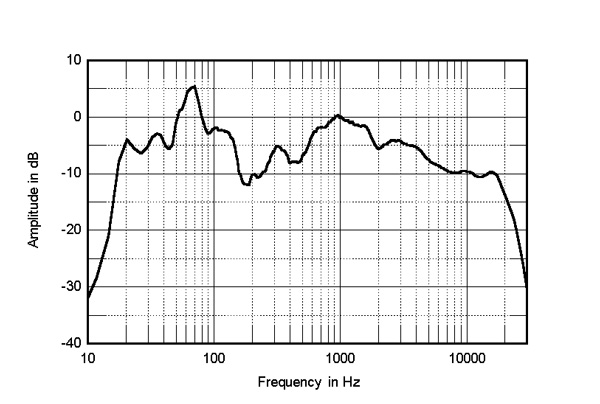
Fig.6 DeVore Fidelity Orangutan O/93, spatially averaged, 1/6-octave response in AD's listening room.
Last summer, when I visited Art Dudley's new home in Albany, I brought along my speaker-measuring gear so that I could examine the Orangutan O/93s' spatially averaged response in his new listening room. The result, with the speakers driven by his Shindo Laboratory Haut-Brion amplifier, is shown in fig.6. The lack of energy in the midrange is due to the Allison Effect interference between the direct sound and the sound reflected from the sidewalls and floor. It looks far worse than it sounds, thank goodness. Other than that and the peak between 50 and 80Hz, the latter due to AD having to place the speakers fairly close to his room's corners, the O/93s' in-room response is relatively even. The downward slope in the treble will be due primarily to the increasing absorption by the room's furnishings as the frequency rises. (With this measurement, a flat treble response is not what you want—it would mean that the speaker's on-axis response rises like a ski jump.) One thing I noticed in the individual measurements when I plotted this graph was that the left and right speakers matched very closely: within 1dB between 500Hz and 1.6kHz, and within 0.5dB from there to 30kHz.
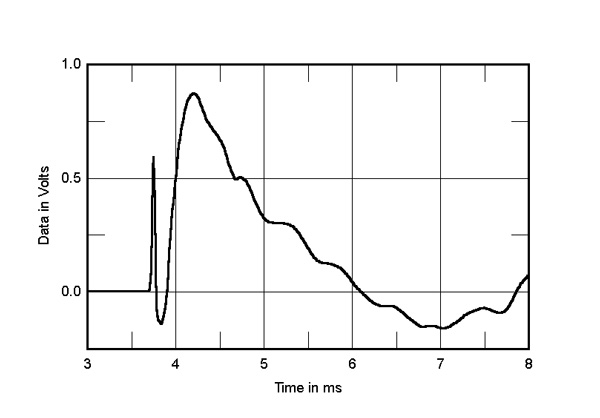
Fig.7 DeVore Fidelity Orangutan O/93, step response on tweeter axis at 50" (5ms time window, 30kHz bandwidth).
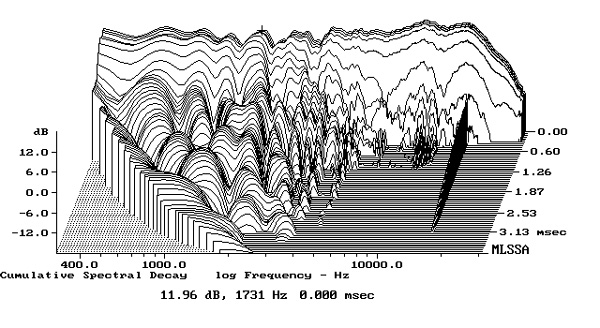
Fig.8 DeVore Fidelity Orangutan O/93, cumulative spectral-decay plot on tweeter axis at 50" (0.15ms risetime).
In the time domain, the O/93's step response (fig.7) indicates that the tweeter's output leads that of the woofer, but the decay of its step smoothly blends with the start of the woofer's, suggesting optimal crossover design. Ripples in the decay of the woofer's step correlate with a ridge of resonant energy at the top of the woofer's passband in the cumulative spectral-decay plot (fig.8).