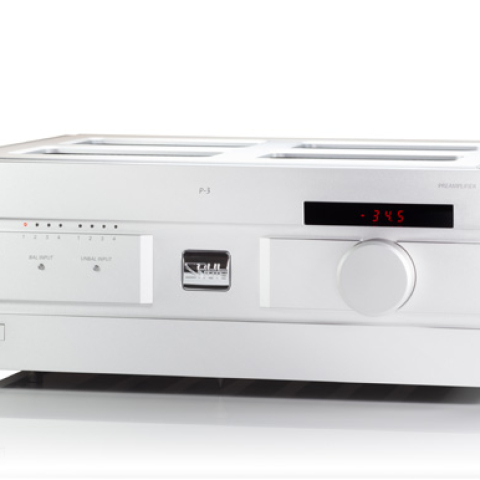
Switching between all those pieces of equipment while keeping power cables and interconnects separate, ensuring optimal setup consistency, and taking coherent notes is not for the faint of heart. A touch of madness helps. Some may be tempted to resort to mood stabilizers or out-of-body escape when they realize that, because the Momentum HD preamp lacks a numeric volume display, it's virtually impossible to match volume levels by sight. There's a reason for the manual's caution: "The dynamic capability of the new Momentum HD Preamplifier is beyond what is normally experienced with other preamplifiers or source units with volume controls. . . . The unlocked dynamics can be system damaging if some care is not exercised." If you can't see the meter's slim volume indicator from afar, listen to your mother for once: Always turn the volume down when switching between components to avoid blowing out your eardrums or speaker drivers.
Reveling in the sound
As so-called chance would have it—are there really such things as accidents?—production delays brought an already broken-in Momentum HD preamp to Port Townsend just one day before a previously scheduled group of six local audio/music enthusiasts arrived for a listening session. Taking advantage of the Roon Nucleus+ to send music to the Rossini DAC/clock combo from reference files, Tidal, and Qobuz, my friends presented a golden opportunity to explore the preamp with music other than my usual fare—not that there's anything "usual" about Morton Feldman, David Lang, Philip Glass, Michael Gordon, Ellen Reid, Terry Riley, Iannis Xenakis, Claude Debussy, Missy Mazzoli, Bryce Dessner, or Ludwig van Beethoven, to name a few of the composers whose music I've explored of late.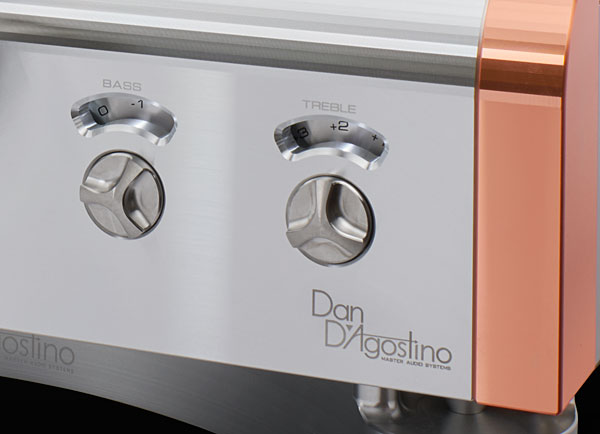 For reasons that some might ascribe to the current political climate, we got on a "Sympathy for the Devil" kick. We began with a bizarrely captivating, crackly-voiced studio rendition by Rickie Lee Jones (Tidal, 16/44.1 FLAC), from her album The Devil You Know. I was immediately taken by the striking spatial depth accorded the sounds of the accompanying instruments, the clear timbral differentiation between bass and electric guitar, the smoothness on top, and an extra touch of warmth to the full midrange. The presentation was also significantly wider and tonally weightier than I expect from the Rossini, and reminded me of the sound of dCS's reference Vivaldi DAC. One visitor, photographer Jonathan Jones, was especially struck by the "detail and micro-inflections of the presentation, and Rickie Lee Jones's vocal hooding technique."
Then we switched to the Rolling Stones' original version of the song—one that I reveled in shortly after college—from Beggar's Banquet. With the Momentum HD preamp, differences between Tidal's 16/44.1 and MQA files, which unfolded to 24/192, were obvious. With higher resolution came greater percussive depth, bottom reach, and clarity; significantly fuller and more enveloping sound, greater dynamics, and realistic treble that saved us from the overly brittle top of the original digital transfer. The D'Agostino Momentum HD preamp conveyed everything with an ease I was unaccustomed to.
We moved on to versions of "Come On in My Kitchen" from Crooked Still (Tidal 16/44.1 FLAC), David Bromberg (Qobuz 16/44.1 FLAC), Cassandra Wilson (Tidal 16/44.1 FLAC), and, of course, Robert Johnson (Qobuz 16/44.1 FLAC). In all cases, bass was absolutely firm, and the midrange gorgeous. I was blown away by the seemingly boundless soundstage and maximum color saturation on Cassandra Wilson's version, which we played numerous times with different electronics. Photographer Marco Prozzo, an uncommonly inquisitive music lover who was familiar with the recording, wrote, "Wow! I'm hearing low-level subtle details I've never heard before, great separation of instruments, and cymbal splashes that are defined and unclouded."
For a make-it-or-break-it track, I cued up the emotionally devastating second movement ("The Ninth of January") from Shostakovich's Symphony No.11, "The Year 1905," performed live by Andris Nelsons and the Boston Symphony Orchestra (24-bit/96kHz download, Deutsche Grammophon 002859502). In Shostakovich's astounding fff depiction of the infamous Bloody Sunday massacre, where merciless Cossacks fired on unarmed citizens, every musician and their mother pounds, blares, and saws away as if their life depended upon it. The Momentum HD preamp rendered their efforts more controlled and less noisy than the Rossini DAC solo, with deeper and more resonant bass and an all-enveloping three-dimensional soundstage that was as thrilling as it was terrifying. The huge dynamic contrast between that all-out assault and the subsequent hushed, sorrowful drone that eventually faded away, like smoke from gun barrels dissipating into the air as peasants' souls left their lifeless bodies, was chilling.
For reasons that some might ascribe to the current political climate, we got on a "Sympathy for the Devil" kick. We began with a bizarrely captivating, crackly-voiced studio rendition by Rickie Lee Jones (Tidal, 16/44.1 FLAC), from her album The Devil You Know. I was immediately taken by the striking spatial depth accorded the sounds of the accompanying instruments, the clear timbral differentiation between bass and electric guitar, the smoothness on top, and an extra touch of warmth to the full midrange. The presentation was also significantly wider and tonally weightier than I expect from the Rossini, and reminded me of the sound of dCS's reference Vivaldi DAC. One visitor, photographer Jonathan Jones, was especially struck by the "detail and micro-inflections of the presentation, and Rickie Lee Jones's vocal hooding technique."
Then we switched to the Rolling Stones' original version of the song—one that I reveled in shortly after college—from Beggar's Banquet. With the Momentum HD preamp, differences between Tidal's 16/44.1 and MQA files, which unfolded to 24/192, were obvious. With higher resolution came greater percussive depth, bottom reach, and clarity; significantly fuller and more enveloping sound, greater dynamics, and realistic treble that saved us from the overly brittle top of the original digital transfer. The D'Agostino Momentum HD preamp conveyed everything with an ease I was unaccustomed to.
We moved on to versions of "Come On in My Kitchen" from Crooked Still (Tidal 16/44.1 FLAC), David Bromberg (Qobuz 16/44.1 FLAC), Cassandra Wilson (Tidal 16/44.1 FLAC), and, of course, Robert Johnson (Qobuz 16/44.1 FLAC). In all cases, bass was absolutely firm, and the midrange gorgeous. I was blown away by the seemingly boundless soundstage and maximum color saturation on Cassandra Wilson's version, which we played numerous times with different electronics. Photographer Marco Prozzo, an uncommonly inquisitive music lover who was familiar with the recording, wrote, "Wow! I'm hearing low-level subtle details I've never heard before, great separation of instruments, and cymbal splashes that are defined and unclouded."
For a make-it-or-break-it track, I cued up the emotionally devastating second movement ("The Ninth of January") from Shostakovich's Symphony No.11, "The Year 1905," performed live by Andris Nelsons and the Boston Symphony Orchestra (24-bit/96kHz download, Deutsche Grammophon 002859502). In Shostakovich's astounding fff depiction of the infamous Bloody Sunday massacre, where merciless Cossacks fired on unarmed citizens, every musician and their mother pounds, blares, and saws away as if their life depended upon it. The Momentum HD preamp rendered their efforts more controlled and less noisy than the Rossini DAC solo, with deeper and more resonant bass and an all-enveloping three-dimensional soundstage that was as thrilling as it was terrifying. The huge dynamic contrast between that all-out assault and the subsequent hushed, sorrowful drone that eventually faded away, like smoke from gun barrels dissipating into the air as peasants' souls left their lifeless bodies, was chilling.
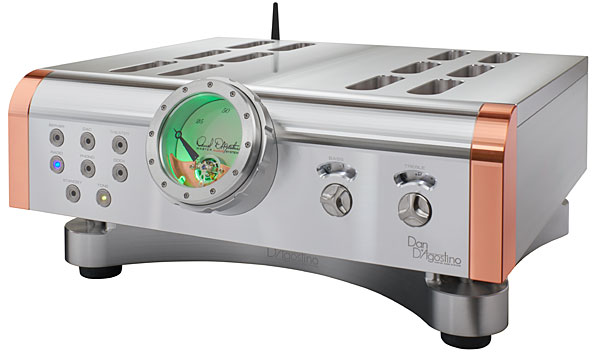 Sticking with Shostakovich, Rickie Lee Jones, and Cassandra Wilson, we switched preamps and discovered that the contrast between the D'Agostino Momentum HD and the Audio Research Ref 6 was profound. While timbres were actually more neutral through the Ref 6 and air was quite fine, highs were noisier, midrange less full, and bass less astounding albeit excellent in its own right. On Yello's "Electrified II" from Toy (24/48 WAV, Polydor 4782160/ HDtracks) and will.i.am's "#thatPOWER" (featuring Justin Bieber) from #willpower (16/44.1 MQA.FLAC, Interscope Records UICS-9136/7), the Ref 6 preamp couldn't deliver the same degree of bass impact, midrange fullness, extended evenness on top, and wall-to-wall sound as the Momentum HD. Which isn't surprising, given the $25,000 price difference. With the Ref 6, my system still sounded like the system I knew inside out; with the Momentum HD, a new window opened, and every recording became a source of wonder.
With no preamp in the chain, the Rossini solo could not deliver the same level of detail and mesmerizing expanse as with the Momentum HD preamp. I missed every last iota of the creaky raspiness in Rickie Lee Jones's voice that made her HD devil as spooky as it was weird.
I briefly switched DACs and used a single S/PDIF cable from the dCS Network Bridge to convey signals from the Roon Nucleus+ to the EMM Labs DV2. With the Momentum HD preamp controlling volume, I heard more air around Cassandra Wilson and Rickie Lee Jones's voices and accompaniment, but a bit less midrange profundity. After realizing that the comparison was flawed due to setup constraints—I've since moved equipment around on my eight-shelf double rack so I don't run into this problem in the future and sent the DV2 back for a major upgrade—I acknowledged that a valid comparison between the two DACs would have to wait.
When I returned to the Rossini DAC/Momentum HD preamp combo, revisiting Cassandra Wilson's performance revealed a complexity of string tone, deep bass grind, and increased color contrast and depth that, compared to what I heard from either DAC alone, left me in awe. Adding the preamp delivered Rickie Lee's creepy vocals with much more subtlety and intimacy, and markedly greater dynamics, even at low volume. I didn't want the music to end.
Until I shipped the Momentum HD preamp to John Atkinson for measurement, one joy-filled listening session followed another. Further revelations arrived with Praeludium, the first track from Michael Tilson Thomas and the San Francisco Symphony's digital-only recording of Berg's Three Pieces for Orchestra (24/192 WAV, SFS Media SFS0070). Even though the dB Pro app on my iPhone measured the music's blaring climax at 90dB, highs were smooth, every line was clean, and multilayered bass lines remained solid. If at any time in my listening I found the treble too toned down, engaging the tone controls and raising treble to "1" did the trick without, to my ears, negatively impacting other ranges or the presentation as a whole. Although I used it rarely, I ended up surprising myself by liking the tone-control option.
In all my listening, the only problem that arose occurred after I plugged the Progression monoblocks directly into the wall and left break-in tones running for 24 hours. When I returned to the music room, the Momentum HD preamp emitted a steady hum that was annoying from 12' away. Returning the power cables to the Niagara 5000's high-current outlets eliminated the hum. When I attempted to duplicate the problem by reconnecting amps to the wall, there was no hum after four hours of break-in tones. I have no idea what was going on. All I could confirm was that, in my system and to these ears, AudioQuest's non–current-limiting power conditioning enhances rather than detracts.
Nights followed when, thanks to Tidal, Qobuz, and my own collection, I revisited one beloved soprano, mezzo, tenor, and baritone after the other. (Sorry, basses; I'll try to visit you in the next review.) Words are inadequate to convey the heart-opening expansive glow mezzo Dame Janet Baker achieves on her first high note of "Die zwei blauen Augen von meinem Schatz" (The Two Blue Eyes of my Beloved), in her famous recording of Mahler's Songs of a Wayfarer (Lieder eines fahrenden Gesellen) with Sir John Barbirolli and the New Philharmonia Orchestra; the smiling warmth that baritone Gerhard HÅsch brings to Schubert's "Die Taubenpost" (The Pigeon Post) from Schwanengesang; the thrilling mixture of fear and abandon that propels Jussi Björling up to the high C in "Che gelida manina" (How cold your little hand is) from Puccini's La Bohème, and that keeps expanding the note to uncommon length as he discovers that everything is working exactly as he hoped it would, in a live 1939 performance I discovered on Tidal; and the beauty that Leontyne Price brings to her marvelously sensual performance of "Depuis le jour" (Ever since the day) from Charpentier's Louise.
I knew all but the Björling performance backward and forward, but thanks to the additional clarity and resolution that the Momentum HD preamp brought to recordings old and new, I discovered new details and colors previously only hinted at. The only disappointment? The sound was so clear and fleshed out that I could hear every teeny flaw in Price's vocal production, as well as Björling's tendency to end low-lying phrases somewhat prosaically as he focuses on the high-flying passages to come. Thus do false goddesses and gods affirm their humanity.
Toward the end of the audition period, I queued up an ultra-familiar track that I've used in numerous reviews, "Sleepers Awake" from Bach Trios, by mandolinist Chris Thile, cellist Yo-Yo Ma, and double bassist Edgar Meyer (24/96 FLAC, Nonesuch 558933). This was the same track that blew me away when Peter McGrath played it through the Momentum HD preamp at the Definitive Audio Music Matters demo last spring. Paired with equipment one level down and several hundred thousand dollars less than the Definitive system, the Momentum HD preamp couldn't deliver sound anywhere near as breathtakingly life-sized and realistic. Nonetheless, it conveyed far more air around instruments, with more subtle detail, natural leading treble edge, midrange richness, and fully fleshed-out, solid bass than I'd come to expect from my system. For the first time, I could sense when Yo-Yo Ma's mike was turned on and hear the short delay between his bow's initial contact with his cello's strings and the emergence of sound so rich and full that it made me content. The D'Agostino Momentum HD preamp delivered much of what I have sought ever since I began upgrading my crappy components 35 years ago: It got me closer than ever to the point of creation, and to the artists I love.
Beyond summation
Sticking with Shostakovich, Rickie Lee Jones, and Cassandra Wilson, we switched preamps and discovered that the contrast between the D'Agostino Momentum HD and the Audio Research Ref 6 was profound. While timbres were actually more neutral through the Ref 6 and air was quite fine, highs were noisier, midrange less full, and bass less astounding albeit excellent in its own right. On Yello's "Electrified II" from Toy (24/48 WAV, Polydor 4782160/ HDtracks) and will.i.am's "#thatPOWER" (featuring Justin Bieber) from #willpower (16/44.1 MQA.FLAC, Interscope Records UICS-9136/7), the Ref 6 preamp couldn't deliver the same degree of bass impact, midrange fullness, extended evenness on top, and wall-to-wall sound as the Momentum HD. Which isn't surprising, given the $25,000 price difference. With the Ref 6, my system still sounded like the system I knew inside out; with the Momentum HD, a new window opened, and every recording became a source of wonder.
With no preamp in the chain, the Rossini solo could not deliver the same level of detail and mesmerizing expanse as with the Momentum HD preamp. I missed every last iota of the creaky raspiness in Rickie Lee Jones's voice that made her HD devil as spooky as it was weird.
I briefly switched DACs and used a single S/PDIF cable from the dCS Network Bridge to convey signals from the Roon Nucleus+ to the EMM Labs DV2. With the Momentum HD preamp controlling volume, I heard more air around Cassandra Wilson and Rickie Lee Jones's voices and accompaniment, but a bit less midrange profundity. After realizing that the comparison was flawed due to setup constraints—I've since moved equipment around on my eight-shelf double rack so I don't run into this problem in the future and sent the DV2 back for a major upgrade—I acknowledged that a valid comparison between the two DACs would have to wait.
When I returned to the Rossini DAC/Momentum HD preamp combo, revisiting Cassandra Wilson's performance revealed a complexity of string tone, deep bass grind, and increased color contrast and depth that, compared to what I heard from either DAC alone, left me in awe. Adding the preamp delivered Rickie Lee's creepy vocals with much more subtlety and intimacy, and markedly greater dynamics, even at low volume. I didn't want the music to end.
Until I shipped the Momentum HD preamp to John Atkinson for measurement, one joy-filled listening session followed another. Further revelations arrived with Praeludium, the first track from Michael Tilson Thomas and the San Francisco Symphony's digital-only recording of Berg's Three Pieces for Orchestra (24/192 WAV, SFS Media SFS0070). Even though the dB Pro app on my iPhone measured the music's blaring climax at 90dB, highs were smooth, every line was clean, and multilayered bass lines remained solid. If at any time in my listening I found the treble too toned down, engaging the tone controls and raising treble to "1" did the trick without, to my ears, negatively impacting other ranges or the presentation as a whole. Although I used it rarely, I ended up surprising myself by liking the tone-control option.
In all my listening, the only problem that arose occurred after I plugged the Progression monoblocks directly into the wall and left break-in tones running for 24 hours. When I returned to the music room, the Momentum HD preamp emitted a steady hum that was annoying from 12' away. Returning the power cables to the Niagara 5000's high-current outlets eliminated the hum. When I attempted to duplicate the problem by reconnecting amps to the wall, there was no hum after four hours of break-in tones. I have no idea what was going on. All I could confirm was that, in my system and to these ears, AudioQuest's non–current-limiting power conditioning enhances rather than detracts.
Nights followed when, thanks to Tidal, Qobuz, and my own collection, I revisited one beloved soprano, mezzo, tenor, and baritone after the other. (Sorry, basses; I'll try to visit you in the next review.) Words are inadequate to convey the heart-opening expansive glow mezzo Dame Janet Baker achieves on her first high note of "Die zwei blauen Augen von meinem Schatz" (The Two Blue Eyes of my Beloved), in her famous recording of Mahler's Songs of a Wayfarer (Lieder eines fahrenden Gesellen) with Sir John Barbirolli and the New Philharmonia Orchestra; the smiling warmth that baritone Gerhard HÅsch brings to Schubert's "Die Taubenpost" (The Pigeon Post) from Schwanengesang; the thrilling mixture of fear and abandon that propels Jussi Björling up to the high C in "Che gelida manina" (How cold your little hand is) from Puccini's La Bohème, and that keeps expanding the note to uncommon length as he discovers that everything is working exactly as he hoped it would, in a live 1939 performance I discovered on Tidal; and the beauty that Leontyne Price brings to her marvelously sensual performance of "Depuis le jour" (Ever since the day) from Charpentier's Louise.
I knew all but the Björling performance backward and forward, but thanks to the additional clarity and resolution that the Momentum HD preamp brought to recordings old and new, I discovered new details and colors previously only hinted at. The only disappointment? The sound was so clear and fleshed out that I could hear every teeny flaw in Price's vocal production, as well as Björling's tendency to end low-lying phrases somewhat prosaically as he focuses on the high-flying passages to come. Thus do false goddesses and gods affirm their humanity.
Toward the end of the audition period, I queued up an ultra-familiar track that I've used in numerous reviews, "Sleepers Awake" from Bach Trios, by mandolinist Chris Thile, cellist Yo-Yo Ma, and double bassist Edgar Meyer (24/96 FLAC, Nonesuch 558933). This was the same track that blew me away when Peter McGrath played it through the Momentum HD preamp at the Definitive Audio Music Matters demo last spring. Paired with equipment one level down and several hundred thousand dollars less than the Definitive system, the Momentum HD preamp couldn't deliver sound anywhere near as breathtakingly life-sized and realistic. Nonetheless, it conveyed far more air around instruments, with more subtle detail, natural leading treble edge, midrange richness, and fully fleshed-out, solid bass than I'd come to expect from my system. For the first time, I could sense when Yo-Yo Ma's mike was turned on and hear the short delay between his bow's initial contact with his cello's strings and the emergence of sound so rich and full that it made me content. The D'Agostino Momentum HD preamp delivered much of what I have sought ever since I began upgrading my crappy components 35 years ago: It got me closer than ever to the point of creation, and to the artists I love.
Beyond summation
In every respect, the D'Agostino Momentum HD preamp improved the sound of two superb DACs that include excellent volume controls. Bigger, clearer, smoother, deeper—more musical and involving, mesmerizing and revelatory in turn—the Momentum HD preamp checked off every box on the Holy List of Audiophile Superlatives and tempted me to ignore the inviolable commandment, "Thou Shalt Not Covet." Forgive me, Lord, for so wanting to meld with the music I love that I momentarily lost my way. But please, may I ask two small favors? Santa is bored at this time of the year: Could you please buy him a gym membership so that he and the Momentum HD preamp can squeeze down my proverbial chimney real soon? And please afford every Stereophile reader the opportunity to hear everything the Momentum HD preamp can do, in systems fine enough to reproduce music at its heavenly best.
As so-called chance would have it—are there really such things as accidents?—production delays brought an already broken-in Momentum HD preamp to Port Townsend just one day before a previously scheduled group of six local audio/music enthusiasts arrived for a listening session. Taking advantage of the Roon Nucleus+ to send music to the Rossini DAC/clock combo from reference files, Tidal, and Qobuz, my friends presented a golden opportunity to explore the preamp with music other than my usual fare—not that there's anything "usual" about Morton Feldman, David Lang, Philip Glass, Michael Gordon, Ellen Reid, Terry Riley, Iannis Xenakis, Claude Debussy, Missy Mazzoli, Bryce Dessner, or Ludwig van Beethoven, to name a few of the composers whose music I've explored of late.
For reasons that some might ascribe to the current political climate, we got on a "Sympathy for the Devil" kick. We began with a bizarrely captivating, crackly-voiced studio rendition by Rickie Lee Jones (Tidal, 16/44.1 FLAC), from her album The Devil You Know. I was immediately taken by the striking spatial depth accorded the sounds of the accompanying instruments, the clear timbral differentiation between bass and electric guitar, the smoothness on top, and an extra touch of warmth to the full midrange. The presentation was also significantly wider and tonally weightier than I expect from the Rossini, and reminded me of the sound of dCS's reference Vivaldi DAC. One visitor, photographer Jonathan Jones, was especially struck by the "detail and micro-inflections of the presentation, and Rickie Lee Jones's vocal hooding technique."
Sticking with Shostakovich, Rickie Lee Jones, and Cassandra Wilson, we switched preamps and discovered that the contrast between the D'Agostino Momentum HD and the Audio Research Ref 6 was profound. While timbres were actually more neutral through the Ref 6 and air was quite fine, highs were noisier, midrange less full, and bass less astounding albeit excellent in its own right. On Yello's "Electrified II" from Toy (24/48 WAV, Polydor 4782160/ HDtracks) and will.i.am's "#thatPOWER" (featuring Justin Bieber) from #willpower (16/44.1 MQA.FLAC, Interscope Records UICS-9136/7), the Ref 6 preamp couldn't deliver the same degree of bass impact, midrange fullness, extended evenness on top, and wall-to-wall sound as the Momentum HD. Which isn't surprising, given the $25,000 price difference. With the Ref 6, my system still sounded like the system I knew inside out; with the Momentum HD, a new window opened, and every recording became a source of wonder.
With no preamp in the chain, the Rossini solo could not deliver the same level of detail and mesmerizing expanse as with the Momentum HD preamp. I missed every last iota of the creaky raspiness in Rickie Lee Jones's voice that made her HD devil as spooky as it was weird.
I briefly switched DACs and used a single S/PDIF cable from the dCS Network Bridge to convey signals from the Roon Nucleus+ to the EMM Labs DV2. With the Momentum HD preamp controlling volume, I heard more air around Cassandra Wilson and Rickie Lee Jones's voices and accompaniment, but a bit less midrange profundity. After realizing that the comparison was flawed due to setup constraints—I've since moved equipment around on my eight-shelf double rack so I don't run into this problem in the future and sent the DV2 back for a major upgrade—I acknowledged that a valid comparison between the two DACs would have to wait.
In every respect, the D'Agostino Momentum HD preamp improved the sound of two superb DACs that include excellent volume controls. Bigger, clearer, smoother, deeper—more musical and involving, mesmerizing and revelatory in turn—the Momentum HD preamp checked off every box on the Holy List of Audiophile Superlatives and tempted me to ignore the inviolable commandment, "Thou Shalt Not Covet." Forgive me, Lord, for so wanting to meld with the music I love that I momentarily lost my way. But please, may I ask two small favors? Santa is bored at this time of the year: Could you please buy him a gym membership so that he and the Momentum HD preamp can squeeze down my proverbial chimney real soon? And please afford every Stereophile reader the opportunity to hear everything the Momentum HD preamp can do, in systems fine enough to reproduce music at its heavenly best.