Sidebar 3: Measurements
As Brian Damkroger is based on the West Coast, it made sense logistically for BD to measure the bulky, heavy Avantgarde Duo SD iTRON G3 loudspeaker and send me his test results to analyze. He used the Room EQ Wizard (REW) system (footnote 1), operating at 44.1kHz with a calibrated UMIK-1 microphone and the soundcard in his computer. A Mytek Brooklyn DAC+ processor output the REW signal via a balanced XLR cable to the Avantgarde's input, with the level set with pink noise so that the response measurements were taken at an SPL of 80dB. As it wasn't practical to raise the heavy speaker off the floor, the microphone was placed 1m away for the farfield tests to reduce the influence of reflections of the Avantgarde's output from the floor.
Avantgarde's original passive Duo, which superficially looked identical to the new SD G3 version, was reviewed by Martin Colloms for Stereophile in June 1998. While the earlier speaker's frequency response had similar low-treble peaks and suckout to those in fig.2, these were less pronounced. Martin performed his response measurements at a greater-than-usual 5' microphone distance because he noted that there would be a "proximity effect" with a fairly tall speaker with spaced multiple drive units like the Duo. He found that the farfield response did "thin" slightly at farther distances. It is possible, therefore, that the Duo SD's treble response would be more even at a greater microphone distance.
As the Duo SD iTRON G3 is an active loudspeaker, estimating a conventional sensitivity rating wasn't appropriate. However, Martin Colloms found that the original passive version's sensitivity was 103dB/2.83V/m, one of the highest Stereophile has published, with very low distortion. Similarly, the Duo SD iTRON offered very low distortion. At 80dB SPL at 1m, REW indicated that the second harmonic of a 1kHz tone lay at just 0.12%, the third harmonic at 0.081%, and no higher harmonics were present.—John Atkinson
Footnote 1: See roomeqwizard.com/.
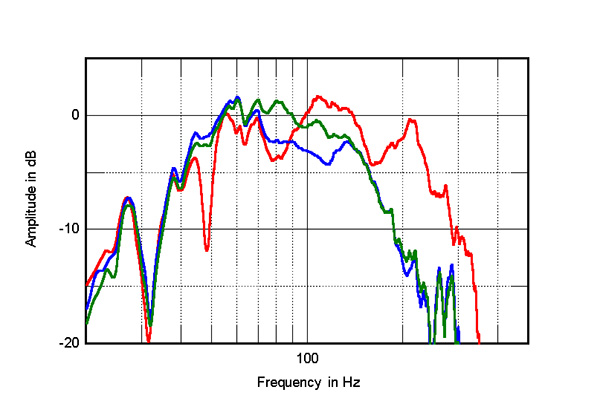
Fig.1 Avantgarde Duo SD iTRON G3, nearfield responses of the woofer with BD's preferred DSP setting (red), with the factory DSP setting (blue), and with the DSP setting that gave the smoothest measured response (green) (5dB/vertical div.).
Looking first at the nearfield behavior of the woofer—BD wasn't able to examine the downward-firing port's output—fig.1 shows the response with the factory DSP setting (blue trace), with the DSP setting that gave the smoothest measured response (green trace), and with BD's preferred DSP setting (red trace). The response rolls off below 50Hz with all three settings, but there is a notch at 48Hz with BD's setting that presumably compensates for a room mode at that frequency. The blue and green traces are down by 6dB at 165Hz, which is close to the speci-fied 170Hz, but BD's setting extends the woofer's output higher in frequency than the other two settings. (The manual does say that the LPF–Range slider can be used to set the crossover frequency higher, which will add "warmth" and give a richer "body" to the "sound character of certain voices and instruments.")
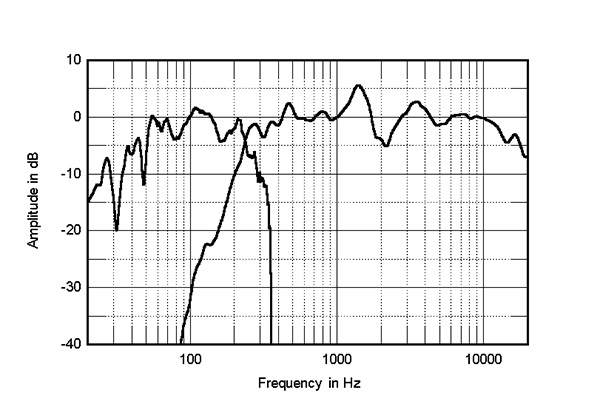
Fig.2 Avantgarde Duo SD iTRON G3, anechoic response of tweeter and midrange horn on tweeter axis at 1m, averaged across 30° horizontal window and corrected for microphone response, with the nearfield woofer response with BD's preferred DSP setting plotted below 360Hz.
The black trace below 350Hz in fig.2 repeats BD's preferred nearfield woofer response. The higher-frequency trace is the response at 1m averaged across a 30° horizontal angle centered on an axis 38.5" high, which was approximately midway between the midrange and tweeter horns and was the height of BD's ears. (The EQ was set to flat for this test.) The speaker's response in the midrange and high treble is even, but between 1kHz and 4kHz there is a peak on either side of a suckout. The response on the tweeter axis, which is 30" from the floor, was very similar, though with more presence-region energy; that on the midrange axis, which is 46.25" high, was also similar but gently rolled off above 4kHz.
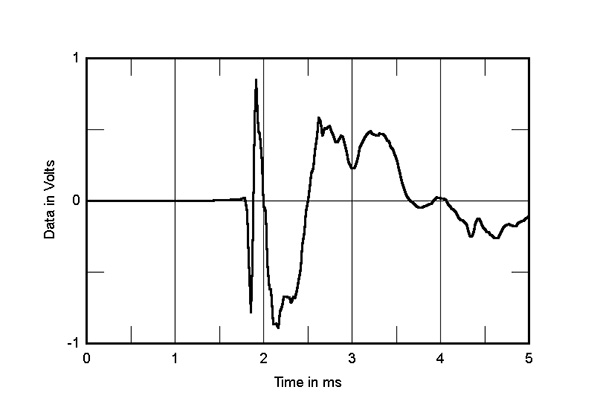
Fig.3 Avantgarde Duo SD iTRON G3, step response on tweeter axis at 1m (5ms time window, 30kHz bandwidth).
The Duo SD iTRON's step response on the ear height axis at 1m (fig.3) indicates that the tweeter and midrange horns are connected in inverted polarity, with the tweeter's output arriving first at the microphone. There is a complicated pattern of reflections in the decay of the steps, and in this respect the Duo SD's behavior is basically identical to that of the original Duo. I haven't shown the cumulative spectral-decay, or waterfall, plot, because these reflections result in a lot of "clutter" that obscures the presence of resonances. Nevertheless, there did appear to be a ridge of delayed energy associated with the response peak between 1kHz and 2kHz. Again, this is similar to what Martin found with the original Duo.
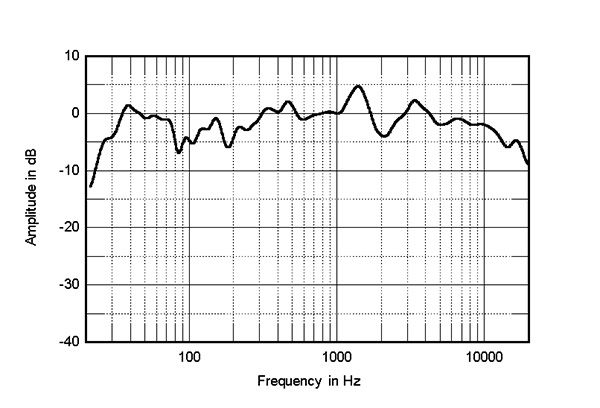
Fig.4 Avantgarde Duo SD iTRON G3, spatially averaged, 1/6-octave response at the listening position in BD's room.
Probably the most meaningful test with a complicated loudspeaker like this is how it measures at the listening position. Accordingly, I asked BD to average 20 spectra, taken for the left and right speakers individually in a rectangular grid 36" wide × 18" high and centered on the positions of his ears. The DSP was set to his preferred setting for these measurements, and the Mid switch was set to +1.5dB, which was the setting he used most of the time. The 1/6-octave–smoothed result is shown in fig.4. The low frequencies extend almost to 30Hz, and other than a slight lack of energy in the lower midrange and upper bass and the familiar combination of peak and suckout in the low treble, the response is even.
Footnote 1: See roomeqwizard.com/.