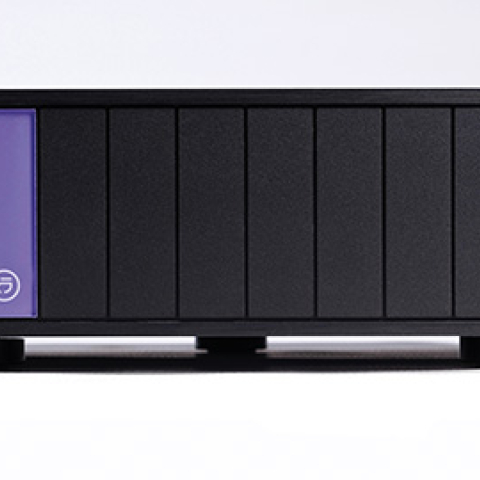
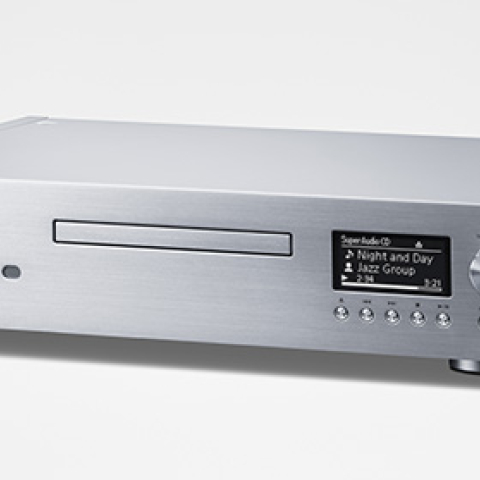
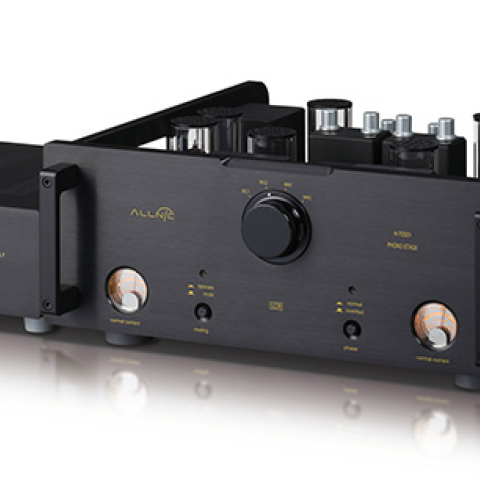
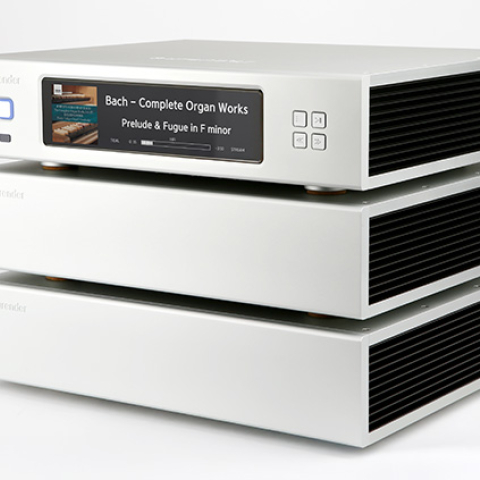
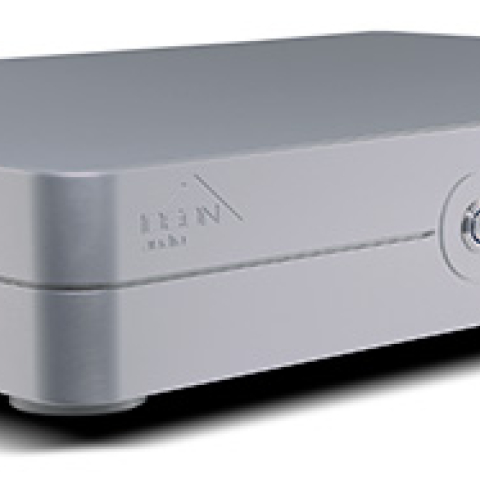
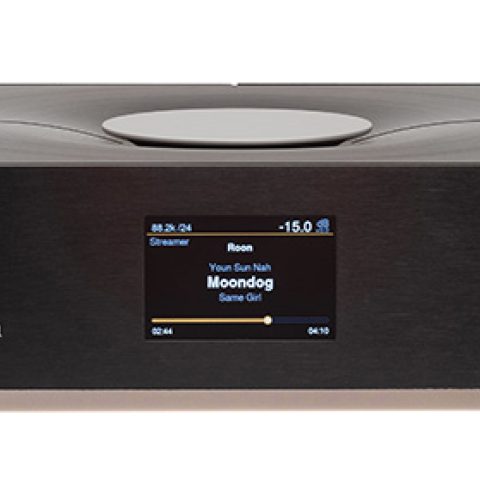
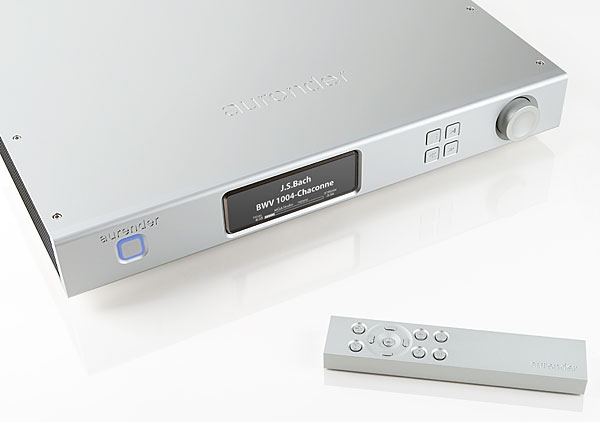
It also made me realize that an honest assessment of the A10 required removing multiple shelves of dCS gear. Once the A10 had a shelf of its own, I further isolated it from noise by placing it on a Grand Prix carbon-fiber Formula platform. These relatively lightweight platforms contribute greatly to the "black"-background transparency of my reference system. On the empty shelf below the Aurender went a Mytek HiFi Brooklyn DAC ($1995), set atop a second Formula platform.
My plan was to first listen to the A10 by itself for an extended period of time. Once I was clear on how it sounded as an all-in-one unit, I would compare its DAC section's sound to the Brooklyn's. Both can play PCM up to 24/384, DSD64 and 128 (the Mytek goes higher), and MQA. Connecting the units was Nordost's excellent, ultra-transparent Valhalla II USB cable, which in my experience transfers data with virtually no loss of sound quality. When the Brooklyn wasn't in use, I left it in standby mode so that it would be performance-ready. Given that the Brooklyn had a shelf of its own, away from both the A10 and the silent dCS Vivaldi that sat on the top shelf of my rack, I had no concerns about unwanted interactions.
There may be trouble ahead
But while there's music and moonlight and love and romance
Let's face the music and dance
Before tackling these setup issues, I'd opened Advanced Settings on the Conductor app and tried to compare the sound of the A10's various digital and analog filters. (There's a separate, nonadjustable filter for MQA.) However, I could hear absolutely no differences among them. Meanwhile, across the country, in Brooklyn, John Atkinson was trying to complete measurements on a different sample of the A10 before renovation of his listening room and test lab began. This was a highly unusual situation: JA usually measures products only after a reviewer has finished his listening and sent the sample to him.
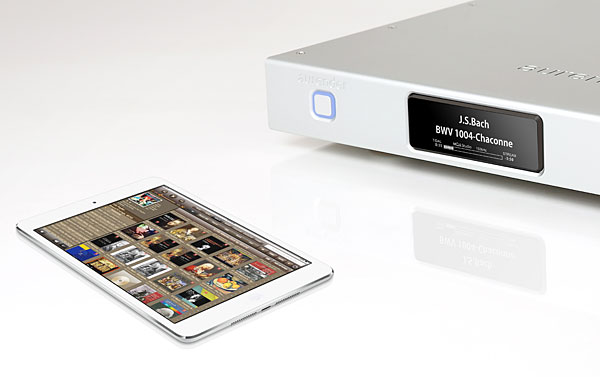 When John, too, could find no differences among the filters, he wrote to ask if I was having the same experience. Given that I'd already spent days assembling four pages of listening notes, I did the ostrich dance. When I could stall no longer, I faced the music and confirmed that switching filters made no audible difference.
At that point, JA felt it best to abort the review until the folks at Aurender HQ could fix what seemed to be a firmware problem. Out went the A10 and Brooklyn, and back in went the dCS components and enough cables to suspend the Brooklyn Bridge. Easier said than done. Only when I'd finished reviewing the dCS Network Bridge did I once again switch all those boxes and cables and reinstall the Aurender A10 and Brooklyn. For the first time in my life, I fantasized about the joys of Assisted Living.
Eventually, Locken e-mailed to tell me that, due to how the A10 processes MQA, filter choices were no longer an appropriate option for this product. Therefore Aurender had "removed the option to select the optional digital and analog filters from the Aurender Conductor app." He also assured me that, under cover of darkness, Eric in Korea had remotely entered my unit, removed all filter options, and fixed the HDD icon.
Not quite. While the HDD icon finally did begin flashing on and off when tracks were being cached in the SSD, the filter choices remained. Doubly assured that changing filters was no longer possible, and that the option would disappear with the A10's next official firmware upgrade, I recommenced listening from scratch.
Listening, Round Two
When John, too, could find no differences among the filters, he wrote to ask if I was having the same experience. Given that I'd already spent days assembling four pages of listening notes, I did the ostrich dance. When I could stall no longer, I faced the music and confirmed that switching filters made no audible difference.
At that point, JA felt it best to abort the review until the folks at Aurender HQ could fix what seemed to be a firmware problem. Out went the A10 and Brooklyn, and back in went the dCS components and enough cables to suspend the Brooklyn Bridge. Easier said than done. Only when I'd finished reviewing the dCS Network Bridge did I once again switch all those boxes and cables and reinstall the Aurender A10 and Brooklyn. For the first time in my life, I fantasized about the joys of Assisted Living.
Eventually, Locken e-mailed to tell me that, due to how the A10 processes MQA, filter choices were no longer an appropriate option for this product. Therefore Aurender had "removed the option to select the optional digital and analog filters from the Aurender Conductor app." He also assured me that, under cover of darkness, Eric in Korea had remotely entered my unit, removed all filter options, and fixed the HDD icon.
Not quite. While the HDD icon finally did begin flashing on and off when tracks were being cached in the SSD, the filter choices remained. Doubly assured that changing filters was no longer possible, and that the option would disappear with the A10's next official firmware upgrade, I recommenced listening from scratch.
Listening, Round Two
Once I'd acclimated to the sound of the A10, the excellent depth and bass impact of the remarkably spacious, driving "Electrified II," from Yello's Toy (24/48 WAV, Polydor 4782160/HDtracks), as well as the strength of its upper midrange, helped compensate for muted colors and a bit of grayness. For contrast, I cued up the capacious voice of operatic great Jamie Barton singing Sibelius's "Var det en drîm?" to Brian Zeger's liquid pianism (24/96 WAV, Delos 3494/HDtracks). I wanted to sink deeply into Barton's glorious mezzo-soprano, but I kept having to turn up the volume when she sang softer (not that a woman with such a huge instrument can truly sing softly), then turn it down when she opened up fully. Under the sound of her voice, Zeger's piano lacked color.
 One of the most revealing of the many recordings I listened to was the second movement of Lou Harrison's remarkable Concerto for Violin with Percussion Orchestra, with soloist Tim Fain, and Angel Gil-Ord¢ñez conducting the Post-Classical Ensemble (24/48 WAV, Naxos 8559825/HDtracks). The impressive impact of Harrison's wild collection of percussion instruments helped compensate for, again, a lack of color. Fain's violin sounded fine at full volume, but a bit hoarse and overly resinous when played softly.
I then chose an MQA file that Bob Stuart had provided of a recording John Atkinson had made, Eric Whitacre's Lux Aurumque. (The original resolution and sample rate was 24 bits and 88.2kHz,) While the male voices of Cantus certainly sounded more real and present than I recalled hearing from my copy of the group's While You Are Alive (CD, Cantus CTS-1208), on which this recording originally appeared, vocal colors were, once more, muted. More engaging were the presence and speed of a stream of the ever-engaging "Babylon Sisters," from Steely Dan's Gaucho (MQA, MCA/Tidal).
Connecting Mytek's Brooklyn DAC and using its digital volume control, I experienced more color and transparency than from the A10's built-in DAC. Revisiting "Electrified II," "Babylon Sisters," and Barton's Sibelius, I found myself more involved with the music. The essential mystery of Harrison's concerto came through loud and clear, and the Mytek did a better job of handling Tim Fain's soft playing without overemphasizing the rasp of bow and resin on strings.
But after a while I began to feel that the Brooklyn's sonic palette was a mite too warm. Rather than knocking me out with the 12-tone take on the devastation of WWI and the dissolution of Old World order, Michael Tilson Thomas and the San Francisco Symphony's download-only release of Berg's Three Pieces for Orchestra (24/192 WAV, SFS Media/HDtracks) sounded seductively smooth, midrange-rich, and remarkably beautiful. But since the Brooklyn's source was the A10's server section, its sonic signature was difficult to ascertain without trying alternative sources.
Thus, I tried two non-Aurender source components to play files through the Brooklyn: my MacBook Pro, using the Amarra Luxe music-playback app to feed files via USB; and the dCS Network Bridge ($4250), using dCS software to feed those files via AES/EBU. The computer source sounded way inferior, lacking the vividness, color, and "blacker" backgrounds transmitted by the A10's server section. The Network Bridge, on the other hand, delivered more midrange and detail than the A10, and sounded more neutral, truthful, and realistic. However, not only was the Network Bridge unable to handle MQA (at the time of the review), it also required extra cables that raised the cost of the Bridge plus Brooklyn far above that of the single-box Aurender A10.
Before wrapping up, I double-checked my observations with a second back-and-forth between the A10 solo and the A10 into the Brooklyn. Playing the final section of Stravinsky's The Rite of Spring, with Ludovic Morlot conducting the Seattle Symphony (24/96 WAV, Seattle Symphony Media 1005/HDtracks), again confirmed that while the A10's color saturation and transparency were just okay, its strong suits were bass, speed, ease of operation, convenience, and ability to play multiple formats.
Conclusions
One of the most revealing of the many recordings I listened to was the second movement of Lou Harrison's remarkable Concerto for Violin with Percussion Orchestra, with soloist Tim Fain, and Angel Gil-Ord¢ñez conducting the Post-Classical Ensemble (24/48 WAV, Naxos 8559825/HDtracks). The impressive impact of Harrison's wild collection of percussion instruments helped compensate for, again, a lack of color. Fain's violin sounded fine at full volume, but a bit hoarse and overly resinous when played softly.
I then chose an MQA file that Bob Stuart had provided of a recording John Atkinson had made, Eric Whitacre's Lux Aurumque. (The original resolution and sample rate was 24 bits and 88.2kHz,) While the male voices of Cantus certainly sounded more real and present than I recalled hearing from my copy of the group's While You Are Alive (CD, Cantus CTS-1208), on which this recording originally appeared, vocal colors were, once more, muted. More engaging were the presence and speed of a stream of the ever-engaging "Babylon Sisters," from Steely Dan's Gaucho (MQA, MCA/Tidal).
Connecting Mytek's Brooklyn DAC and using its digital volume control, I experienced more color and transparency than from the A10's built-in DAC. Revisiting "Electrified II," "Babylon Sisters," and Barton's Sibelius, I found myself more involved with the music. The essential mystery of Harrison's concerto came through loud and clear, and the Mytek did a better job of handling Tim Fain's soft playing without overemphasizing the rasp of bow and resin on strings.
But after a while I began to feel that the Brooklyn's sonic palette was a mite too warm. Rather than knocking me out with the 12-tone take on the devastation of WWI and the dissolution of Old World order, Michael Tilson Thomas and the San Francisco Symphony's download-only release of Berg's Three Pieces for Orchestra (24/192 WAV, SFS Media/HDtracks) sounded seductively smooth, midrange-rich, and remarkably beautiful. But since the Brooklyn's source was the A10's server section, its sonic signature was difficult to ascertain without trying alternative sources.
Thus, I tried two non-Aurender source components to play files through the Brooklyn: my MacBook Pro, using the Amarra Luxe music-playback app to feed files via USB; and the dCS Network Bridge ($4250), using dCS software to feed those files via AES/EBU. The computer source sounded way inferior, lacking the vividness, color, and "blacker" backgrounds transmitted by the A10's server section. The Network Bridge, on the other hand, delivered more midrange and detail than the A10, and sounded more neutral, truthful, and realistic. However, not only was the Network Bridge unable to handle MQA (at the time of the review), it also required extra cables that raised the cost of the Bridge plus Brooklyn far above that of the single-box Aurender A10.
Before wrapping up, I double-checked my observations with a second back-and-forth between the A10 solo and the A10 into the Brooklyn. Playing the final section of Stravinsky's The Rite of Spring, with Ludovic Morlot conducting the Seattle Symphony (24/96 WAV, Seattle Symphony Media 1005/HDtracks), again confirmed that while the A10's color saturation and transparency were just okay, its strong suits were bass, speed, ease of operation, convenience, and ability to play multiple formats.
Conclusions
If the Aurender A10 is not the CD player of the 21st century, it's certainly a viable 21st-century successor to that less-than-perfect source. That the A10 provides a single front-end solution for playing digital music in far more formats, sourced from far more platforms, than the designers of the CD ever envisioned makes it a most tempting proposition for those with limited space and budgets, or who consider a pile of boxes and cables the work of the devil. Whether or not the A10 will end up on your shelf will depend, in large part, on your sonic priorities. Those who tend to listen to music while multitasking, or who don't spend hours on end sitting undisturbed in the sweet spot, need not hesitate.
But while there's music and moonlight and love and romance
Let's face the music and dance
When John, too, could find no differences among the filters, he wrote to ask if I was having the same experience. Given that I'd already spent days assembling four pages of listening notes, I did the ostrich dance. When I could stall no longer, I faced the music and confirmed that switching filters made no audible difference.
At that point, JA felt it best to abort the review until the folks at Aurender HQ could fix what seemed to be a firmware problem. Out went the A10 and Brooklyn, and back in went the dCS components and enough cables to suspend the Brooklyn Bridge. Easier said than done. Only when I'd finished reviewing the dCS Network Bridge did I once again switch all those boxes and cables and reinstall the Aurender A10 and Brooklyn. For the first time in my life, I fantasized about the joys of Assisted Living.
Once I'd acclimated to the sound of the A10, the excellent depth and bass impact of the remarkably spacious, driving "Electrified II," from Yello's Toy (24/48 WAV, Polydor 4782160/HDtracks), as well as the strength of its upper midrange, helped compensate for muted colors and a bit of grayness. For contrast, I cued up the capacious voice of operatic great Jamie Barton singing Sibelius's "Var det en drîm?" to Brian Zeger's liquid pianism (24/96 WAV, Delos 3494/HDtracks). I wanted to sink deeply into Barton's glorious mezzo-soprano, but I kept having to turn up the volume when she sang softer (not that a woman with such a huge instrument can truly sing softly), then turn it down when she opened up fully. Under the sound of her voice, Zeger's piano lacked color.
One of the most revealing of the many recordings I listened to was the second movement of Lou Harrison's remarkable Concerto for Violin with Percussion Orchestra, with soloist Tim Fain, and Angel Gil-Ord¢ñez conducting the Post-Classical Ensemble (24/48 WAV, Naxos 8559825/HDtracks). The impressive impact of Harrison's wild collection of percussion instruments helped compensate for, again, a lack of color. Fain's violin sounded fine at full volume, but a bit hoarse and overly resinous when played softly.
I then chose an MQA file that Bob Stuart had provided of a recording John Atkinson had made, Eric Whitacre's Lux Aurumque. (The original resolution and sample rate was 24 bits and 88.2kHz,) While the male voices of Cantus certainly sounded more real and present than I recalled hearing from my copy of the group's While You Are Alive (CD, Cantus CTS-1208), on which this recording originally appeared, vocal colors were, once more, muted. More engaging were the presence and speed of a stream of the ever-engaging "Babylon Sisters," from Steely Dan's Gaucho (MQA, MCA/Tidal).
Connecting Mytek's Brooklyn DAC and using its digital volume control, I experienced more color and transparency than from the A10's built-in DAC. Revisiting "Electrified II," "Babylon Sisters," and Barton's Sibelius, I found myself more involved with the music. The essential mystery of Harrison's concerto came through loud and clear, and the Mytek did a better job of handling Tim Fain's soft playing without overemphasizing the rasp of bow and resin on strings.
If the Aurender A10 is not the CD player of the 21st century, it's certainly a viable 21st-century successor to that less-than-perfect source. That the A10 provides a single front-end solution for playing digital music in far more formats, sourced from far more platforms, than the designers of the CD ever envisioned makes it a most tempting proposition for those with limited space and budgets, or who consider a pile of boxes and cables the work of the devil. Whether or not the A10 will end up on your shelf will depend, in large part, on your sonic priorities. Those who tend to listen to music while multitasking, or who don't spend hours on end sitting undisturbed in the sweet spot, need not hesitate.