Sidebar 3: Measurements
Because the Antipodes Oladra, like music library/reclocker/server solutions from Melco, Aurender, Auralic, Innuos and others, is a data-storage and -delivery device, any technical or subjective uplift in performance—over a conventional NAS or PC/Mac USB solution—can only be inferred via an attached, third-party streaming player or DAC. Identifying any reduction in jitter or circulating RF interference from the Oladra also depends on the efficacy of the USB receiver's jitter suppression and/or galvanic isolation; a USB DAC with excellent data recovery/reclocking may not express a significant difference.
Similarly, any DAC solution with its own baked-in sources of jitter that arise after the input interface will suffer the same phase/amplitude-modulation sidebands in the analog domain regardless of the coherence of the source's digital data. Ironically, the more rudimentary USB hub-powered DAC/headphone amplifier solutions—as opposed to high-end USB DACs with integral power supplies, etc.—provide the best indicator of incoming data integrity and noise (or lack of it) on the +5V supply.
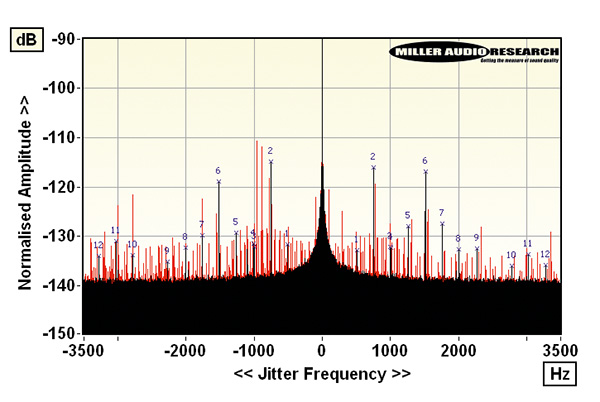
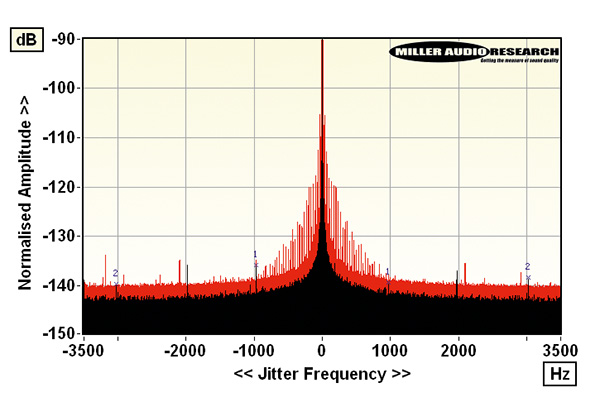
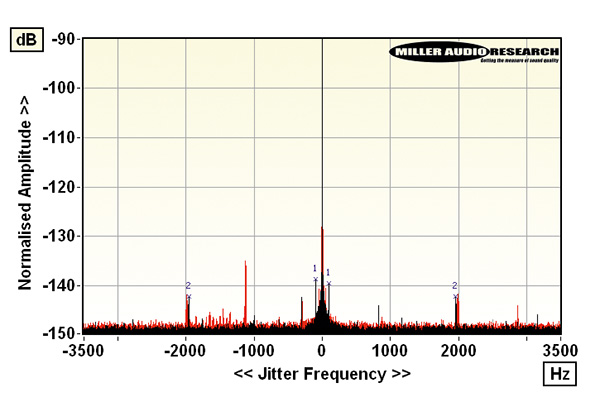
Fig.1 High-resolution 24/48 jitter spectra from AudioQuest's DragonFly DAC via PC (red) and via the Antipodes Oladra (black, with markers).
AudioQuest's original DragonFly DAC (fig.1) illustrates this perfectly, for while there's a worthy reduction in correlated jitter from 300ps (desktop PC, USB source) to 120ps (Oladra source) it's the approximate 95% suppression of circulating interference (spuriae), and the improvement in A-weighted S/N from 94dB to 104dB, that will surely have the biggest subjective impact.
Fig.2 High-resolution 24/48 jitter spectra from iFiAudio's NEO iDSD DAC via PC (red) and via the Antipodes Oladra (black, with markers).
A significant cleaning up was also realized with iFi Audio's NEO iDSD, where the 550ps of ±33/66/99Hz sidebands collapsed to just 10ps (fig.2) with Antipodes' Oladra as the USB source. Otherwise, there is no change in the NEO iDSD's 4.29V peak output, minimum 0.00015% THD (ref. 1kHz/–10dBFs) or, despite the 2dB "step" reduction in HF noise, its 109.7dB A-weighted S/N ratio. (iFi Audio has improved its input jitter reduction at source in its more recent NEO Stream DAC; review forthcoming.)
Fig.3 High-resolution 24/48 jitter spectra from Mytek's Brooklyn DAC via PC (red) and via the Antipodes Oladra (black, with markers).
Other USB DACs tested, including the Mytek Brooklyn (fig.3) and dCS Vivaldi One Apex, have sufficient galvanic isolation/onboard reclocking that very little difference in jitter was observed between the PC and Oladra USB sources. Variations of a mere ±1–2ps were measured, although there is still a visible reduction in the finest spuriae (red spectrum, fig.3). Arguably, every little helps.—Paul Miller