Sidebar 3: Measurements
 I measured the Advance Paris X-CD9 using my Audio Precision SYS2722 system. I first used the Pierre Verany Digital Test CD to check the X-CD9's error correction. It played the tracks with gaps in the data spiral up to 2.4mm in length without any problems, though there were audible glitches when the gap was longer than that or when there were two 2.4mm gaps in succession. The Compact Disc Red Book standard requires only that a player cope with gaps of up to 0.2mm. The Advance player's error correction is one of the best that I have encountered.
The Advance Paris X-CD9's measured performance is a mixed bag. While it offers superb error correction and low distortion, the measured resolution was low, and the noisefloor was modulated with high-level, high-frequency signals.—John Atkinson
I measured the Advance Paris X-CD9 using my Audio Precision SYS2722 system. I first used the Pierre Verany Digital Test CD to check the X-CD9's error correction. It played the tracks with gaps in the data spiral up to 2.4mm in length without any problems, though there were audible glitches when the gap was longer than that or when there were two 2.4mm gaps in succession. The Compact Disc Red Book standard requires only that a player cope with gaps of up to 0.2mm. The Advance player's error correction is one of the best that I have encountered.
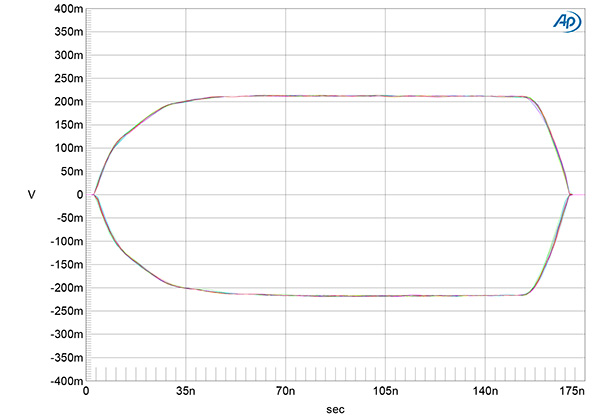
Fig.1 Advance Paris X-CD9, eye pattern of coaxial S/PDIF output carrying 16-bit, 44.1kHz J-Test data (±400mV vertical scale, 175ns horizontal scale).
As this player doesn't have digital inputs, I used 16-bit test signals burned on a CD-R to assess its behavior. The Advance Paris X-CD9 has coaxial and optical digital outputs to allow it to be used as a CD transport with a separate D/A processor. Fig.1 was taken from the coaxial output with a CD-R playing J-Test data plotted over one "unit cycle." The eye pattern is wide open, with no blurring of the leading and trailing edges. The average jitter level, assessed with a 50Hz–100kHz bandwidth, was moderately high, at 875.5 picoseconds (ps) compared with 340.5ps when I looped the Audio Precision SYS2722's S/PDIF output to its coaxial input. The optical output also offered a wide-open eye pattern but with higher jitter, 1.654 nanoseconds (ns).
Unusually, the X-CD9 has a USB Type-A port on its front panel. I loaded a USB stick with various test tone files and plugged it in. "USB" appeared on the Advance's display, which then showed how many files were on the stick. The X-CD9 played WAV and MP3 files sampled at 44.1kHz via USB but couldn't play AIF or AAC files. It wouldn't play 96kHz or 192kHz files. It did play a file sampled at 88.2kHz, though with repetitive dropouts, and the sample rate at the digital outputs was 44.1kHz. The 24-bit files on the USB stick played, but the Audio Precision indicated that only the top 16 bits were active in the digital output signals. Jitter was slightly lower with USB J-Test data, at 827ps from both output types.
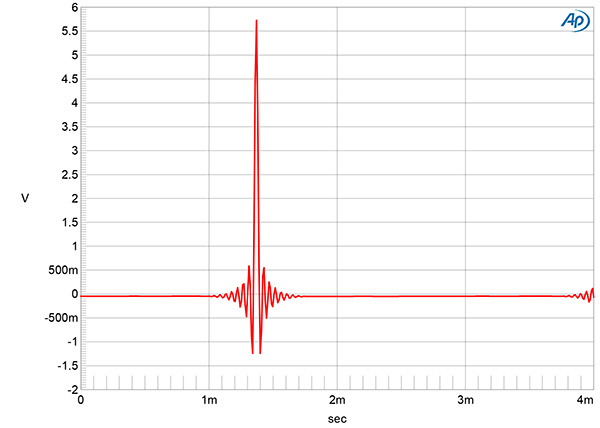
Fig.2 Advance Paris X-CD9, impulse response (one sample at 0dBFS, 44.1kHz sampling, 4ms time window).
The X-CD9's single-ended output impedance was a high 1140 ohms from 20Hz to 20kHz; the balanced impedance was even higher, at 2.4k ohms at 20Hz and 1.965k ohms at 1kHz and 20kHz. A 1kHz signal at 0dBFS resulted in an output level of 2.12V from the single-ended outputs, 4.33V from the balanced outputs. The Advance Paris's impulse response (fig.2) indicates that the output preserved absolute polarity from both types of analog output and that its reconstruction filter is a conventional linear-phase type, with symmetrical ringing before and after the single sample at 0dBFS.
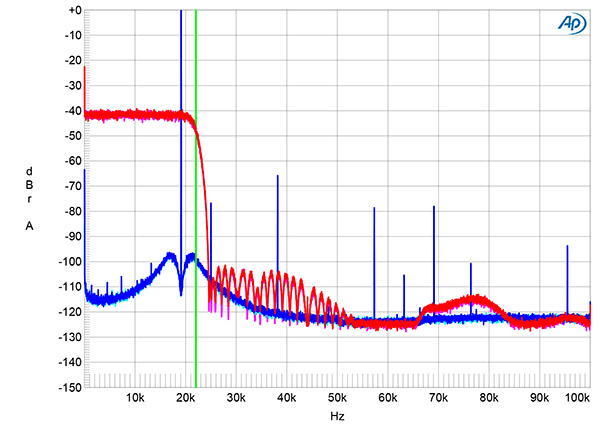
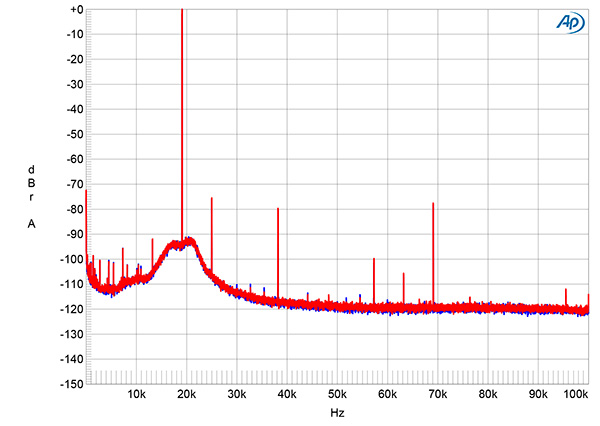
Fig.3 Advance Paris X-CD9, wideband spectrum of white noise at –4dBFS (left channel red, right magenta) and 19.1kHz tone at 0dBFS (left blue, right cyan), with 16-bit data sampled at 44.1kHz (20dB/vertical div.).
Fig.4 Advance Paris X-CD9, wideband spectrum of 19.1kHz tone at –12dBFS (left blue, right red), with 16-bit data sampled at 44.1kHz (20dB/vertical div.).
With white noise at –4dBFS (fig.3, red and magenta traces), the X-CD9's response was flat in the audioband then rolled off sharply above 20kHz, reaching full stopband suppression at 24kHz, just above the Nyquist frequency of 22.05kHz (green vertical line). An aliased image at 25kHz of a full-scale tone at 19.1kHz (blue and cyan traces) lies at –77dB (0.014%), and the highest-level distortion harmonic of the 19.1kHz tone was the second, at –66dB (0.05%). There is an unusual rise in the noisefloor on either side of the 19.1kHz tone. This behavior didn't change when I repeated the spectral analysis with a 19.1kHz tone at –12dBFS (fig.4).
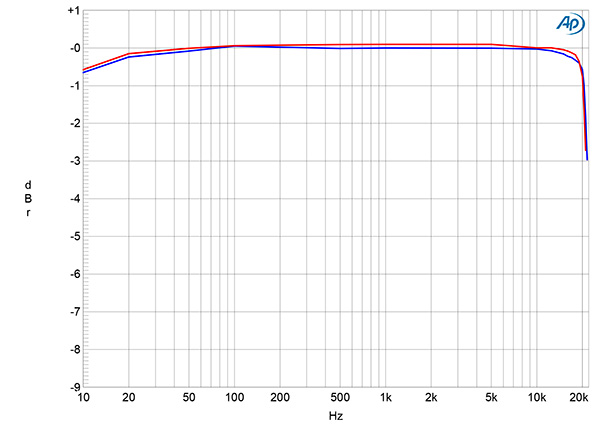
Fig.5 Advance Paris X-CD9, frequency response at –12dBFS (left channel blue, right red) (1dB/vertical div.)
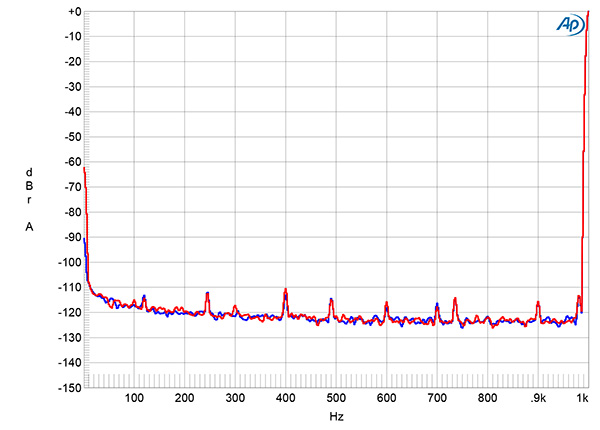
Fig.6 Advance Paris X-CD9, spectrum of 1kHz sinewave, DC–1kHz, at 0dBFS (left channel blue, right red) (linear frequency scale).
The player's frequency response was down by 0.5dB at 20kHz, with close channel matching (fig.5). Channel separation (not shown) was excellent, at 91dB in both directions from 20Hz to 10kHz, dropping to a still-good 74dB at the top of the audioband. With data representing a 1kHz tone at 0dBFS (fig.5), the random low-frequency noisefloor was low in level, as were supply-related spuriae.
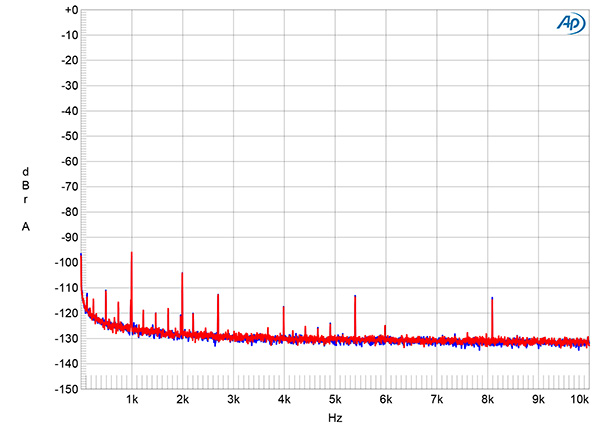
Fig.7 Advance Paris X-CD9, spectrum with noise and spuriae of dithered 1kHz tone at –90dBFS with 16-bit data (left channel blue, right red) (20dB/vertical div.).
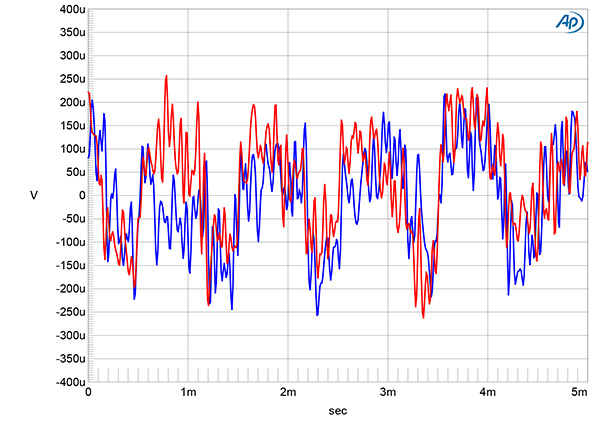
Fig.8 Advance Paris X-CD9, waveform of undithered 16-bit, 1kHz sinewave at –90.31dBFS (left channel blue, right red).
A dithered 1kHz tone at –90dBFS (fig.7) was reproduced at only –96dB, and the second harmonic was less than 10dB lower in level. Peculiarly, the 1kHz tone was reproduced at the correct level with the same signal on the USB stick. I routinely examine the intrinsic level of a CD player's noisefloor by playing a "Digital Black" track, ie, all the data are zeroes. However, the X-CD9 muted its output with this track, as it did when I played a track that comprised a DC offset of –1LSB. With undithered 16-bit data representing a tone at exactly –90.31dBFS, the three DC voltage levels described by the data were obscured by noise, and the waveform was asymmetrical (fig.8).
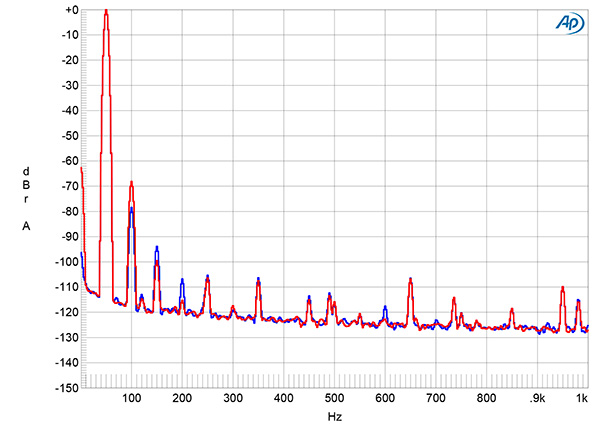
Fig.9 Advance Paris X-CD9, spectrum of 50Hz sinewave at 0dBFS, DC–1kHz, into 100k ohms (left channel blue, right red; linear frequency scale).
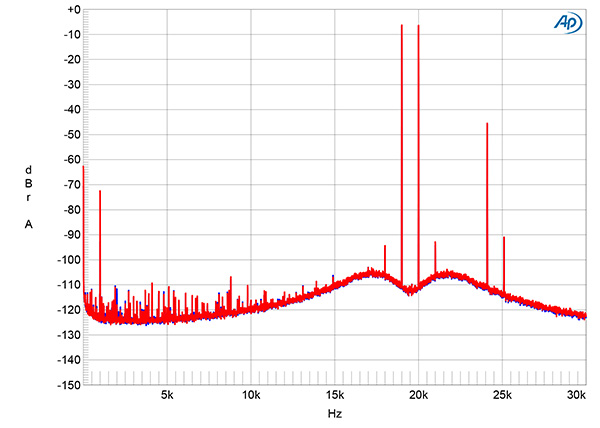
Fig.10 Advance Paris X-CD9, HF intermodulation spectrum (DC–30kHz), 19+20kHz at 0dBFS into 100k ohms (left channel blue, right red; linear frequency scale).
With the X-CD9 driving a full-scale 50Hz tone into 100k ohms, the second harmonic was the highest in level, at –69dB (0.03%) in the right channel (fig.9, red trace) and –79dB (0.01%) in the left channel (blue trace). This was the case with both the balanced and unbalanced outputs. Commendably, the levels of the distortion harmonics didn't rise when I reduced the load to 600 ohms. When I examined the intermodulation distortion with a mix of equal levels of 19 and 20kHz tones, the difference tone at 1kHz lay just below –70dB (fig.10); higher-order spuriae were more than 20dB lower in level. However, the symmetrical rise in the noisefloor seen in fig.3 was present, as were the aliased images of the signal tones.
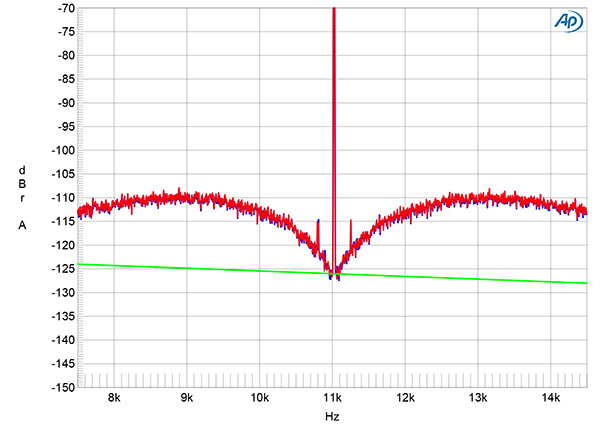
Fig.11 Advance Paris X-CD9, high-resolution jitter spectrum of analog output signal, 11.025kHz at –6dBFS, sampled at 44.1kHz with LSB toggled at 229Hz: 16-bit CD data (left channel blue, right red). Center frequency of trace, 11.025kHz; frequency range, ±3.5kHz.
This peculiar modulation of the noisefloor affected my examination of the X-CD9's rejection of word-clock jitter. As always, I used the undithered Miller-Dunn J-Test signal (a high-level tone at one-quarter the sample rate over which is overlaid the least-significant bit toggled on and off at a frequency equivalent to the sample rate divided by 192) for this test. The correct levels of the odd-order harmonics of the LSB-level, low-frequency squarewave are shown by the sloping green line in fig.11; other than the two on either side of the spectral spike that represents the high-frequency tone, they all lie beneath the noisefloor. This was also the case when I repeated the test with 16-bit USB data.