However, I had some problems with Apple Lossless files. The 24/96 ALAC files of Beck's Morning Phase (Capitol/HDtracks) played okay, as did the 24/88.2 ALAC files of Random Access Memories. But some ALAC files at 88.2 and 96kHz were incorrectly identified as "44.1kHz" and played at half speed. This was true with my own recordings and with some commercial recordings, such as Richard Egarr and the Academy of Ancient Music's of J.S. Bach's Brandenburg Concertos (Harmonia Mundi), and Sara K.'s Play on Words (Chesky). With some 192kHz ALAC files, the sample rate was again identified as "44.1kHz," but these files wouldn't play at all.
These rogue files played correctly on the Pono, Questyle, and Astell&Kern players, on Aurender and Antipodes media servers, and on my Mac mini running Pure Music and Audirvana. On investigating this problem, however, I realized that every one of the problem files had been transcoded from an AIFF original with iTunes. I Dropboxed examples of some of these files to AR's Arex Li, who responded that "the file headers were misread and the files were misrecognized as 44.1kHz files. While M2 switches the clock according to the file for native playback, a wrong clock was used to play the file. My software engineers have already identified the issue and prepared a fix. We will verify the fix and send it to you."
I installed the revised version of the AR-M2 firmware (v.2.5.1) when I received it. All the rogue files now played correctly, and the new version of the app also added gapless playback, which I verified with some symphonic files where there was no pause between movements. It was time for some comparisons.
Against the Astell&Kern AK100
I compared the AK100 with the AR-M2 with levels matched by ear, and listened through the AudioQuest NightHawks. "Heart Like a Drum," from Beck's Morning Phase (24/96 ALAC, Capitol/HDtracks), sounded cleaner on the AR, with less "fog" at low frequencies. This was the opposite of what I'd expected, as the AK100's output impedance is twice that of the AR. Recorded detail—eg, the piano vamping under the guitars in the verses—could be heard a bit more clearly than on the AK100. Advantage, the AR-M2. Against the PonoPlayer
Playing Rachmaninoff's Symphony 2, with Iván Fischer conducting the Budapest Festival Orchestra (DSD64, Channel Classics 21604), the Pono didn't quite match the dynamic swings of the AR-M2. When I drove the Audeze 'phones single-ended and again matched levels by ear, the Pono sounded quieter than the AR: the orchestral flare-up with the Tchaikovsky-esque brass choir some 11:00 into the first movement was not as overwhelming. The ambience surrounding the orchestra seemed better resolved with the M2, as was the space around the solo clarinet in the second movement. However, it was a close call with these two players: The Pono was sweeter with that glorious melody in the symphony's slow third movement, the AR-M2 airier; the Pono was a little more involving, the M2 a little more resolving. Against the Astell&Kern AK240
When Michael Lavorgna reviewed the AK240 in November 2014, he wrote: "While I've heard more lush, ripe presentations . . . [u]pper frequencies were finely detailed, yet never edgy or too sharp. Its combined strengths of superb resolution and clean, clear, fatigue-free reproduction made it a joy to listen to." I spent a weekend with the AK240 using LCD-X and Ultimate Ears 18 Pro IEM headphones, and my own feelings about this expensive player echo ML's.
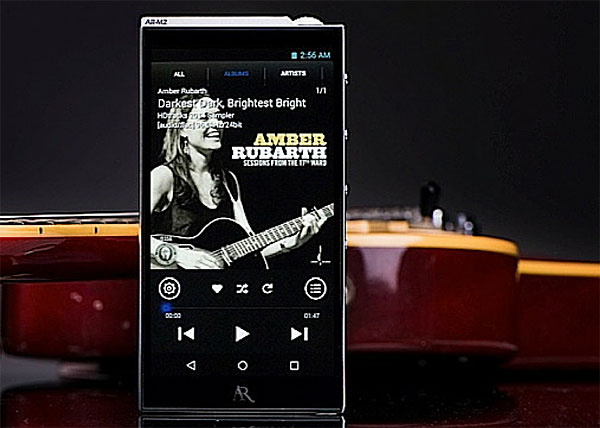 But returning to the AR-M2, I didn't feel I was taking much of a step down in sound quality. With the forceful quality of the double-bass groove in "Ode to Billy Joe," from Patricia Barber's Café Blue (DSD64, Premonition/Acoustic Sounds), and the gloriously real-sounding quality of the reverberation behind Barber's voice and finger snaps, the two players sounded very close to one another, and equal in their powers of resolution. Perhaps the AR-M2 slightly emphasized the sibilance, and perhaps the double bass sounded a bit rounder through the AK240—but, again, the differences were small, and may well have been due to the inevitable difficulty in matching playback levels by ear.
On balance, if I didn't have to count pennies, I'd go for the $2500 Astell&Kern—but for $1300 less, the Acoustic Research comes very close.
Streaming with Tidal
But returning to the AR-M2, I didn't feel I was taking much of a step down in sound quality. With the forceful quality of the double-bass groove in "Ode to Billy Joe," from Patricia Barber's Café Blue (DSD64, Premonition/Acoustic Sounds), and the gloriously real-sounding quality of the reverberation behind Barber's voice and finger snaps, the two players sounded very close to one another, and equal in their powers of resolution. Perhaps the AR-M2 slightly emphasized the sibilance, and perhaps the double bass sounded a bit rounder through the AK240—but, again, the differences were small, and may well have been due to the inevitable difficulty in matching playback levels by ear.
On balance, if I didn't have to count pennies, I'd go for the $2500 Astell&Kern—but for $1300 less, the Acoustic Research comes very close.
Streaming with Tidal
With WiFi capability and preloaded with Tidal and Spotify apps, the AR-M2 comes ready for a streaming world. Linking the Tidal app to my account took less time than it did for me to write this sentence. What, then, to play? Glenn Frey's death in January prompted me to listen not to "Hotel California," "One of These Nights," or "Take It Easy," but to "New Kid in Town," from the 16/44.1 remastering of the Eagles' Hotel California (Elektra/Asylum). This is a beautifully engineered recording, and the AR-M2 got everything right: the gentle pathos in Frey's lead vocal, the vocal harmonies that soar upward to emphasize the key change after the solo bridge, the chiming quality of the chords with which Don Felder begins his guitar solo, the softened low frequencies of Randy Meisner's guitarrón, the restrained tastefulness of Joe Walsh's interjections on electric piano. That experience triggered an afternoon's worth of enjoyment streamed from Tidal. I suspect that the ability to stream true CD-quality audio from Tidal will be the selling point for many buyers of the AR-M2.
Conclusion
Each of the four personal players I used in preparing this review offers a different combination of features: the PonoPlayer plays only audio files; the AK100 has digital input and output and can be used as a DAC; the feature-rich AK240 also adds WiFi capability and native DSD playback; the AR-M2 dispenses with a digital input but is almost as versatile as the AK240 at less than half its price. And when it comes to sound quality, I'd be hard put to choose between the AR-M2 and the AK240. I recommend the AR-M2. It's good to see the Acoustic Research brand applied to such a well-engineered product after all these years. It's just a shame that the beautiful-looking and -sounding AR-M2 couldn't be made in the US—let alone in Houghton Regis!
I compared the AK100 with the AR-M2 with levels matched by ear, and listened through the AudioQuest NightHawks. "Heart Like a Drum," from Beck's Morning Phase (24/96 ALAC, Capitol/HDtracks), sounded cleaner on the AR, with less "fog" at low frequencies. This was the opposite of what I'd expected, as the AK100's output impedance is twice that of the AR. Recorded detail—eg, the piano vamping under the guitars in the verses—could be heard a bit more clearly than on the AK100. Advantage, the AR-M2. Against the PonoPlayer
Playing Rachmaninoff's Symphony 2, with Iván Fischer conducting the Budapest Festival Orchestra (DSD64, Channel Classics 21604), the Pono didn't quite match the dynamic swings of the AR-M2. When I drove the Audeze 'phones single-ended and again matched levels by ear, the Pono sounded quieter than the AR: the orchestral flare-up with the Tchaikovsky-esque brass choir some 11:00 into the first movement was not as overwhelming. The ambience surrounding the orchestra seemed better resolved with the M2, as was the space around the solo clarinet in the second movement. However, it was a close call with these two players: The Pono was sweeter with that glorious melody in the symphony's slow third movement, the AR-M2 airier; the Pono was a little more involving, the M2 a little more resolving. Against the Astell&Kern AK240
When Michael Lavorgna reviewed the AK240 in November 2014, he wrote: "While I've heard more lush, ripe presentations . . . [u]pper frequencies were finely detailed, yet never edgy or too sharp. Its combined strengths of superb resolution and clean, clear, fatigue-free reproduction made it a joy to listen to." I spent a weekend with the AK240 using LCD-X and Ultimate Ears 18 Pro IEM headphones, and my own feelings about this expensive player echo ML's.
But returning to the AR-M2, I didn't feel I was taking much of a step down in sound quality. With the forceful quality of the double-bass groove in "Ode to Billy Joe," from Patricia Barber's Café Blue (DSD64, Premonition/Acoustic Sounds), and the gloriously real-sounding quality of the reverberation behind Barber's voice and finger snaps, the two players sounded very close to one another, and equal in their powers of resolution. Perhaps the AR-M2 slightly emphasized the sibilance, and perhaps the double bass sounded a bit rounder through the AK240—but, again, the differences were small, and may well have been due to the inevitable difficulty in matching playback levels by ear.
On balance, if I didn't have to count pennies, I'd go for the $2500 Astell&Kern—but for $1300 less, the Acoustic Research comes very close.
Streaming with TidalWith WiFi capability and preloaded with Tidal and Spotify apps, the AR-M2 comes ready for a streaming world. Linking the Tidal app to my account took less time than it did for me to write this sentence. What, then, to play? Glenn Frey's death in January prompted me to listen not to "Hotel California," "One of These Nights," or "Take It Easy," but to "New Kid in Town," from the 16/44.1 remastering of the Eagles' Hotel California (Elektra/Asylum). This is a beautifully engineered recording, and the AR-M2 got everything right: the gentle pathos in Frey's lead vocal, the vocal harmonies that soar upward to emphasize the key change after the solo bridge, the chiming quality of the chords with which Don Felder begins his guitar solo, the softened low frequencies of Randy Meisner's guitarrón, the restrained tastefulness of Joe Walsh's interjections on electric piano. That experience triggered an afternoon's worth of enjoyment streamed from Tidal. I suspect that the ability to stream true CD-quality audio from Tidal will be the selling point for many buyers of the AR-M2.
Each of the four personal players I used in preparing this review offers a different combination of features: the PonoPlayer plays only audio files; the AK100 has digital input and output and can be used as a DAC; the feature-rich AK240 also adds WiFi capability and native DSD playback; the AR-M2 dispenses with a digital input but is almost as versatile as the AK240 at less than half its price. And when it comes to sound quality, I'd be hard put to choose between the AR-M2 and the AK240. I recommend the AR-M2. It's good to see the Acoustic Research brand applied to such a well-engineered product after all these years. It's just a shame that the beautiful-looking and -sounding AR-M2 couldn't be made in the US—let alone in Houghton Regis!