Tonearm Reviews

Sort By:  Post Date TitlePublish Date

Clearaudio Ovation & Clarify turntable & tonearm

Like many audiophiles, I cohabit with someone who understands my audio obsession but has no desire to share it. That someone is my wife. Since I began writing for Stereophile, Ashley has helped me carry amplifiers, tape up boxes for shipping, and found room in our house for all the extra components and their boxes—which sometimes make the place look like a scene from an episode of Hoarders. She's a peach. Every time new gear comes to the house or to my studio, my wife has calmly helped me move stuff around while I dance around like a six-year-old on Christmas morning.

Listening #118

Until recently, my favorite shirt was one I'd found on a clearance table at Macy's: a red paisley thing with long sleeves and a button-down collar, not unlike the ones seen in photographs of Peter Holsapple or the young Syd Barrett. When I first found it, this shirt was dusty, and appeared to have been marked down at least a half-dozen times before bottoming out at a price that wouldn't buy a six-pack of Mountain Dew at the local stop-and-rob. Maybe it was on the verge of being discarded, but I suspect that the people at Macy's had simply forgotten it was there.

VPI Classic 3 turntable & Classic-JMW tonearm

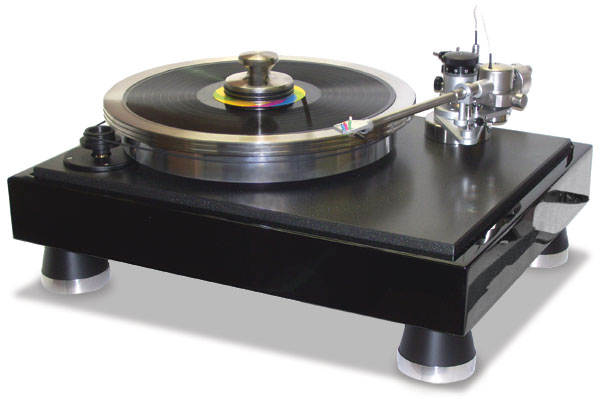
Trends in turntable design shift back and forth over time, each "advance" turning out to be a mostly sideways move. Over its long history, VPI's founder and designer, Harry Weisfeld, has moved the analog goalposts back and forth as he's refined his thinking. His early turntables were mostly standard spring-suspension designs of normal size. By the time Weisfeld produced his fully tricked-out TNT model, which was originally designed to stably hold the heavy moving mass of Eminent Technology's ET2 air-bearing arm, he'd moved to a massive, oversized, sandwiched plinth with isolating feet at the corners. He first used springs and, later, air bladders originally designed to cushion a tractor-trailer's load, and which he'd found in a trucker's supply catalog. Via an O-ring, the TNT's outboard motor drove one of three pulleys that protruded from holes in the plinth, and attached to a T-shaped subchassis that, in turn, drove the other two pulleys via two additional O-rings.

Eminent Technology Two tonearm

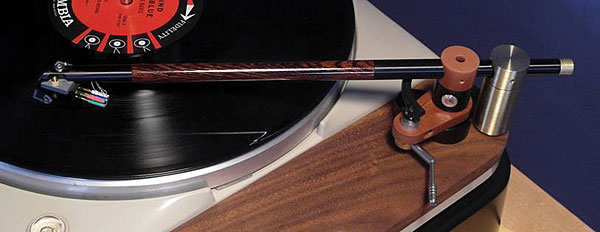
666et2.jpgIf analog disc is fading, it is a twilight of the gods. Tonearms, cartridges, and turntables get steadily better; the overall quality of the best analog disc systems today is far better than it was two years ago. Bruce Thigpen and Edison Price's new Eminent Technology Two tonearm is a case in point. It has evolved from a highly specialized product for only the bravest of audiophiles to a reference quality arm that any dealer can install, and any audiophile can safely use. More importantly, it may have no sonic equal at any price.

Kuzma 4Point tonearm

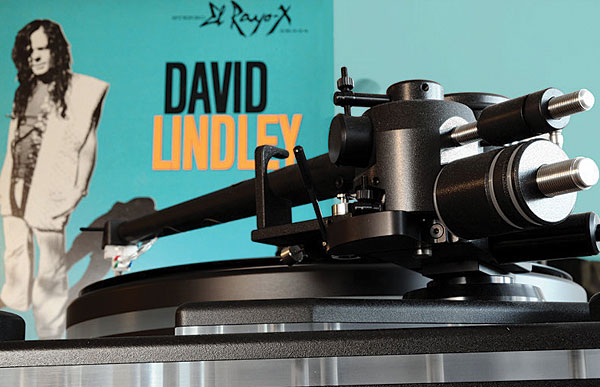
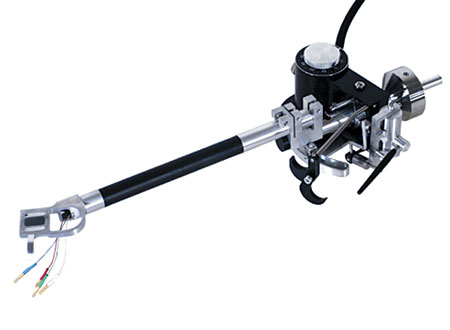
No one has ever accused Franc Kuzma of designing glamorous audio jewelry. His turntables and tonearms are industrial-strength examples of engineering know-how and machining excellence. But to those who appreciate such things, his products are truly beautiful, even if they're not adorned with chrome, wood, and sleekly polished surfaces. And if looking at the 4Point tonearm ($6500) in pebbly Darth Vader black doesn't get your analog juices flowing, perhaps its innovative design will. But first, this message:

Brinkmann 9.6 tonearm

Brinkmann's 9.6 tonearm ($3990) resembles the German company's longer, more expensive 10.5 and 12.1 arms, which in turn resemble the legendary Breuer. The new arm includes the same headshell, armtube, mounting socket, and cueing device used in the other arms. The bearing system differs, though the Swiss-made ball bearings are identical.

While the more expensive arms use traditional fixed-gimbal bearings, the 9.6 has a unipivot-like construction for the horizontal bearing. The weighted arm housing sits on a small ball that rests on a pivot, also as in a typical unipivot design. A second ball at the bottom of the housing prevents "arm lean," but since the arm's weight rests on the top ball, the lower one isn't critical, and I could feel some play when I handled the arm. Vertical arm motion is effected via a second pair of captured bearings. This arrangement allowed the use of less costly parts and kept the price down, Brinkmann says. The arm's effective length is 248mm (231.5 from pivot to spindle, plus 16.5mm of overhang), while its effective mass, referenced to the center position of the headshell slot, is 12gm.

HiFiction Thales AV tonearm

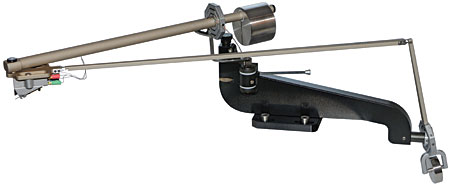
Ideally, LPs should be played with the pickup stylus remaining tangential (ie, at a 90° angle) to the groove—just as the lacquer from which the LP was ultimately stamped was cut in the first place. Over the years, many attempts have been made to accomplish this. Back in 1877, Thomas A. Edison's original machines tangentially tracked his cylinders, but Emil Berliner's invention of the flat disc put an end to cylinders altogether. In the 1950s, a number of companies marketed so-called "tangential" trackers that used dual arms, based on conventional pivoting arrangements, to change the angle at which the headshell was mounted as it moved across the LP side. In 1963, Marantz introduced the SLT-12, which used a plastic pantograph to move the stylus across the record surface. Garrard's Zero 100 pivoting arm controlled its independently pivoting headshell with a bar that extended from the main bearing of the tonearm.

Spiral Groove Centroid tonearm

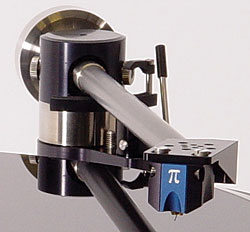
Spiral Groove's new Centroid tonearm ($6000) arrived just a few days before press time, so it would be risky to say anything definitive about it. But I will take that risk: using the system described in my">http://www.stereophile.com/turntables/spiral_groove_sg2_turntable/">my review of the SG2 turntable, this may be the best tonearm I've heard. Its sound is different in ways that will open people's ears, and I predict that it will affect the design of every tonearm from now on. The Centroid's design deserves and will await full coverage in its own review, but here are the basics: It's a fluid-damped unipivot design unlike any other that gives the user fine adjustment of all relevant parameters.

The Tri-Planar Tonearm

While brushing my teeth this morning, it occurred to me that there are significant similarities between a toothbrush and a tonearm/cartridge. The bristles would be analogous to the cartridge and the brush handle to the tonearm. In either case it is the business end of the device that does all the work. The bristles track the contours of your ivories in search of hazardous waste deposits, while the cartridge tracks the record groove transducing wall modulations into an electrical signal. I think that this is where the old adage came from: "A used cartridge is like a used toothbrush—nobody wants one!"

Advertisement
Advertisement
Advertisement