Tonearm Reviews

Sort By:  Post Date TitlePublish Date

Ortofon RS-212 tonearm

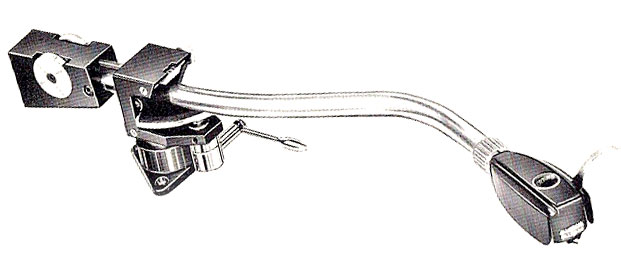
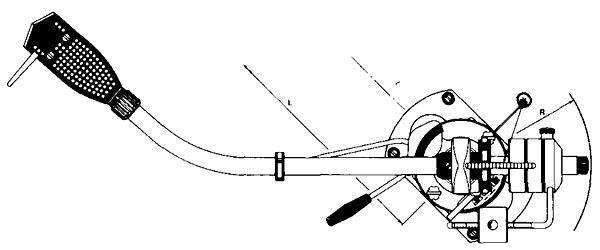
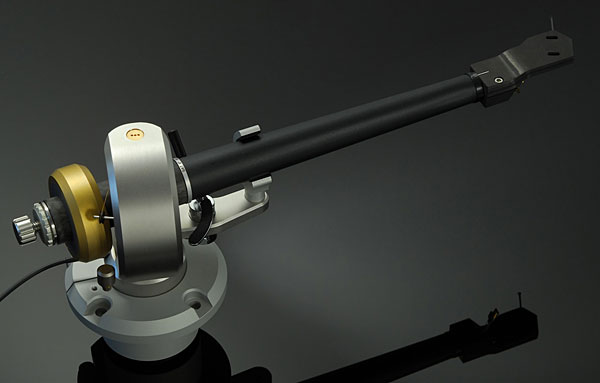
The RS-212 is one of the most impressive-looking tonearms we've seen in many a moon. Our first reaction to it, in fact, was much the same as our reaction to the first big, professional Ampex tape recorder we ever saw: it reminded us of one of those precision-engineered and cleanly styled electronic devices you see in hospitals and industrial laboratories—devices which make no attempt to cater to the current fashion in interior decorating or depth-researched consumer preferences, but which are designed simply to do a job neatly and efficiently. This arm, in short, is practically guaranteed to impress your Magnavox-oriented friends with the quality of your phono system, no matter how oblivious they may be to its actual sound.

Listening #170: Audio Origami UniArm

My first attempt at writing this piece began with a list of the Top Ten Audio Products I Wish Were Still in Production. Unfortunately, that proved unworkable. Although some of my selections—the Audio Research SP-6C preamplifier, the Stax ELS-F81 loudspeaker—were straightforward, it turned out that most of the others were burdened with complications. Examples: It's no longer feasible to mass-produce Bakelite headshells for a revival of the original Ortofon SPU or similar phono pickup. It's no longer possible to obtain the precisely correct vacuum tubes and other components required to return to production the Leak Stereo 20 amplifier. And I'm certain that a torch- and pitchfork-wielding mob would prevent the manufacture of an authentic Altec 604B drive-unit, unless those audio villagers were first allowed to "improve" the design.

Gramophone Dreams #9

"Hail, Neophyte!"

That's what members of the Smoky Basement Secret Audio Society would exclaim in unison at the end of each ceremony admitting a new devotee. It was called the Smoky Basement Society not because everyone smoked (though they did), but because its members believed that whenever an audio designer finally got a design dialed in just right, he or she had metaphorically "let the smoke out." They exclaimed, "Hail, Neophyte!" because they believed that the most important aspect of being an audio engineer was to have a fully open "beginner's mind." In Zen practice, this is called Shoshin, or beginner's heart.

Acoustic Signature Triple X turntable & TA-1000 tonearm

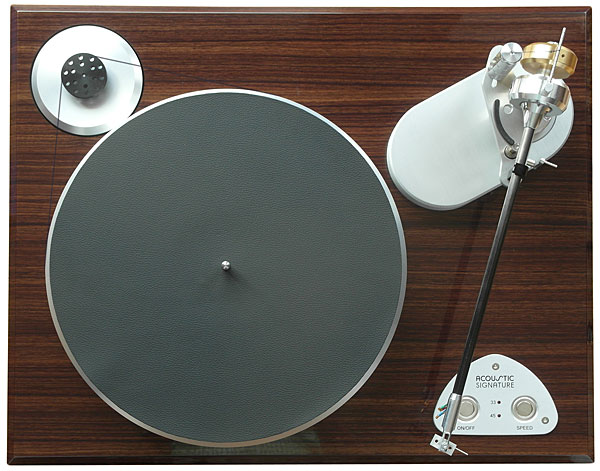
In a bizarre but happy turn of events, recent consumer trends have given even the most socially awkward audiophile something to talk about at cocktail parties and family gatherings at which normal people predominate: the PonoPlayer and vinyl. These are hot topics; each is among the best-sounding music sources available, and both offer hope for our hobby, if not for music lovers in general. But vinyl has the advantage of appealing to a much wider range of budgets. LPs can be had from anywhere to "We'll pay you to haul these away" to "Your loan officer is on line one." Likewise, vinyl playback hardware is available in virtually every price range, from a second-hand Dual 1229 ($50 and up) to the highly praised Continuum Audio Labs Caliburn ($200,000 and down).

Formula 4 tonearm

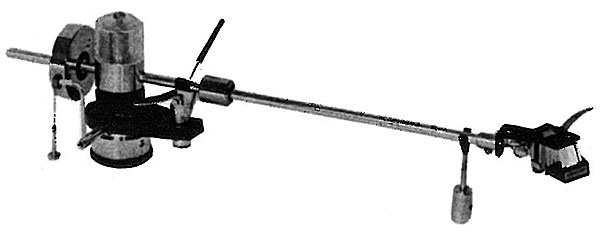
Not the easiest tonearm to set up (let your dealer do it if you aren't overly skilled at such things), this English-designed and Japanese-made device is the best pivoted tonearm we have tested to date, and at a very reasonable price at that. Polk Audio is importing them and distributing to dealers, most of whom sell them for around $130 to $140, and some buyers have managed to purchase them directly from stores in England for as little as $80. We received two samples of this for testing, one directly from the US distributor, Polk Audio, the other from Natural Sound, a Nebraska dealer and (naturally) one of our advertisers. Suffice it to say that both samples were identical in every perceptible manner.

Analog Corner #233: Pear Audio Blue Kid Thomas turntable & Cornet 2 tonearm

Pear Audio Analogue's Peter Mezek can keep you up all night spinning fascinating turntable tales. Had my mind not been numbed by Sunday evening, October 12, the last day of the 2014 Rocky Mountain Audio Fest, I might have insisted that he do just that.

Over dinner that evening he regaled Pear Audio's North American importer, Michael Vamos of Audio Skies, and me with turntable stories dating back to the late 1970s and the Linn Sondek LP12, which, until the early '80s, he distributed in Czechoslovakia. In the mid-'80s, Mezek was involved in the development and distribution of the Rational Audio turntable, designed for Mezek by Jirí Janda (pronounced Yeerzhee Yahnda), who died in 2000. For those of you old enough to remember, Janda, a founder of NAD, designed that company's 5120 turntable; among other features, it had a flat, flexible, plug-in tonearm that you could easily swap out, much as you can with VPI's current models.

Analog Corner #239: Swedish Analog Technologies tonearm

Late in the fall of 1982, Los Angeles turned ugly for me. I'd finished my work on Tron and despite the Academy Award nomination for Best Sound (which went to the mixing team, not the sound supervisor), it was obvious that nothing else was coming my way anytime soon. To earn a living, I had to reinvent myself.

So there I was in Las Vegas, at the 1983 Consumer Electronics Show, schlepping heavy bags filled with press kits, each containing an audio cassette of a dozen radio commercials for a car-stereo store that I'd voiced and produced, along with a résumé-bio and endorsements from clients.

Listening #151

Before hitting the Refresh key on last month's column, which was dedicated to the challenges one encounters when evaluating audio cables and other accessories, I'd like to share with you a true story: a cautionary tale, as it were, about the hazards of writing reviews for a living.

Seven or eight years ago, just as spring was returning to upstate New York, I made my annual trek to Montreal for Salon Son et Image: one of my favorite audio shows for a number of reasons, not the least being the fact that I can travel there by train.

Pear Audio Blue Kid Howard turntable & Cornet 2 tonearm

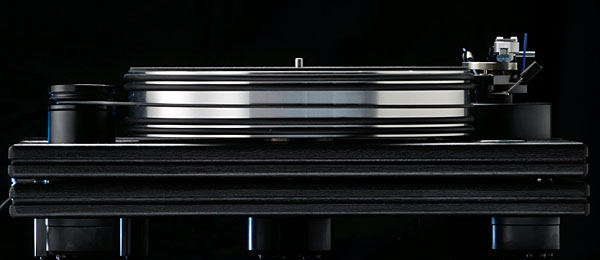
There's nothing new under the sun, or so we are told. Nevertheless, in the early 1990s, a British designer named Tom Fletcher upset the audio status quo with a turntable that combined otherwise-familiar elements in a manner that was, at the very least, new with a lower-case n. Fletcher's product, the Space Deck, was perhaps the first original design in British phonography since the Roksan Xerxes of 1985; and his company, Nottingham Analogue, went from nothing to something in no time at all.
Advertisement
Advertisement
Advertisement