Floor Loudspeaker Reviews

Sort By:  Post Date TitlePublish Date

Green Mountain Audio Diamante loudspeaker
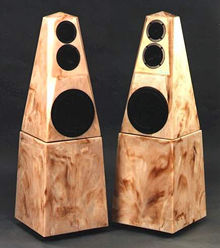
I live in a house that has a pyramid-shaped roof, so I guess you could say that I have a thing for pyramids (footnote 1). That's probably why I was immediately drawn to the Green Mountain Audio Diamante. I'm also attracted to floorstanding speakers with small footprints, since my listening/video room is only 13' by 16'. My Holy Grail of loudspeakers is a small speaker that's flat between 20Hz and 20kHz, can do 110dB sound-pressure–levels without straining, and costs less than $1000/pair.
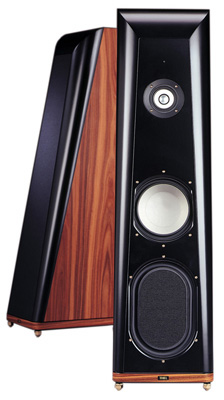
Audio Physic Caldera III loudspeaker

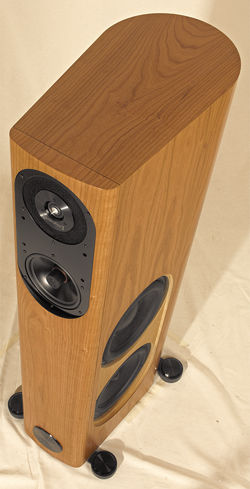
More, I think, than any other link in the audio chain, loudspeaker designs tend to reflect the personal preferences, opinions, and philosophies of their creators—think Henry Kloss, Paul Klipsch, Rudy Bozak, David">http://www.stereophile.com/interviews/478">David Wilson, Jon Dahlquist, Arnie Nudell, and Amar Bose (just kidding). Consider, if you remember, where Ken">http://www.stereophile.com/interviews/232">Ken Kantor took Acoustic Research when he took over AR's design reins. Might as well have called AR NHT, for all that the new designs followed the old.

Thiel CS2.4 loudspeaker

Jim Thiel sounded almost bored. "Almost everything about the CS2.4 is pretty standard stuff—short-coil, long-gap, low-distortion drivers, aluminum diaphragms, polystyrene capacitors, spatial coherence, time coherence, reduced diffraction baffles, reduced cabinet vibration, etc., etc. Of course, I think the execution of the 2.4 is more successful than our previous models, but in terms of what's really different, that mechanical crossover is what's special."

Watkins WE-1 loudspeaker

First I should clear up what may be an ambiguity in the driver-lineup spec for these speakers. In each system, three 8" cone units serve as woofers. Two of these crossover from the midrange drivers at 100Hz. Crossover to the third 8-incher, the subwoofer, is at 40Hz. Thus, two woofers are active from 100Hz down to 40Hz, and all three are active below 40. In other words, the third woofer does not come into play until the frequency drops to the point where the radiating area of two 8-inchers starts to become inadequate for moving air, at which point the additional area of the third speaker is thrown in. Below 40Hz, all three are working together.

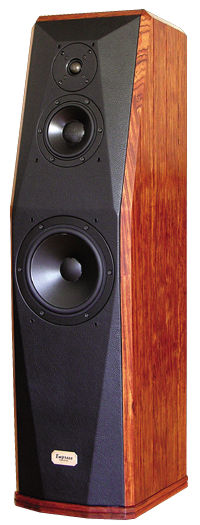
Peak Consult Empress loudspeaker

I'd heard rumors about Peak Consult. John Marks was all a-burble, having reviewed the InCognito in "The">http://www.stereophile.com/amplificationreviews/932/index2.html">The Fifth Element" in the September 2003 Stereophile, but I'd never actually heard anything designed by PC's Per Kristoffersen. Therefore, when US distributor Chris Sommovigo proposed that I audition the $25,000/pair Empress, I was intrigued. Well, who wouldn't be?

Monitor Audio Studio 50 loudspeaker

English loudspeaker manufacturer Monitor Audio has mined a rich vein with their exclusive 6½" metal-cone driver, which covers a range from the bass to the midrange. MA designs using this drive-unit have fared well in these pages, ranging from the Monitor Audio Studio 6 minimonitor (reviewed">http://www.stereophile.com/standloudspeakers/910">reviewed by JA in February '94, Vol.17 No.2) to the floorstanding Studio 20 (reviewed by RH in December '91, Vol.14 No.12, and by ST in April '92, Vol.15 No.4).

Shahinian Diapason loudspeaker system

Richard Shahinian has been offering loudspeakers to music lovers for more than 15 years. I use the word "offering" here in its strictest sense, because Dick has never "sold" his products—by pushing them. Indeed, he is probably one of the worst self-promoters in the business. If we think of "soft sell" in the usual context of laid-back and low-pressure, then Shahinian's approach would have to be called "mushy sell."

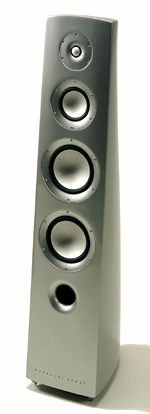
Mordaunt-Short Performance 6 loudspeaker

Wood is not an engineering material. It might look pretty, but it's inconsistent and therefore unpredictable. So we smash cheap wood into sawdust and then glue it all together again to create something that can be machined. This is called medium-density fiberboard, or MDF. We then thinly slice some classy hardwood—hopefully harvested from sustainable sources—and use it to cover the ugly MDF. This might have made sense back when Chippendale was making furniture, but it seems strangely old-fashioned in our age of plastics and composites. I haven't seen wood trim on a TV set for more than a decade. Why is it still the norm for loudspeakers?

Almarro M0A loudspeaker

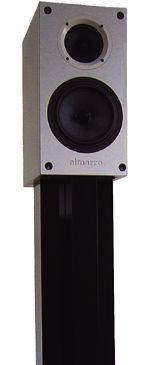
One of my favorite parts of attending Stereophile's Home Entertainment shows—aside from seeking out the sexy new gear and pressing the flesh of readers—is the "Ask the Editors" panel discussions. What begins as a Q&A session usually turns into a free-for-all, as the outspoken and opinionated likes of Sam Tellig, Michael Fremer, Ken Kessler, and John Marks barely give room for wallflowers such as Art Dudley and yours truly to express our opinions—except when editor John Atkinson asks each of us, in turn, to cast our votes for the "most interesting rooms to visit." At both the HE2004 and HE2005 "Ask the Editors" panels, one company was recommended by a number of Stereophile writers, me included: Almarro Products.

Advertisement
Advertisement
Advertisement