Floor Loudspeaker Reviews

Sort By:  Post Date TitlePublish Date

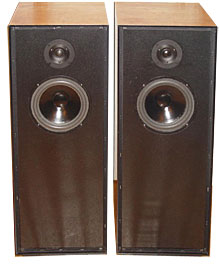
Snell Type E/III loudspeaker

One question posed by John Atkinson at the July 1991 Stereophile Writers">http://www.stereophile.com/features/109">Writers Conference had to do with the ease of reviewing: Is it harder to write a bad review of an expensive product than a good review? I find it hardest to write a good review of an inexpensive product. If I admire a less expensive loudspeaker, for example, it may become a recommended component, and can displace a more expensive speaker (that received mixed comments) from our twice-yearly rankings. This can be a big responsibility; even a conditional rave of a low-cost product means that JA may assign another Stereophile reviewer to do an immediate follow-up report. The Snell Type E/III loudspeaker may be a good case in point.

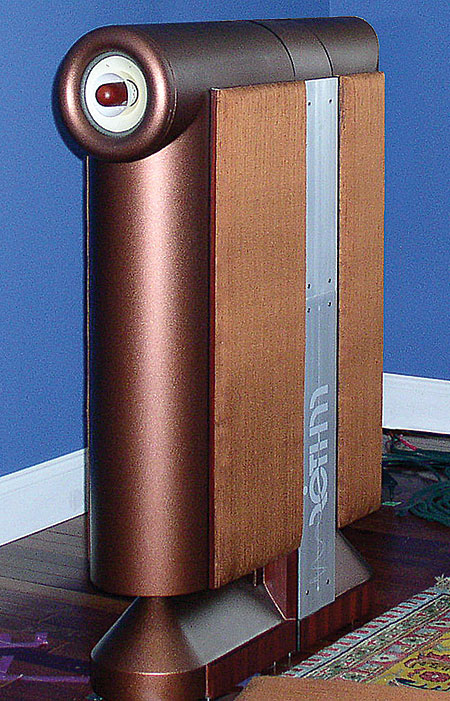
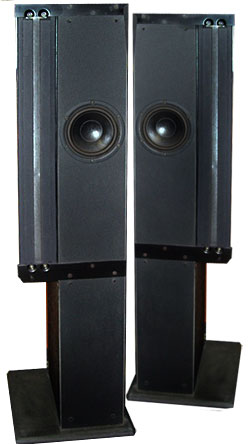
Apogee Centaurus Slant 6 loudspeaker

The idea of mating a dynamic woofer to a ribbon midrange/tweeter is appealing on paper. Such a "hybrid" loudspeaker would have the many advantages of a dipole ribbon transducer, yet be more practical and affordable than full-range ribbon designs. Among the ribbon's great strengths is its narrow vertical dispersion (reducing the ceiling and floor reflections), contributing to the ribbon driver's well-deserved reputation for transparency, terrific soundstaging, transient zip, and excellent resolution of detail. By adding a dynamic woofer to a ribbon midrange/tweeter, the system cost can be contained compared to a full-range design.

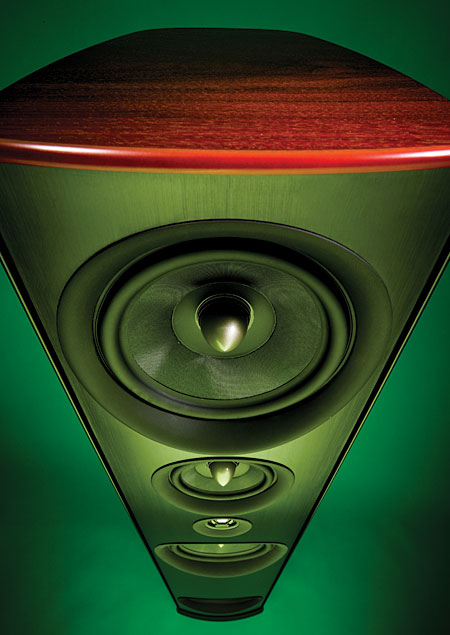
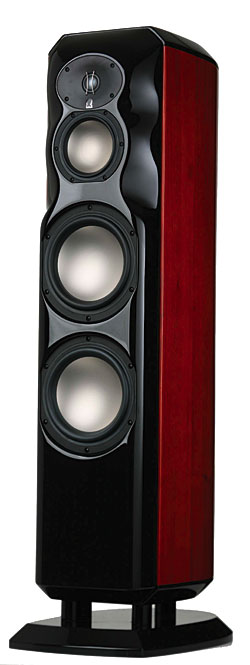
Revel Ultima Studio2 loudspeaker

This is my fourth review of a Revel loudspeaker, and I was even more excited by the arrival of the Ultima Studio2s ($15,999/pair) than I was when their predecessors, the original Ultima Studios ($10,799/pair when first reviewed; $15,000/pair when last listed in "Recommended Components"), were delivered in 2000. (See my">http://www.stereophile.com/floorloudspeakers/302">my review in the December 2000 Stereophile, Vol.23 No.12.) After all, the Studios were my reference speakers for years and, along with the larger Ultima Salons, were statement products that were the product of the talented designer Kevin Voecks and the considerable resources of Harman International, parent of Revel as well as of JBL and Infinity. Over the years, I've also reviewed Revel's Performa">http://www.stereophile.com/floorloudspeakers/244">Performa F30 (May 2000, Vol.23 No.5) and Concerta">http://www.stereophile.com/floorloudspeakers/706revel">Concerta F12 (July 2006, Vol.29 No.7), each outstanding at its price point. If, after all these years, Voecks and his team were ready to reconsider their statement products, they should be something special.

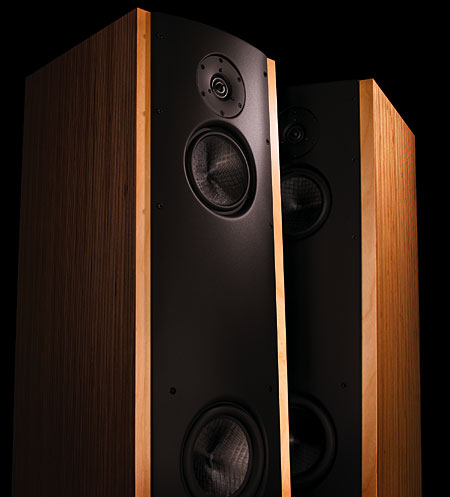
DALI Helicon 400 Mk.2 loudspeaker

Danish Audiophile Loudspeaker Industries (DALI), a relatively large maker of loudspeakers, was founded in 1982 by the peripatetic Peter Lyngdorf, who has worked with or founded Steinway/Lyngdorf, Lyngdorf Audio, TacT, NAD, etc. Audionord International, another company founded by Lyngdorf, owns DALI as well as American subsidiary DALI USA, along with yet another Lyngdorf creation: the 60 Hi-Fi Klubben stores, said to be the world's largest chain of high-end audio retail shops. Whew! The guy keeps busy.

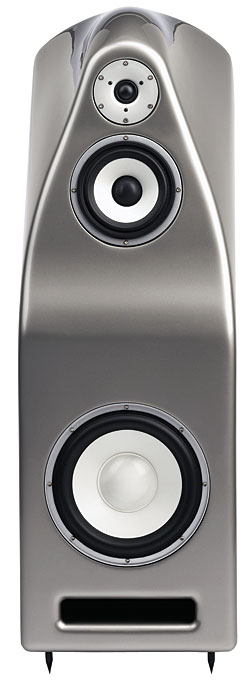
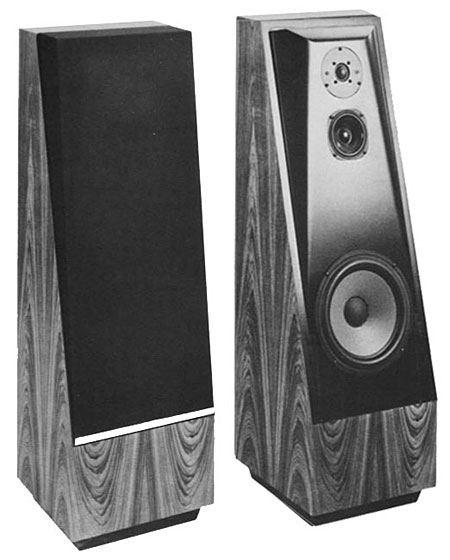
Thiel Model 04 loudspeaker

These speakers inadvertently managed to put me in a good mood even before I listened to them, because of a dumb little gaffe committed by Thiel's packing department. Each speaker came with an Owner's Information sheet, which is nice. Each sheet included Unpacking (and Repacking) Instructions, which is nicer. But each sheet came packed inside the carton, underneath the speaker, where it was not accessible until after the speaker was dumped out of the box, which is pretty silly!

Dahlquist DQ-10 loudspeaker

The Dalhquist DQ-10 loudspeaker has not as yet been formally submitted for review. (The designer tells us he is still working on the low end.) We auditioned a pair at the one local dealer we could find who had the DQ-10s on demo, and were immensely impressed. Obviously, Jon Dahlquist is on to something that other speaker designers have been overlooking, for, despite the multiplicity of driver speakers in the system, the DQ-10 sounds like one big speaker. There is no awareness of crossovers or separate drivers (except at the low end, about which more subsequently), and the overall sound has a degree of focus and coherence that is surpassed only by the Quad full-range electrostatic, which don't go as low at the bottom or as far out at the top.
Advertisement
Advertisement
Advertisement