Audacious Audio

Sort By:  Post Date TitlePublish Date

Krell KRC preamplifier

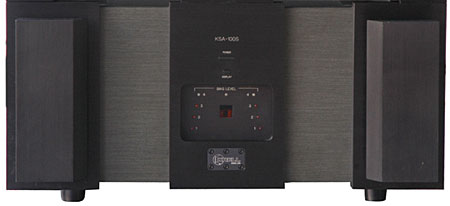
Compared to the Krell KSA-300S power amplifier that I also review this month, the KRC preamp's design is, at first glance, almost conventional. But its thoroughly high-end internal design has been equally well thought-out and executed. Its main, four-layer, glass-epoxy circuit board is for the audio signal, DC power, and ground—two layers for the latter are said to minimize noise. The gain stages are pure class-A and complementary. As in the amplifier, the circuit is direct-coupled, with servo circuits controlling the DC offset. The fully regulated power supply is housed in an external chassis. Seven inputs are provided: four single-ended, two balanced, and one single-ended tape. All inputs are line-level except for the optional, single-ended phono stage. (This review will address the line stages; a Follow-Up will discuss the phono stage's operation.) There are three outputs: balanced and single-ended main outputs, and a single-ended tape output.

HiFiction Thales AV tonearm

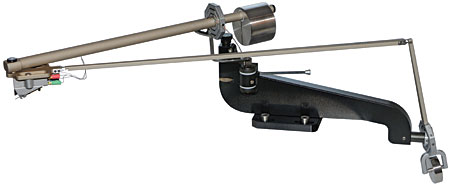
Ideally, LPs should be played with the pickup stylus remaining tangential (ie, at a 90° angle) to the groove—just as the lacquer from which the LP was ultimately stamped was cut in the first place. Over the years, many attempts have been made to accomplish this. Back in 1877, Thomas A. Edison's original machines tangentially tracked his cylinders, but Emil Berliner's invention of the flat disc put an end to cylinders altogether. In the 1950s, a number of companies marketed so-called "tangential" trackers that used dual arms, based on conventional pivoting arrangements, to change the angle at which the headshell was mounted as it moved across the LP side. In 1963, Marantz introduced the SLT-12, which used a plastic pantograph to move the stylus across the record surface. Garrard's Zero 100 pivoting arm controlled its independently pivoting headshell with a bar that extended from the main bearing of the tonearm.

Acapella High Violoncello II loudspeaker

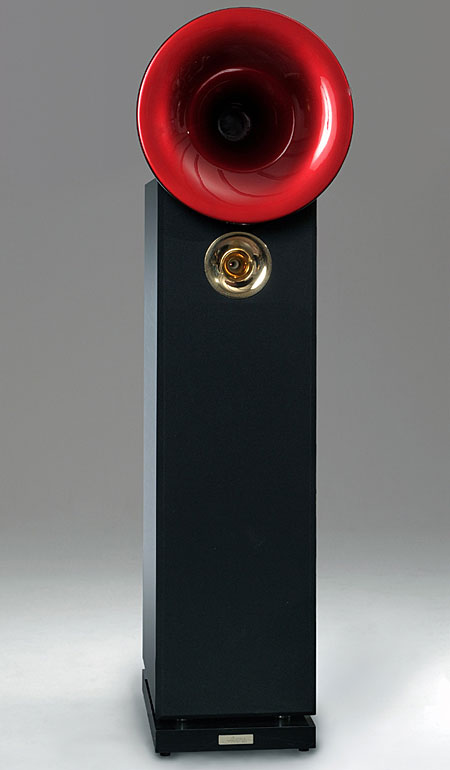
Stereophile's founder, the late J. Gordon Holt, always had a thing for horn loudspeakers, feeling that these archaic beasts offered a "jump factor" that could never be rivaled by conventional, direct-radiating designs. A horn drastically increases the efficiency with which electrical power is converted into acoustic power, which means that for a given sound-pressure level, a smaller amplifier can be used compared with a direct-radiator, and that all distortions, both electrical and mechanical, can theoretically be much lower. Yet outside of a small circle of enthusiasts, horns never got much of a following in high-end audio, and as high amplifier power became plentiful and relatively cheap, horns largely disappeared from domestic audio use (except in Japan).

Mark Levinson No.30.5 Reference digital processor

The arrival of the Mark">http://www.stereophile.com/digitalprocessors/mark_levinson_no30_referen… Levinson No.30 digital processor more than 2½ years ago marked a turning point in digital-audio reproduction. Although the No.30's $13,950 price tag put it out of reach of all but a few audiophiles, its stunning performance suggested that much more musical information was encoded on our CDs, waiting to be recovered by better digital processors. Further, it was inevitable that this level of performance would become less expensive over time. I was more excited by the No.30 than I've been over any other audio product. In fact, its musical performance was so spectacular that it alone occupied the Class A category in Stereophile's "Recommended Components."

Sennheiser Orpheus HE 90 headphones

While headphone listening remains secondary to that of loudspeakers for most serious listeners, it's still an important alternative for many. And while good conventional headphones exist, electrostatics are usually considered first when the highest playback quality is required. As always, there are exceptions (Grado's headphones come immediately to mind), but most high-end headphones are electrostatic—such designs offer the benefits of electrostatic loudspeakers without their dynamic limitations. Last">http://www.stereophile.com/headphones/koss_esp950_electrostatic_stereop… year I reviewed the Koss ESP/950 electrostatics (Vol.15 No.12), a remarkable set of headphones from the company that practically invented headphones for serious home listening. Here I listen to examples from two other companies, each known for its headphones since Pluto was a pup.

Advertisement
Advertisement
Advertisement