John Atkinson

Hot Stuff from Rosso Fiorentini & AMR
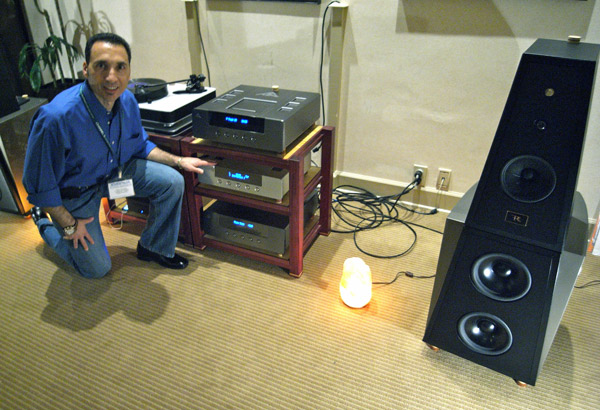
The Avatar Acoustics room featured the Rosso Fiorentini Siena speakers ($24,995/pair) that made their North American debut at last January's CES, seen here with Avatar's Darren Censullo. A four-way sealed-box design, the Siena features two 8" aluminum-cone woofers, a 6.5" paper-cone midrange unit, a 1" silk-dome tweeter, and a Murata ultrasonic generator and produced a big sweep of sound on what appeared to be the Show's ubiquitous dem track, Nils Lofgren's live acoustic number "Keith Don't Go," driven by an AMR AM-77.1 integrated amplifier. But converting Nils' bits from an AMR CD-77.1 CD player used as a transport was AMR's new DP-77 D/A converter ($4995). Uniquely, this offers a choice of two DAC chips, one a non-oversampling 16-bit type which is recommended for CD playback, the other a 32-bit type optimized for playback of high sample-rate data, which offers minimum-phase, apodizing, and "organic" reconstruction filters.

The DP-77 has an asynchronous USB input that can accept data with sample rates up to 192kHz and jitter is reduced by using a high-precision clock and rather than adjusting its frequency in continuous steps to match the average rate of the incoming data, which can allow jitter to bleed through to the DAC chip, the DP-77's clock switches between 28 million discrete frequencies.

Continue Reading »

Acoustic Zen's Transmission Lines

I have never been a fan of transmission-line speakers. My experience has been that too often resonant problems in the line color the speaker's upper bass. But I didn't hear any such problems with the Acoustic Zen Crescendo speakers ($16,000/pair), seen here with designer Robert Lee. The Crescendo combines two 5" midrange units with magnesium-impregnated paper cones placed either side of a horn-loaded tweeter with two 8" woofers that use ceramic-coated "non-pressed" paper cones, these loaded with a transmission line venting at the speaker's base. Driven by a Triode Corporation 20Wpc TRV-845SE integrated amplifier ($6000), which uses two 845 output tubes running in class-A, and a Triode TRV-CD4SE CD player, the sound in this room was uncolored and extended at both frequency extremes, revealed by a superb recording of a female singer accompanied by a double bass.
Continue Reading »

MBL Conquers Room Acoustics

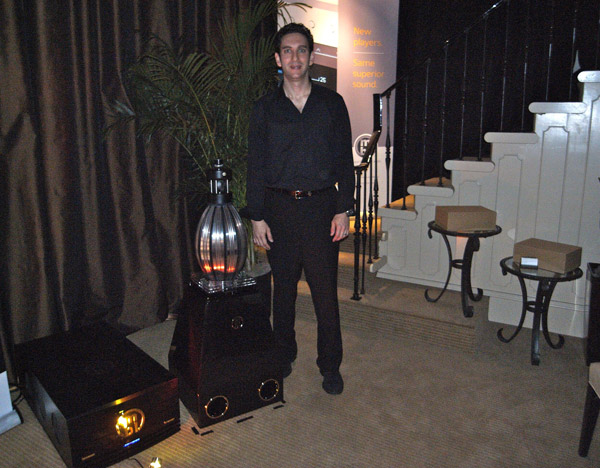
MBL's Jeremy Bryan had an interesting problem when set up his system at Axpona, in that while the hotel room was large, it was also double-story, with a 16' ceiling and an acoustic nightmare of a mezzanine level at the rear. Jeremy, shown in the photo next to the unanticipated in-room stairway, solved it by packing the mezzanine floor with queen-size mattresses that had been emptied from other hotel rooms. The system was the same used at SSI in Montreal two weeks ago—101E Mk.2 omnidirectional speakers driven by gigantic 9011 monoblock amplifiers, a 6010D preamp, a 1621A CD transport, and a 1611F D/A converter—and I listened to the same hi-rez solo piano recording made by MBL's long-time chief engineer Jürgen Reis, "Walchensee, Mondnacht," performed by Martin Vatter, from the album Klangbilder. Once again, the piano sound was disturbingly lifelike, with full-range dynamics.
Continue Reading »

Sanders' Electrostatics

Back in the day, you couldn't cruise the corridors at an audio Show without hearing Willie Nelson's arrangement of "Stardust" coming from every open door. So it was with a feeling of nostalgia that I walked into the Sanders room at Axpona and heard that familiar voice. Providing the tunes was an all-Sanders system featuring the Model 10c speakers ($13,000/pair including 500Wpc bass amplifier and crossover module), which combines an electrostatic panels for the midrange and highs with a transmission line-loaded 10" moving-coil woofer. Unusually, the active crossover operates in the digital domain, operating at 24/96 and splitting the signal at 172Hz with 48dB/octave slopes, which should ameliorate the problem blending the omnidirectional woofer with the dipolar panel. With a Sanders line stage, Sanders electrostatic amplifier ($4000), and Sanders cables—Roger Sanders feels strongly that a system should designed as a system—the 10cs sounded unexpectedly dynamic.
Continue Reading »

DaVinci USB DAC Does 384kHz

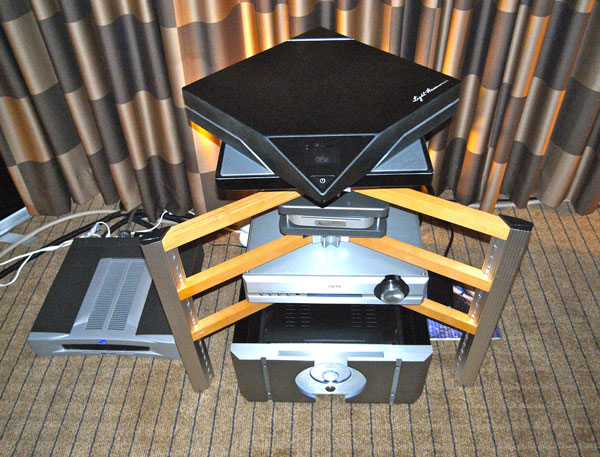
"It's fitting for the world premier of the Da Vinci 384k DAC to happen on the first day of Axpona," explained Light Harmonic's Larry Ho, "as today is Leonardo da Vinci's birthday." 384k? Yes, the Da Vinci DAC ($11,999 regular price, $8999 Axpona price [NOTE: The actual retail price ended up at $20k-ed.]) will operate at sample rates up to 384kHz. At the show, in a system featuring Wilson Sophia 3 speakers driven by Pass Labs amplification, a 2L recording of Ole Bull's violin concerto, sourced from a Mac 2-modded Mac mini running Pure Music and recorded with a 352.8kHz sample rate, according to the DAC's front panel display, offered up some of the sweetest-sounding, natural violin sound and the most solid stereo imaging I have experienced from a classical recording. The 384k DAC uses the USB2.0 protocol and functions on a Mac without a driver having to be installed.
Continue Reading »

Sutherland's Phono Block

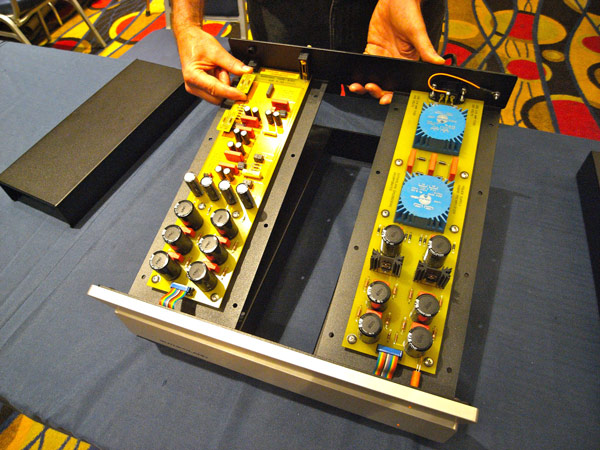
"I made this for myself," explained the genial Ron Sutherland, as he showed me the interior of his new monophonic phono preamplifier ($9800/pair). The power supply on the right, which uses both choke and RC smoothing, feeds DC to the active circuitry on the left via a ribbon cable running in a channel machined in the front panel. Plug-in daughterboards are used to change loading and gain and three chassis grounding options allow for the lowest noisefloor: floating, grounded directly, and grounded via a 50 ohm resistor. Ron has used 1/8"-thick circuit boards to lower dielectric effects. There are two outputs to allow a mono cartridge to to be fed to both left and right inputs of the phono preamplifier.
Continue Reading »

Bob's Devices

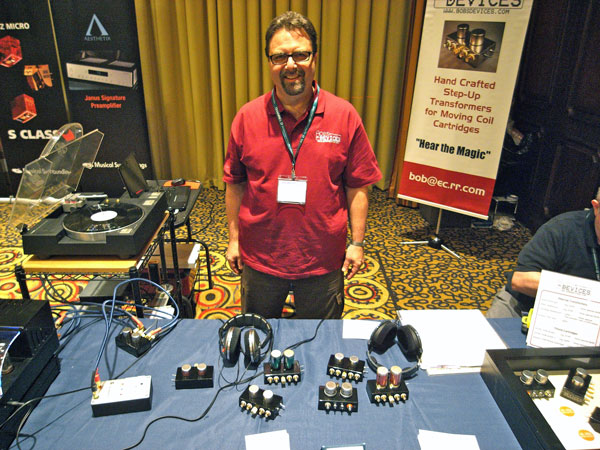
"A North Carolina firm called Bob's Devices has joined my list of favorite phono step-up suppliers," wrote Art Dudley in June 2010. There in the Analog Ballroom at Axpona was Bob Sattin himself, showing off his range of affordable step-ups, using selected new and vintage transformers from manufacturers like CineMag, Sowter, and Altec.
Continue Reading »

Dean Peer, Musician

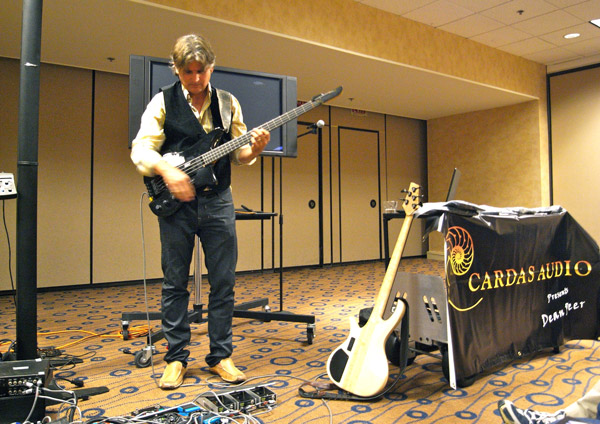
Electric bassist Dean Peer's concerts with drummer Bret Mann at the Montreal Show two weeks ago had been a highlight for me of that Show. At the Atlanta Show, Dean Peer was scheduled to take part in a jam session Saturday night, but Friday and Saturday afternoon, he gave a 60-minute talk on how he approaches playing the bass, making recordings, and how a musician and composer became involved in the world of audiophiles. He also played some of his compositions, including a favorite of mine from his first album Ucross, which was released exactly 20 years ago. Can't beat that live music!
Continue Reading »

Michael Fremer Explains Turntable Set-Up

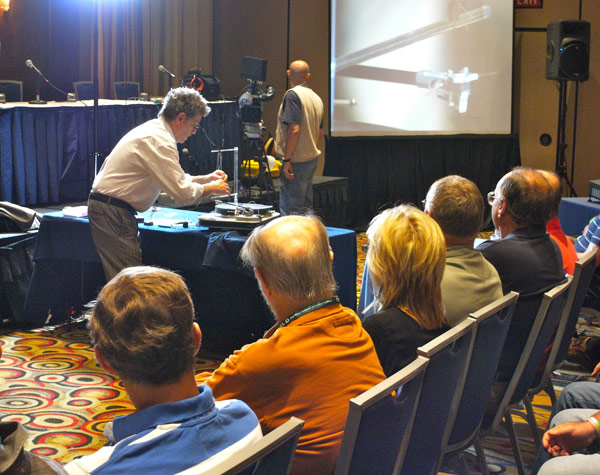
An enthusiastic crowd turned up on the first morning of the Show to catch Michael Fremer's workshop on how to optimally set-up a turntable. With the help of close-up video, Michael used a Spiral Groove turntable and arm, and Lyra cartridge to show how to optimize headshell offset, overhang, antiskating, VTA, azimuth, and other analog mysteries. The session is being repeated Saturday at 11:30am in the Goldmine seminar room.
Continue Reading »

Audio Show Porn

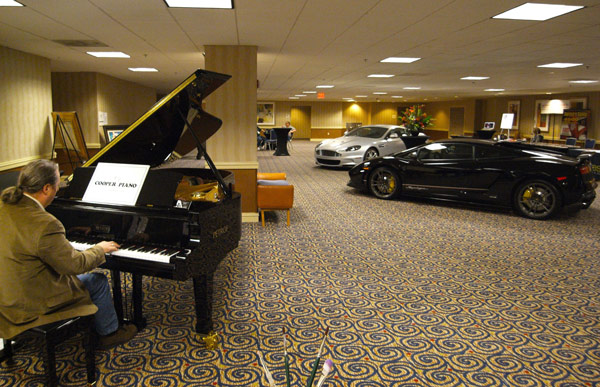
While making my way to the Goldmine seminar room at Axpona, to catch Michael Fremer's turntable set-up talk, I came across pianist John Yurick playing some smooth jazz improvisations to a background of a Lamborghini and Aston Martin that happened to be parked in front of the Stereophile booth.
Continue Reading »
Advertisement
Advertisement
Advertisement