John Atkinson

Now those are speakers!

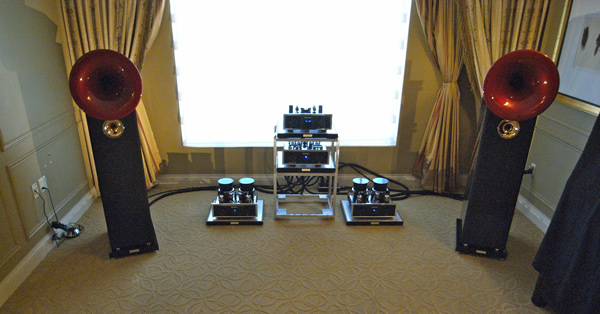
Looking at the ginormous horn speakers in the Silbatone room, all I could think was "how did they get them through the door?" The speakers were a hybrid, the lower half being vintage Western Electric with field-coil–energized 18" woofers, and the midrange and highs being modern recreations from GIP in Japan.

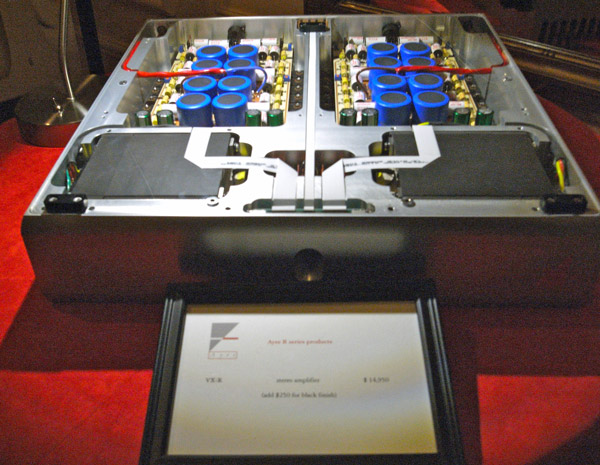
I hadn't been aware of the Silbatone brand before this CES. Their website says that "The goal of Silbatone Acoustics is to recreate the musical enjoyment of the great theater systems in the home, creating practical realizations for today's serious music listeners." Okay. It turns out that their beautifully constructed power amplifiers ($150,000, depending on tube choice) are vehicles for unusual and rare tubes. The amplifier seen in front of the speakers, for example, used square-base Marconi DA100 broadcast modulation tubes (around $5000 each) for the outputs, with pre-WWII Siemens ED red-base tubes as the drivers. The audiophile air in this room was rarefied, indeed.
Continue Reading »

T+A Solitaire

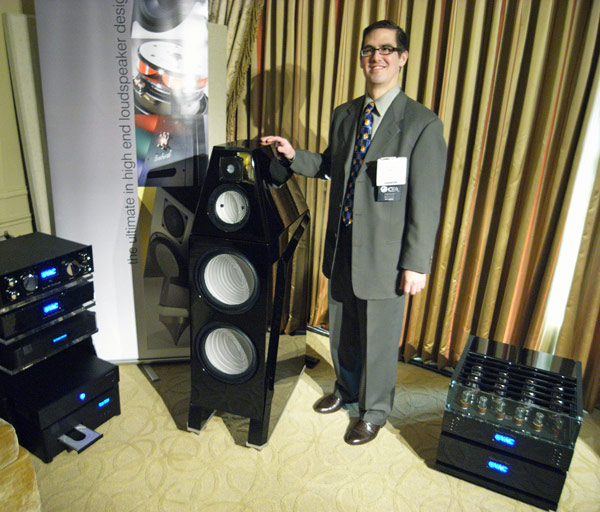
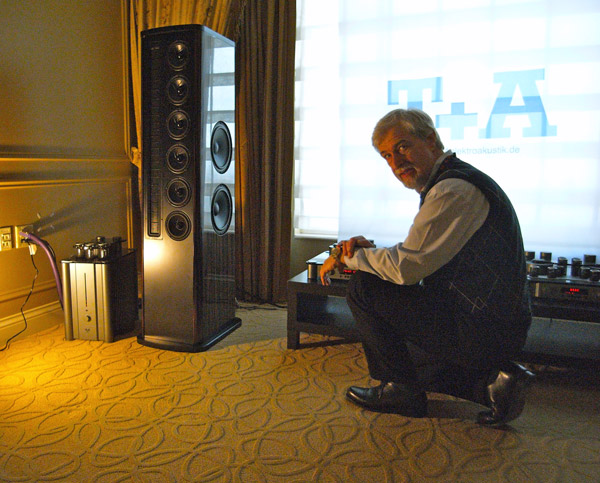
The German T+A brand is now being distributed in the US by Dynaudio North America and having only been aware of their electronic products, I was surprised when I went into the T+A room at CES to see a large pair of speakers, the Solitaire CWT2000s ($45,000/pair). However, "I have been designing speakers since the company started," explained T+A's Siegfreid "Siggi" Amft, seen here with his creation.

The speaker features an electrostatic tweeter, 45mm wide but mechanically split into three 15mm-wide sections. as the frequency increases, the crossover increasingly cuts off drive to the outer sections, maintaining lateral dispersion. Adjacent to the tweeter is an array of six 6" cone midrange units, with the higher frequencies mainly being handled by the central units, again to optimize dispersion. Two pairs of 10" woofers complete the driver complem3nt, one pair being mounted each side of the enclosure and driven in-phase so that their reactive forces cancel. The sealed-box alignment is said to give a &#150dB point of 37Hz. Two more, smaller, less expensive Solitaire models will be launched later in the year.

The T+A speakers were bring driven by T+A M10 hybrid monoblocks ($33,000/pair), which use a tube input stage capable of delivering the full output voltage required by the speakers, with then a solid-state current amplifier providing the necessary cone-controlling grunt.

Continue Reading »

Tidal Sunray Speakers

In prior Show reports, we have photographed Tidal's Jörn Janczak standing next to his speakers. But as Jörn stands 6' 8' in his socks, I made him crouch by the Sunray ($151,000/pair). so you can get an idea of how big this bi-amped speaker really is.

As at the 2010 CES, the rest of the system included two BAlabo 500Wpc stereo amps ($77,500 each), and the BAlabo BD-1 24/192 DAC ($37,500). Preamp was the BAlabo BC1 ($60,000) and the source was the Blue Smoke music server. Cabling was by Argento. I listened to a recording that many were playing at CES, piano/bass/drums jazz from the German Tingvall Trio, and was impressed by the effortless sweep of full-range sound produced by this admittedly very expensive system.

Continue Reading »

Talon's Phoenix

The Talon loudspeaker brand has been revitalized since it was purchased by Richard Rives Bird. Richard is see here with the new Phoenix, a floor-standing three-way with ceramic drive-units. The Phoenix costs $72,000/pair in passive form, which is what was being demmed at CES, driven by VAC amplification. The crossover is mounted in a separate compartment at the rear of the woofer section and an upgrade (approximate price $15,000) is planned whereby the passive crossover module can be replaced by one containing a line-level crossover, Rives' PARC bass equalizer to provide room correction, and a class-D amplifier to drive the woofers.
Continue Reading »

Lotus Group Granada

The Lotus Group's Granada speaker ($125,000/pair) combines 21st-century technology—a digital-domain crossover realized with DSP, including room correction—with distinctively retro loudspeaker engineering—frequencies above 200Hz are handled by a single Feastrex unit featuring a field-coil magnet and a paper diaphragm with a coincident "whizzer" cone. The paper used for the diaphragms is sourced from a Japanese "National Treasure" paper maker, Ichibei Iwano, and the surrounds are made from lambs' skin. Two woofer handle the bass and all three drivers are open at the back to give a dipole radiation pattern. There is also a rear-firing 0.75" dome tweeter to maintain the speaker's power response in the top octave. (The treble energy from the whizzer is emitted in a quite narrow frontal beam.)

My photo doesn't do justice to the beauty of this speaker; the rest of the system included Musical Fidelity AMS-50 class-A amplifiers, a Steve McCormack VRE-18 preamp, a Hanss T-10A turntable with phono stage and fitted with Dynavector DRT XV-1t cartridge,with interconnects and power cabling by Pranawire and speaker cabling by Acoustic Revive. Total system costs was $324,245! Listening to Joan Armatrading's "Show Some Emotion" then the Roy DuNann-recorded The Eleven LP by Art Pepper, I was struck by the effortless nature of the sound and the sheer musicality of the system, though I have to admit that instruments didn't quite sound tonally correct.

Continue Reading »

Electrostatic Kingsound

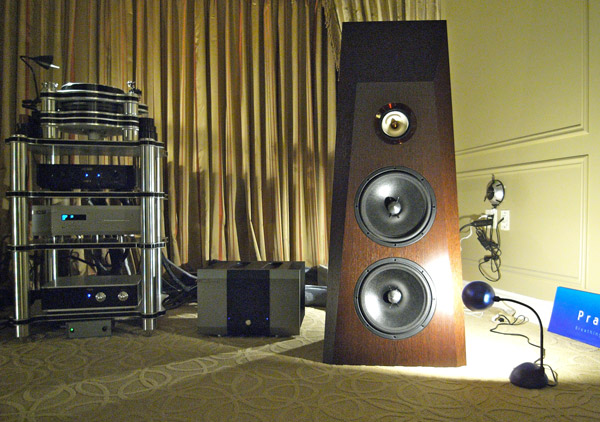
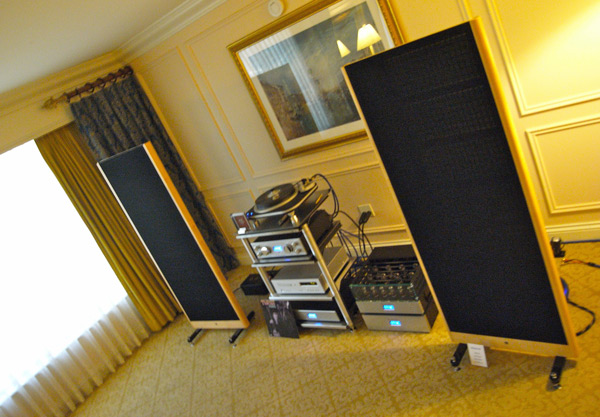
The electrostatic Kingsound speakers were hits at 2010 Shows, so I was anticipating good sound in the room where VAC was demming their tubed electronics with the King II speakers ($11,500/pair) and a Spiral Groove SG2 turntable and arm fitted with a Lyra Kleos cartridge. Stands were all-Symposium.)

The bugbears of electrostatic panels have been limited treble dispersion and a lack of low-frequency definition, but listening to Hans Theesink's and Terry Evans' rendition of "You Can't Tell a Book," from the LP Vision, where the guitarist and singer were accompanying themselves with footstomps, the bass remained in control and the top-octave sounded airy and spacious.

Continue Reading »

Sony reenters the high-end speaker market

Sony has a track record of sporadically producing high-quality loudspeakers, like the SS-M9 that I reviewed in 1997. But as good as these speakers could be, their commercial success was limited. But at the last two Rocky Mountain Audio Fests, Ray Kimber had been getting great sound with a prototype Sony floorstander and the 2011 CES saw the official launch of the Sony SS-AR1 ($27,000/pair).

A three-way design, the SS-AR1 uses Scanspeak drive-units made to Sony's specification, housed in a unique, Japanese-made enclosure. Seen here standing next the basic enclosure, designer Yuki Sugiaro explained that the walls are made from Finnish birch ply and the front baffle from maple ply. The latter is sourced from trees grown in Hokkaido.) The woodworking is so precise that the cabinet shown here is holding itself together without any glue (thoigh glue, of course, is used on the production line).

Driven by Pass Labs amps and an EMM SACD player, the SS-AR1s were demmed in too small and crowded a room for me to pronounce on their sound quality, other than to note that the midrange seemed exceptionally clean and uncolored. But my prior experience at RMAF suggests that this will be a contender.

Availability is said to be "spring" and Sony announced that they have already signed up blue-chip US dealers like Goodwins, Definitive, David Lewis, and Music Lovers.

Continue Reading »

More German Horns: the Avantgarde Duo Grosso

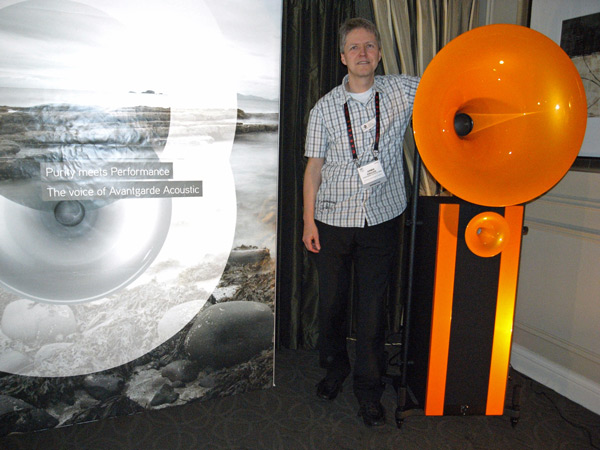
Avantgarde's Armin Kraus stands next to the new version of the three-way Duo speaker, the Grosso ($36,000/pair). Finished in "Lamborghini Orange," the Grosso substitutes two 12" woofers for the Duo's 10-inchers, and drives them with twice the amplifier power. The midrange and treble horn units are the same, but the speaker is now supported by a sturdier space-frame with spikes that are adjustable from above. And again, this is a horn speaker that offers the advantages of horns—high dynamic range, sensitivity, and "jump factor"—without the disadvantages, such as midrange coloration.
Continue Reading »

Acapella Revises the High Violoncello II

A highlight of my reviewing year in 2010 was living with and writing about the Acapella High Violoncello II speaker from Germany ($80,000/pair). With its horn-loaded, ionic tweeter and horn-loaded midrange unit, this speaker offered both high sensitivity and some of the most satisfyingly musical sound I have experienced in my room.

Current production has been modified a little compared with the much-traveled samples I auditioned for my review. (They were the same pair I had auditioned at the 2010 CES, Axpona and RMAF Shows.) The drive-unit complement, cabinet, and crossover are all the same, but there is now a greater range of level adjustment for the ionic tweeter and isobaric-loaded woofers. But the sound of the latest version at CES. driven by Einstein electronics, sounded just as I remembered: dynamic, transparent, neutrally balanced, and not a trace of horn colorations.

Continue Reading »
Advertisement
Advertisement
Advertisement