Jim Austin, Tom Fine

It Isn't Just the Music

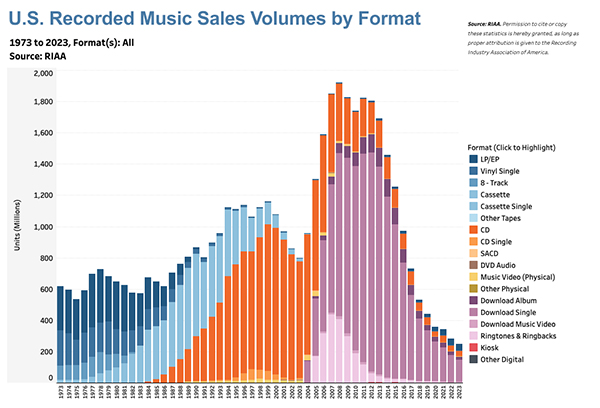
Physical media market shares, from 1973–2024. From riaa.com/u-s-sales-database.

When the CD is gone, and it will be soon, we'll miss it. New CD releases are winding down (footnote 1). In the classical world, the era of big, bargain-priced boxes of CDs—a somewhat recent development—is ending because, after a long, slow descent, retail sales have fallen off a cliff in the past year or so. In pop and rock, if you discover a new band you like, you may or may not be able to buy a CD. Perhaps they'll self-publish a few to sell at concerts; there's a better chance they'll have LPs, assuming they can get time at a vinyl-mastering studio and a pressing plant, both of which are booked to the max. CDs, though, are an afterthought if they're even that.

Vinyl records will likely stay around indefinitely as a collector's artifact, but new CDs are fading fast. This is momentous. CD will be remembered as the last mainstream physical music format. Its passing marks the death of physical music media.

Continue Reading »

Rediscoveries #7: Harold Land's The Fox from Craft Recordings and Acoustic Sounds

Most of the 1950s Contemporary Records catalog is the bullseye of "West Coast Jazz," a smoother, more laid-back flavor than the hard bop and soul jazz styles percolating back east. Set in that context, tenor saxman Harold Land's The Fox stands out for its aggressive speed and punch. Its style would seem more at home on Blue Note or Prestige.

Read the back notes on the beautifully packaged new reissue from Craft Recordings and Acoustic Sounds and clarity emerges. The Fox wasn't born in Contemporary's studio/shipping room. Instead, it was laid to tape at Radio Recorders, Studio B, Los Angeles, in August 1959. It was the first record produced by David Axelrod, who would become a fixture at Capitol Records. It was released by short-lived label Hifijazz. Contemporary reissued it in 1969, and it has rarely been out of print since.

Continue Reading »

Revinylization #55: An American Beauty Unblemished

Of all the albums in the Grateful Dead catalog, American Beauty is the one with the widest appeal. Its proto-Americana tunes are neither antique nor modern; instead, they are timeless. The album's sound is clean and lean, up to modern snuff even more than a half-century after its original release in November 1970.

The tunes seem to roll like a Sunday drive on a country road, in and out of dark hollows and up and down hills. Three of its 10 songs have become folk-rock standards: "Friend of the Devil," "Sugar Magnolia," and "Truckin'."

Continue Reading »

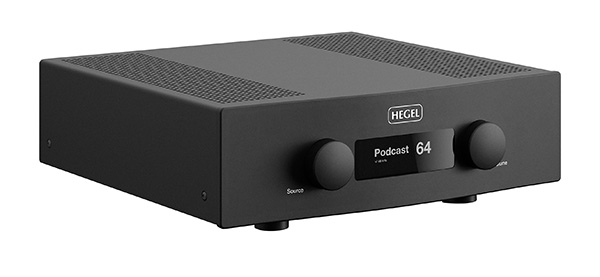
WiiM Amp streaming D/A integrated amplifier

Life is not for Goldilocks. "Just right" is elusive. Every day, we face countless situations where our choices are either too many to navigate or too few to find satisfaction. Behavioral scientists call those dissatisfying alternatives "choice overload" and "choice deprivation," respectively.

I think choice overload may scare some audiophiles away from the glorious world of streaming, where the bulk and finite scope of a physical music-media collection can be traded for (or augmented by) many more listening choices. If you're willing to explore and choose, you can hear as deep and wide as most musical rabbit holes are likely to go, and then return to your favorite songs with a couple of finger-pecks on your phone.

For some people, all that choice is intimidating, paralyzing, overwhelming, highly stressful. That's no way to enjoy music! I sympathize. I'm not ready to leave physical media behind. But I am very happy in the streaming present. In fact, I urge the hesitant: Cast aside your fears and trepidations, sign up for a free month of Qobuz, Spotify, Tidal, Apple Music, you decide—then take it slow. At first, avoid browsing—just search for the music you want to hear. Try something new each day. Over time, you'll adjust to the overwhelming abundance. By the end of the month, especially with a full-resolution service like Qobuz, Tidal, or Apple Music+HD, you may not want to give it up. The future-present beckons loudly.

Continue Reading »

The Forever Half-Life of Quadraphonics

The popular history of quadraphonics (4-channel sound from LP records, tapes, and radio broadcasts) chronicles a spectacular failure. The major record labels, led by CBS/Columbia and JVC/RCA, invested millions in ill-fated schemes to convince music lovers to ditch 2-channel stereo for 4-channel surround sound. The concept was killed, so the story goes, by competing and incompatible LP formats, high prices on the better-sounding discrete-channel reel tapes, and a collective shrug by the buying public.

That story is mostly true, though the format thrived for a while in Japan and Germany, and it never fully died. Now, modern tech has made possible rereleases of 1970s quad albums on relatively common formats: multichannel SACD and Blu-ray discs (BD). No more "meh" LP formats, no more fussy 1970s-tech decoders.

Continue Reading »

Cambridge Audio MXN10 streamer–D/A processor

For music listening circa 2024, streaming is both the present and the future. Physical formats are still around, and they are still the best choice in some cases, as with deluxe reissues of beloved albums, which may add value with extra live performances, full-resolution surround sound, and other perks. The niche vinyl market continues to thrive, and that business model obviously works for releases of a few thousand copies. (It also works, apparently, for releases of hundreds of thousands of T-Swift platters to be displayed on shelves and hung on walls.)

But facts is facts: Streaming is now the only mass medium for listening to recorded music—the primary carrier for music—and has been for a few years now. According to RIAA statistics, the crossover year was 2016. That's when, in revenue terms, streaming outpaced physical formats. By 2022, the latest full year tabulated, streaming accounted for 84% of US recorded-music revenue.

So what's a long-time audiophile, born into the analog world, with strong roots in physical media, supposed to do?

Continue Reading »

Bowers & Wilkins 801 D4 Signature loudspeaker

Back in August, I received an email from Editor Jim Austin. Subject line: "Want to do a big review?" He had my attention. Jim wrote that he had visited Bowers & Wilkins parent company Masimo Consumer in Carlsbad, California, for a demo of the brand-new B&W 801 D4 Signature and 805 D4 Signature loudspeakers. (That visit was chronicled by Jim in the September 2023 Industry Update section.) B&W had offered Stereophile the first US review of both products—look for John Atkinson's review of the 805 D4 Signature in the coming months—and Jim thought the big 801s would be "right up my alley."

Indeed! The voice of my full-range system in the living room is a pair of B&W 808 speakers, ca late 1980s. The smaller-scale system at our house upstate features a pair of B&W 805 D2s. So, outside of my mastering studio, most of the music I listen to is through Bowers & Wilkins speakers. I am accustomed to and enjoy B&W sound and styling.

Continue Reading »

Klipsch The Nines integrated loudspeaker system

Do you remember your first really decent hi-fi system? It opened up your music, teased your brain with the possibilities of thrilling aural excitement, of dives to the bottom of the musical ocean. Perhaps it was all you needed, but more likely it was the beginning of a quest for your own ultimate sound-induced bliss.

That quest may be ongoing and never-ending, because our tastes and preferences evolve over time, money comes and goes, and we're simply never satisfied. And even if we are, eventually, we're audiophiles, and the industry always offers something interesting and new, or something old that's new again.

My time with a pair of Klipsch The Nines speaker-gadgets reminded me of the exciting, youthful bloom of my first serious sound system: a Technics SL-D2 turntable with Audio-Technica cartridge, a Philips 45Wpc receiver, and New Advent Loudspeakers.

Continue Reading »

ReDiscoveries #6: Old is New, The Beatles' Red & Blue

The first Beatles music is more than 60 years old, and the group broke up 53 years ago. Yet they and their music remain relevant. So when Apple Corps announced "The Last Beatles Song," on October 26, the world's media ran with the story.

Beatles fans span at least four generations, and the group's promotion machine is looking to hook today's youth, and perhaps rekindle old flames, with 50th Anniversary deluxe reissues of the "Red" (1962-1966) and "Blue" (1967-1970) compilations. These expanded editions—12 new tracks on Red and nine on Blue, including the new-old single "Now & Then"—sport remixes performed since 2015.

Continue Reading »
Advertisement
Advertisement
Advertisement